Coming Attractions: Arduino Park

Oh, this thing has gotten out of control. Originally, I meant to have a simple blog entry with a series of Sketchup images. Then I thought about making a Youtube video.

It’s not that it takes that long, but after I finish correcting a mistake, I like to let a project sit for a while before I come back and check to make sure there aren’t any more mistakes. I’m assuming that I’m seeing more with fresh eyes and that there isn’t some quantum-physical attribute to the universe that causes mistakes to ‘grow’ in the meantime! And with this project, mistakes do seem to grow.

Anyhow, Arduino Park should be on Youtube tomorrow. And remember, Stomping Is Not Recommended.

Posted in Uncategorized | Tagged , , , | 2 Comments

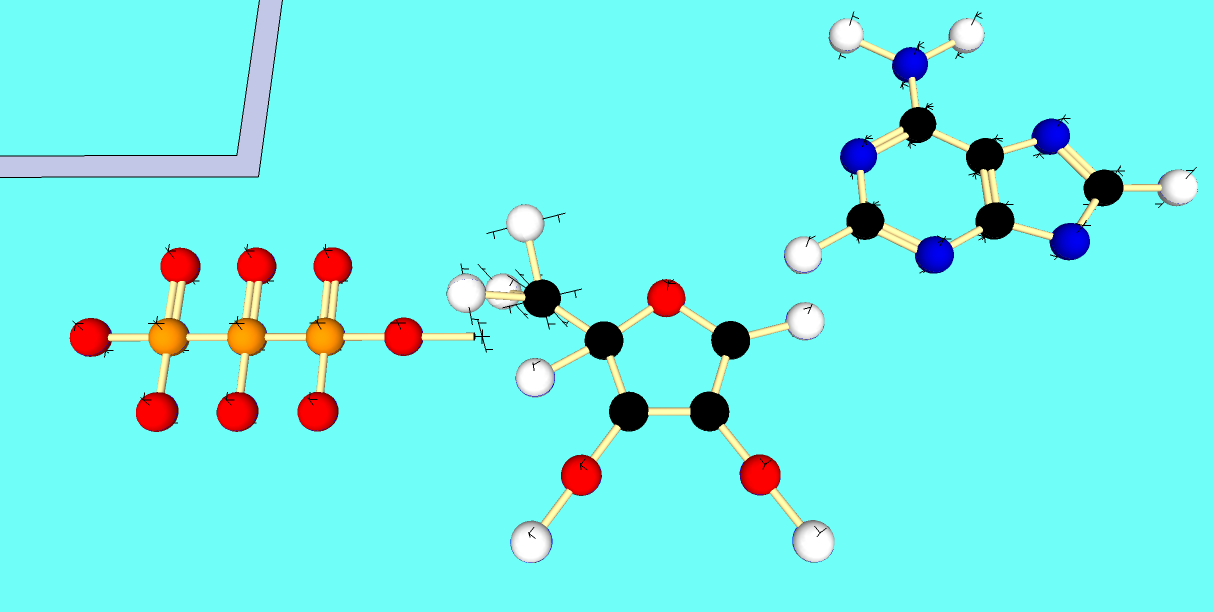
I got those adenosine triphosphate blues

Welllll, I got all the atoms and bonds right, I think. Now the problem is the angles. Oh, and to be in the cool crowd, I’ll have to indicate somehow that the single-bonded oxygens on the phosphate chain are negatively charged.

Maybe I should do amino acids first . . . .

Posted in Uncategorized | Leave a comment

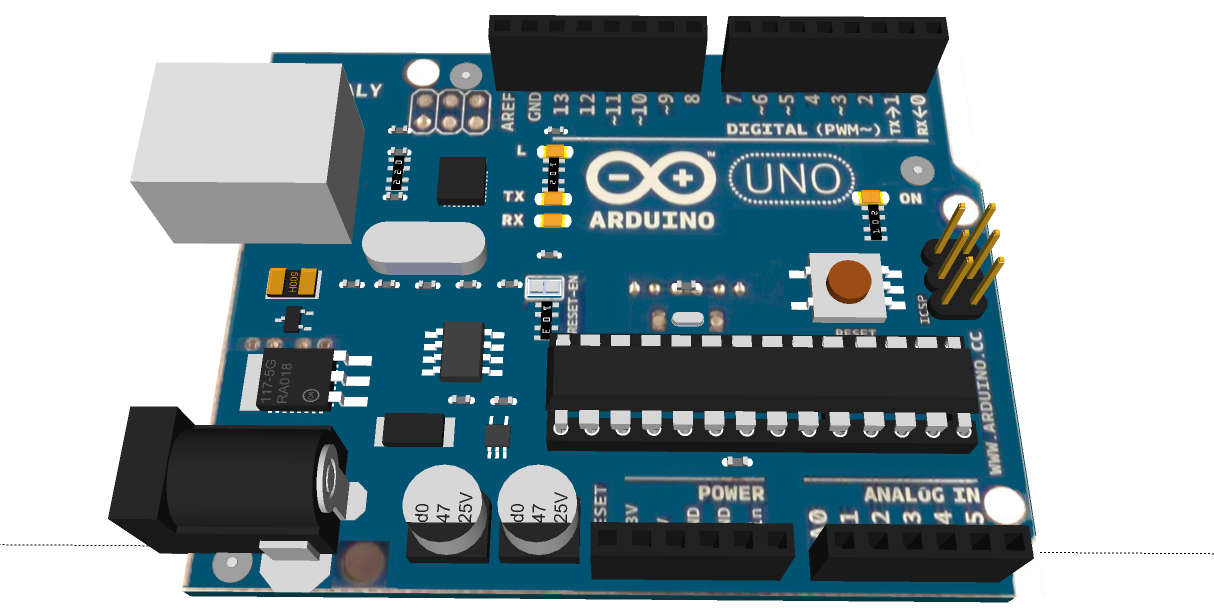
Arduino Uno uploaded to Google Sketchup 3D Warehouse

Posted in Uncategorized | Tagged , , , , , , , , | Leave a comment

Teleportation by Optical Tweezers

A few months ago, I learned about optical tweezers. Basically, a laser beam is used to manipulate very small particles down to individual atoms. The laser beam is not so strong as to burn up the object, but is strong enough to exert a force stronger than gravity so that the object can be lifted up and moved around.

It turns out that you can also manipulate biological cells this way too. Here is a scientific paper (“Cell manipulation by use of diamond microparticles as handles for optical tweezers”) you can read, to learn more than I do about the subject (yet).

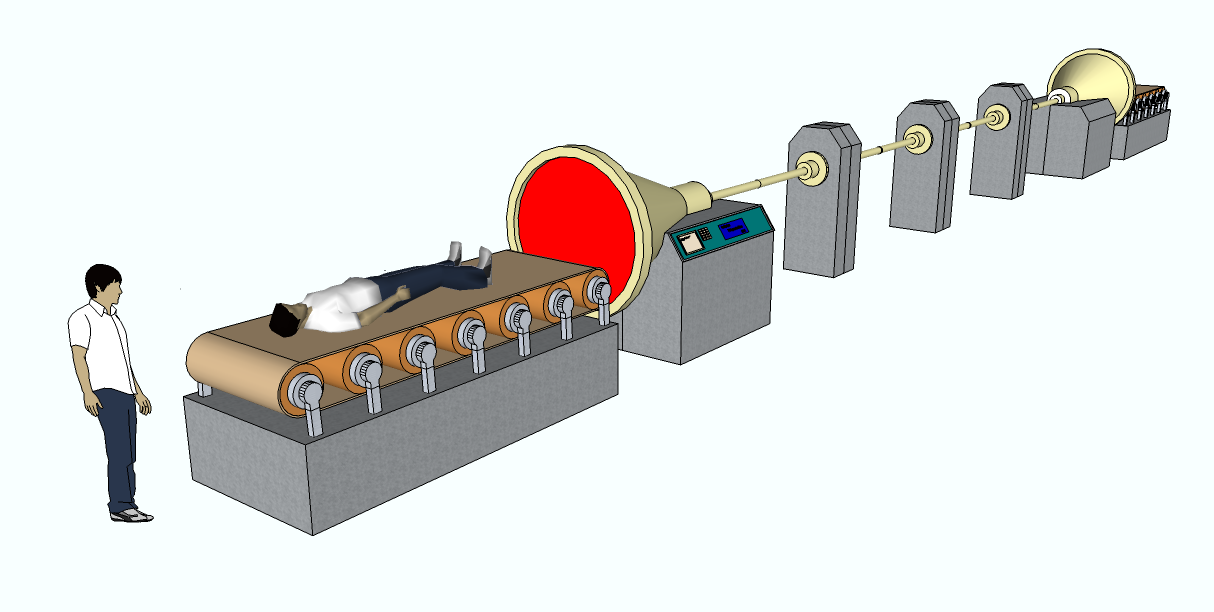
Google Docs doesn’t let me copy and paste, so I won’t excerpt here. But as I show in my diagram, it did occur to me that optical tweezers might be used as a form of teleportation.

Instead of breaking a person down into component atoms, we need only break him down into component cells. The difference is that while a human body is made of quadrillions of quadrillions of atoms, it is composed of ‘only’ twenty trillion cells. Modern computers can’t handle quadrillions of quadrillions, but they can handle trillions.

The ‘cellular’ teleporter works by having an array of thousands of computers operating thousands of microlasers acting as optical tweezers. Cells are carefully sliced out of the body, and electromagnetically propelled down an electrostatically charged, air-evacuated tube.

The effect of G-force can be counteracted by a strong magnetic field, as has been demonstrated in frog levitation experiments (you may think I’m joking, but I’m not). Thus cells can be accelerated at thousands of gees and reach velocities of hundreds of kilometers per second as they are transmitted from one teleportation site to another.

At the receiving site, the cells are reassembled by the computer and optical tweezer arrays back into the original human body. The entire process could take only a split second.

Say for example we build an Arduino-based system. The Arduino can execute millions of commands at a cost of $35 per board. Trillions of commands — enough to target every cell, position the lasers, accelerate the cells, etc, in less than second — would therefore require a cost of $35 million to implement. That’s less than the cost of a small jetliner, yet this system could ‘transmit’ thousands of people per hour, across continents in a matter of seconds each.

Now, this system isn’t instantaneous teleportation, and even falls far short of lightspeed teleportation. But at a thousand kilometers per second, it takes less than five seconds to go from LA to New York. That’s good enough for practical purposes. Well, I think so.

Since clothing, computers, wristwatches, smart phones, and other physical objects are not conveniently made of cells, accomodations would have to be made. There might be special teleporation-friendly clothing to wear. Your computer and phone data could be uploaded to a rental device at your destination. Jewelry could be shipped by overnight airfreight. I’m not sure what to do about dental fillings.

Anyhow, here’s the experimental system again this time with labels, 2D Sang watching on as 3D Sang becomes the first daring volunteer for the teleportation process:

Posted in Uncategorized | Tagged , | Leave a comment

Let Them Eat Football

On the internet somewhere, there have been concerns raised that America is headed for a food crisis. I don’t put much stock in that and here’s why.

As mentioned in my recent blog entry (The One TEU Per Family Initiative), it’s possible to grow enough food to support 1800 adults from a single acre of hydroponic gardens. So where are we going to find the land in an increasingly urbanized America?

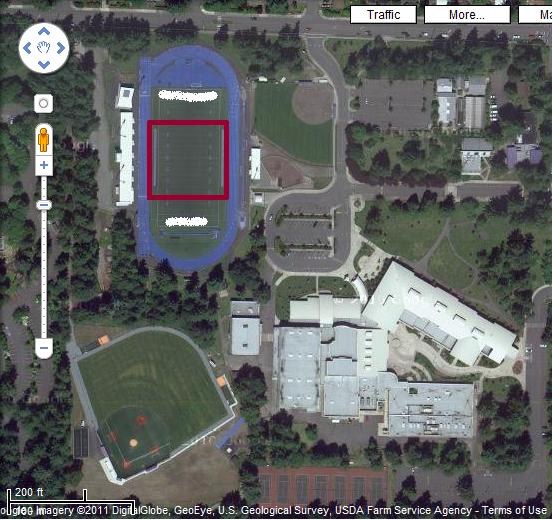
Well, here’s an overhead view of a typical high school. The superimposed square represents 40,000 square feet, or approximately an acre. Using the aforementioned statistics, the square works out to 1674 persons fed hydroponically.

This particular high school has a student body of about 1400, which means that a single such square of hydroponically cultivated land can feed them all. As you can see, I’ve put the square to feed them in the event of a global food crisis on top of the football field.

The school and team names have been whited out in the end zones not for legal reasons but to minimize embarrassment. Really, if the football field is converted to foodage, the state rankings aren’t going to change significantly.

Nonetheless, I realize that for some parents, football is divinely ordained because it says in the Book of Genesis that on the eighth day God created football, but for those who have growly stomaches, here’s a lifestyle choice: Give up eating, or give up football.

Some will ask, “Why not put the garden on the roof?” Safety issues aside, students are already up to something on the roof. Really, Mr. Principal, go check.

Hey, I notice there’s a baseball field too. Well, problem solved then.

Posted in Uncategorized | Tagged , , | Leave a comment

Arduino: Once More, with Photo Import

I made this drawing by first getting a picture of the Uno (from the Arduino site) and then modifying the image of the circuit board so that only the words appear. This made it a lot easier to accurately lay out the components, which I simply moved and resized from the old board.

Arduino Park, here we come. Hey, is it really Wednesday already?

Posted in Uncategorized | Tagged , , , | 1 Comment

Arduino in Sketchup (in Progress II)

Here’s a Youtube video on the next issue of Make Magazine. Note the sketchup-like illustration at :17.

I made a screen capture of the Arduino illustration in the video and compared it to an export image from my Arduino drawing, and identified a few ‘discrepancies,’ like so:

(The circles are where I need to make corrections, the X’s are the ones I’ve fixed so far.) For the most part they’re easy to fix, but now I look at my work and wonder why on Earth I wasn’t more careful in matching fonts. Times New Roman obviously is a very bad choice here. If I’m to upload my drawing of the Arduino Uno to Google 3D Warehouse, I’ll have to redo the fonts.

That said, I’m pleased with how much I got right. I can see being done with this by the end of the week.

In other news today, I finally bothered to figure out how Sketchup layers work. Piece of cake, excuse the quasi-pun.

Posted in Uncategorized | Leave a comment

The One TEU Per Family Initiative

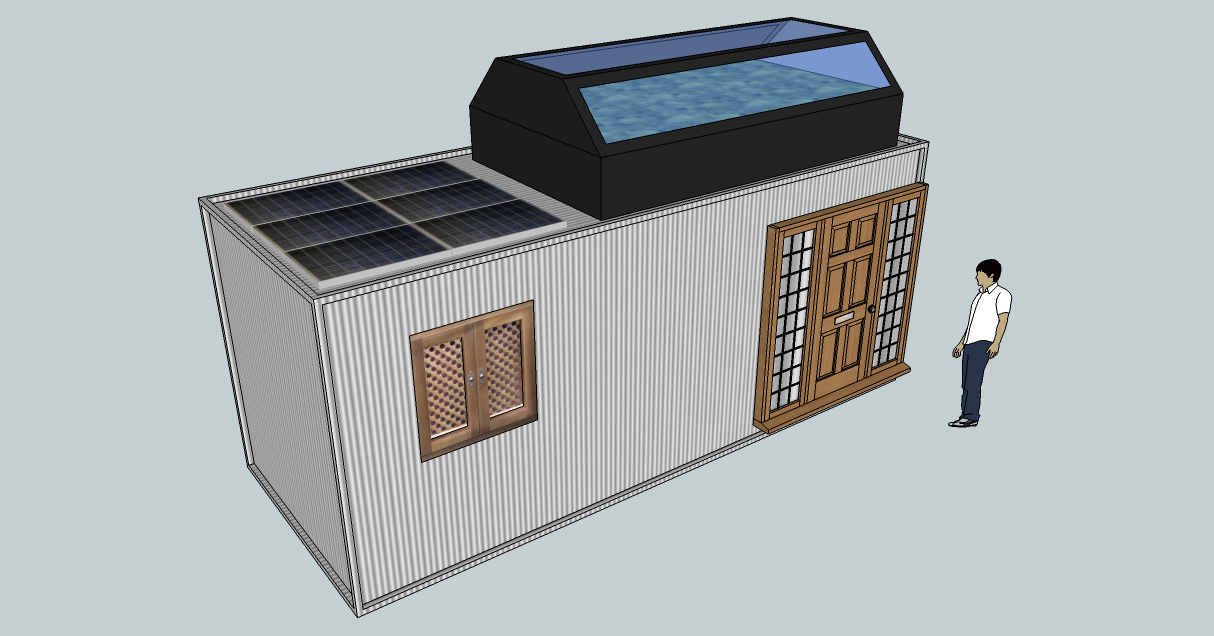
In the design shown, I’ve added a fancy door and window to a TEU (Twenty-foot Equivalent Unit) shipping container just for the fun of it. Otherwise, I’m serious about this concept.

Each of the six solar panels provides 80 watts of electrical power, or about three kilowatt hours per day. My laptop, which keeps me preoccupied much of the day, runs on seventy-five watts.

Next to the solar installation is a small hydroponic garden. From the Beginner’s Guide to Hydroponics:

In India, where household hydroponics is spreading amongst village and urban societies, it is considered that the simple method of hydroponics can supply eighteen hundred adult persons with a good meal of three pounds of greenfood daily throughout the year, from each acre of soilless garden under cultivation.

The garden I show here is 2.5 x 3 meters, which I calculate based on the above figures should be able to provide enough food for 2.8 persons — two adults and two preteen children, in other words.

The Beginner’s Guide was published in 1973, so I presume that the yields are even higher today. The question is, why does my internet search on hydroponics in India and China provide articles which refer to hydroponics as ‘promising?’ After nearly forty years, you would think that promise would be realized.

I think that maybe there is a Catch-22 involved here. Regions where technology such as hydroponics can be accessed also have market access to cheap food grown by traditional methods, so there is no need for hydroponics. Places where food is difficult to come by are also information-poor when it comes to hydroponics.

What’s needed then is some kind of low-cost, modular, turn-key, self-sufficient system to bring electricity, information technology, and hydroponics to the masses. That’s what I have in mind here.

As far as a government initiative, I’ll leave the political debate alone. What I’m interested in doing is reducing the cost of home technology so that even the poorest of the poor will have a place to live. If nothing else, you would at least be able to afford this.

Posted in Uncategorized | Tagged , , , | 1 Comment

Paracetamol single-double bond representation

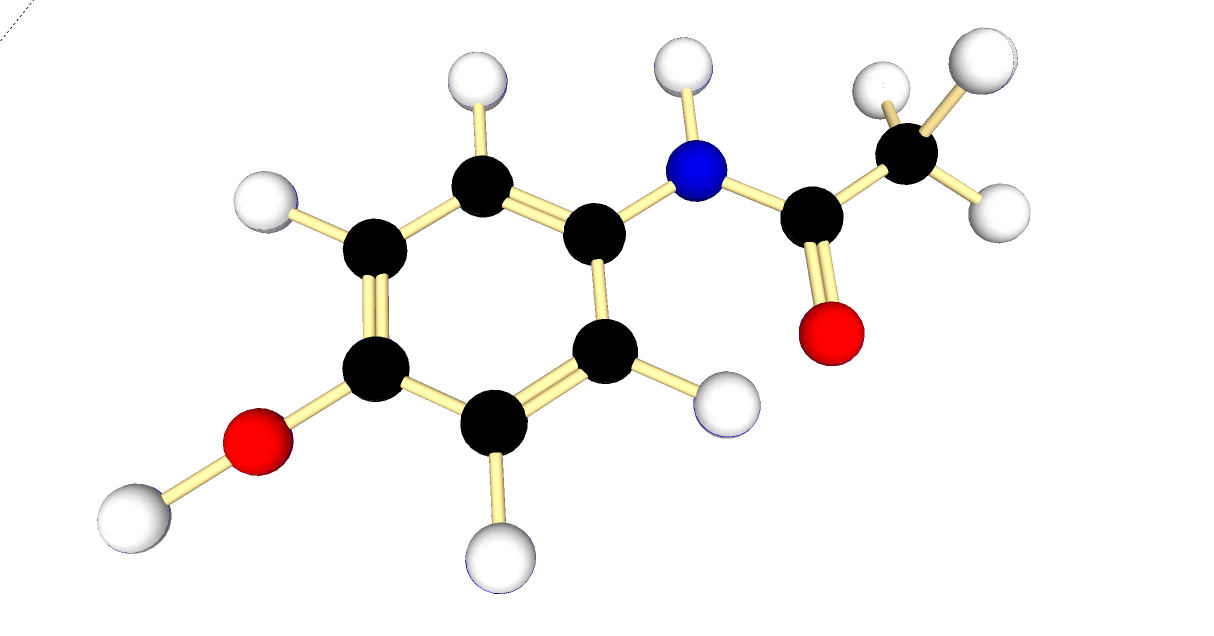
Well, that title is a mouthful. The basic issue however is as shown in the wikipedia entry for paracetamol:

Now here’s my guess as to what’s going on here:

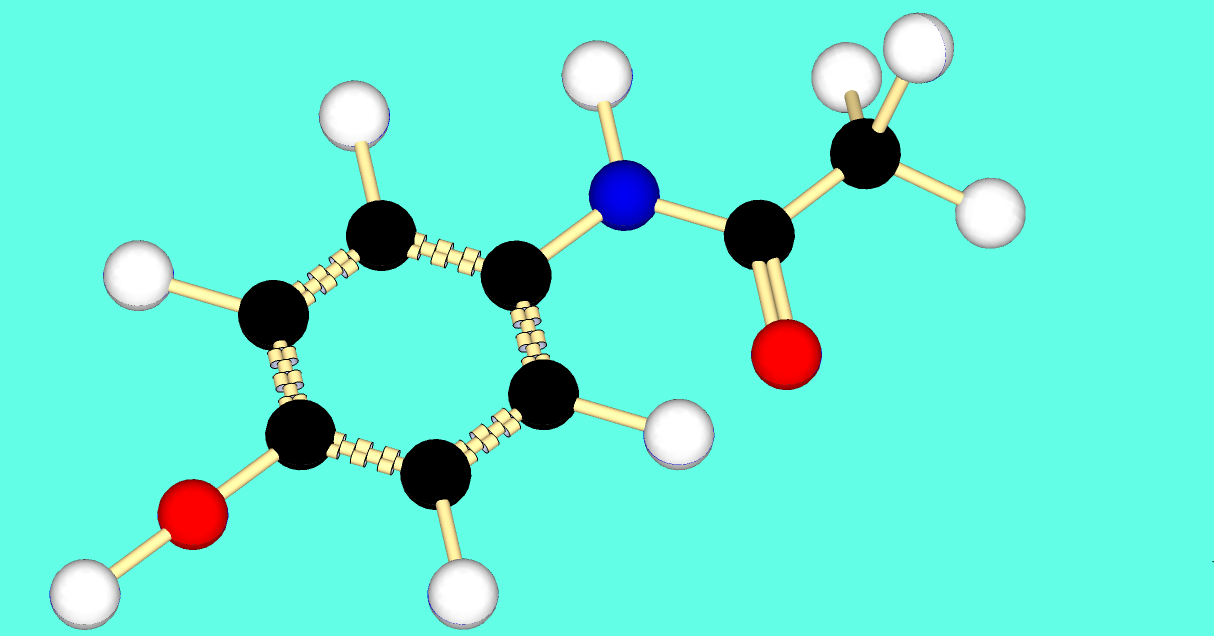
As indicated by the dotted circle, the benzene ring alternates between single and double bonds, but you can never tell when. That is, because of the equipotential of the carbon atoms, the electrons are free to race about the ring, so that at any given point in time, the bond between two adjacent carbon atoms in the ring can be single or double. This is not a problem that occurs in the nucleobases because there’s always at least one nitrogen atom to tell the electrons to cut that out.

When I uploaded my original version of a paracetamol molecule, I tried to sweep the issue under the rug, like so:

But then I thought, “Why don’t I figure out a way to represent this single/double bond sorcery?” And so I came up with this:

I think that looks nicer than wikipedia’s solution, and it explains better at a glance what’s going on.

Posted in Uncategorized | Leave a comment

Arduino on Battery Power

It seemed a straight-forward proposition last night when my nephew and I were wondering how to run the Arduino without being connected to the laptop. I must confess there was a point in our internet search where I wondered whether it was possible at all.

So then I went to ladyada.net and found this Arduino Tutorial – Lesson 0: Getting Prepared. It states near the bottom: “Another way to power up the Arduino is to plug in a battery or wall adapter into the DC jack.”

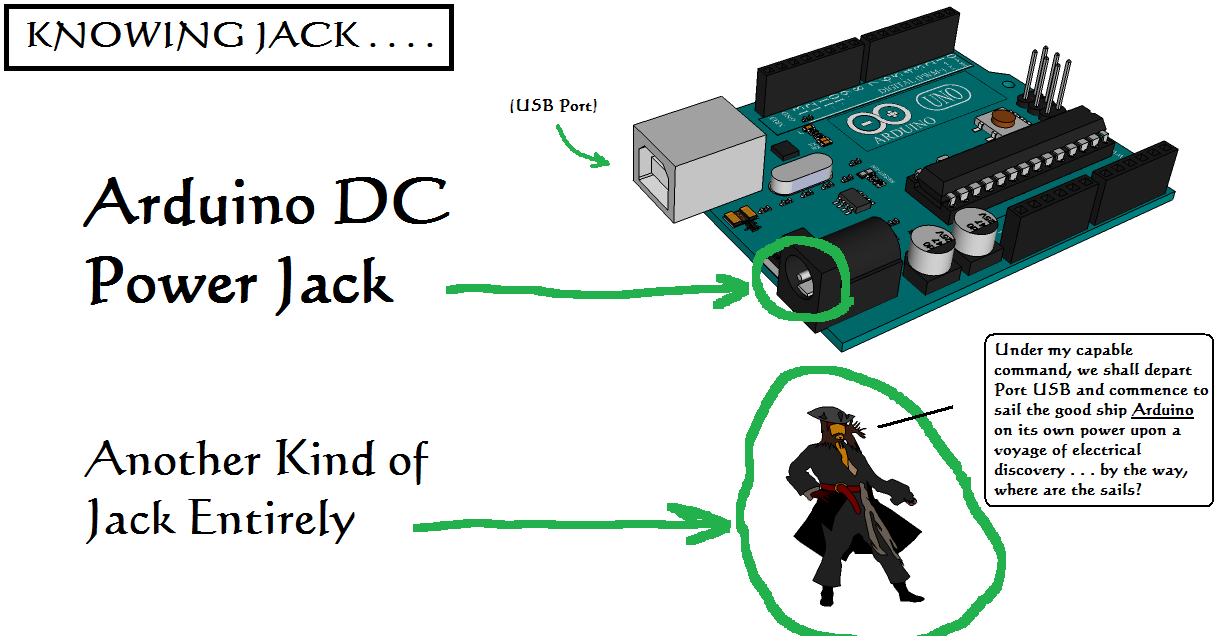
Just so we’re clear, the DC jack is this here:
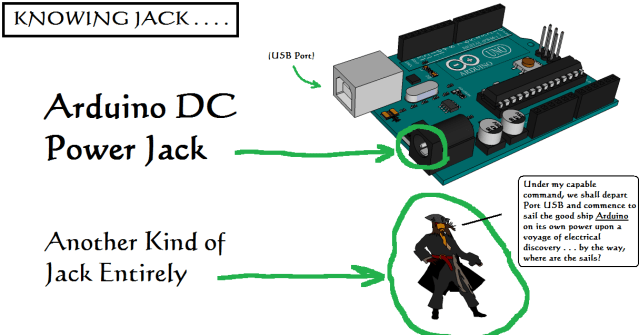
Adafruit continues: “Verify that you have a 9V DC 100-500mA power adapter, with a 2.1mm barrel plug and positive tip. If the box doesn’t have any information about the adapter, you can look for these clues” — whereupon it shows the information that should be printed on the adapter.

Just now I inspected one of the half dozen or so of the Mystery Power Adapters that my apartment seems to collect in lieu of stray cats, and the symbol is reversed from the one in the Adafruit example, with the plus on the left and the minus on the right, but the minus is still on the outside and the plus inside, and that’s what matters.

My Mystery Adapter outputs 400 mA, which is okay for current, but only 5.2V DC, which may not be enough to power the Arduino. I suppose I could test. After all, low voltage never damaged a circuit. He said.

Anyhow, according to Adafruit, a 9V power supply can be handily obtained at Radio Shack for about ten bucks, and that’s probably the safest bet. But I’m sure Goodwill has bins brimming with orphan power supplies that might inexpensively fill the bill for a more daring soul.

So onto the question of battery power. Along the way in my voyage of electrical (electronic? electronical?) discovery, I asked the question, “Well, how much current can a 9v battery deliver?” That was answered here. I’m reading the charts to say that with the Arduino as the load, you can get about 3-5 hours off a 9 volt battery.

The next question is, how do you plug your battery into the DC power jack? Well, SparkFun has a 9V-to-barrel-jack adapter (PRT-09518) that is specifically identified as good for the Arduino. It only costs $2.95, so there you go. Link is here.

And finally, you can just stick the leads of a 9V battery snap connector into Vin and a GND (why not the one next to Vin?), like so:

The use of Vin is explained at the Arduino site here.

The wires of this particular Radio Shack connector (270-0324) shown in the photo are braided and despite efforts to avoid it, tend to bend into shapes that don’t want to go into the holes anymore. Since you may be wanting to insert and retract the positive lead a lot in order to turn the Arduino on and off, it might be best to stick the snap connector leads into a breadboard, then use a solid-wire jumper to go from the breadboard to the Arduino. Or, you could solder a bit of solid wire (and maybe also even a switch) to the positive lead. I suppose in the short run a paper clip will make do in order to attach a jumper to the lead in the event that you don’t want to reach for the soldering iron just yet.

So what have we learned? We learned that we can program the Arduino to do all sorts of things, and then we can disconnect the board from our laptop and send it into the great world to do those things on a DC Power supply or, even more independently, a 9V battery. I’ll claim that I already knew this (though my faith was shaken), but it’s good to know what the numbers are and where the links are.

(NOTE: This entry was updated 14 October 2011 to add info on the use of a battery snap connector.)

Posted in Uncategorized | Tagged , , | Leave a comment