Ultrasonic Pinger Game, Part I

DSCN1444

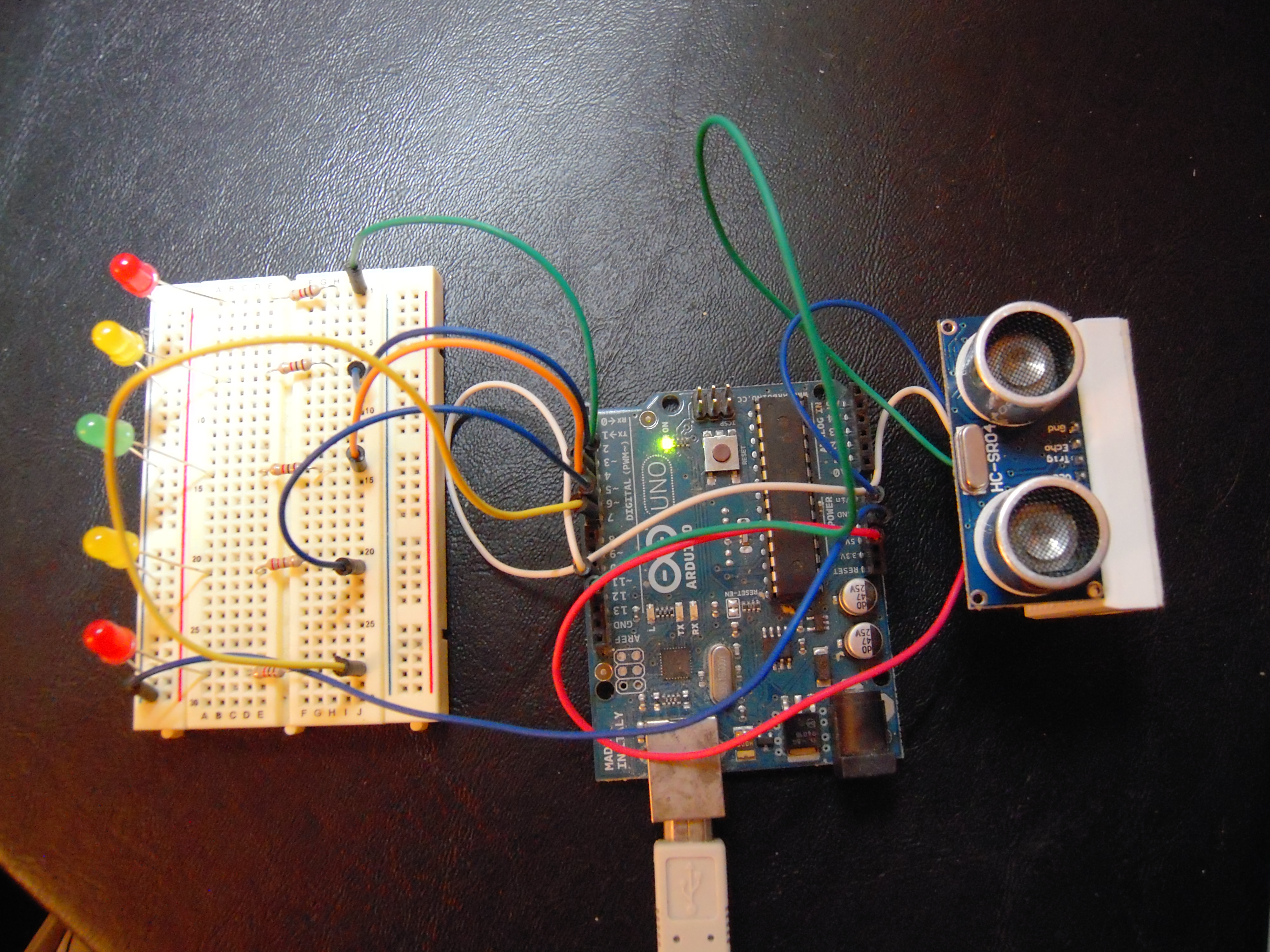
I’m working on this idea for a game which involves an ultrasonic distance sensor. The set-up is shown above. As you can see, it uses an Arduino for the prototyping but the goal is to transfer the programming over to an ATTiny eventually.

Anyhow, the first step in building the game is to have the sensor measure the distance to one’s hand, and then the Arduino will activate the LEDs on the left depending on the distance between the hand and sensor. Of course, that doesn’t qualify as a game in itself, but it is the first step on the path.

Here’s how the set-up works so far:

I have some ideas on how the game will work and on how scoring will be accomplished, but if you have any suggestions,they would be most appreciated.

Posted in Uncategorized | Tagged , , , , | Leave a comment

How to turn on the electronic nonlethal mousetrap with a thyristor

mouse trap

As you recall, I was working on a design for an electronic nonlethal mousetrap. Well, I was stumped as to how to turn it on. It wasn’t as easy as it sounds.

There was a manual ON switch, but I didn’t want the trap to be on all the time or the battery would run down prematurely. Instead, I wanted the trap to activate only after a mouse actually entered. Thus, the manual switch would merely ‘enable’ the mouse trap to be turned on. It was the act of the mouse entering the trap, and triggering the reed switch, that would turn the mousetrap on for real.

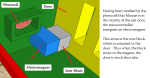
Here’s the slide show slide for the manual switch:
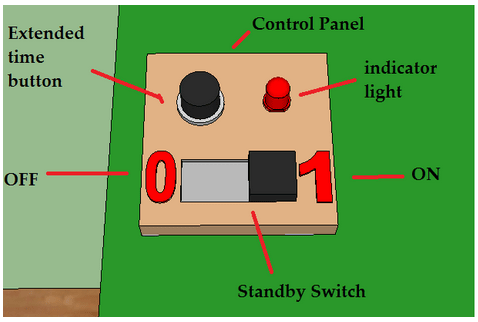
manual switch

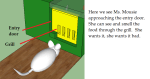
Here’s the slide for the reed switch:

reed switch

At first I thought it was a simple matter of sending a signal from the microcontroller back to a transistor that would always keep it on. But then I realized that would mean having a positive current flow from a lower to higher voltage. No no.

What comes to the rescue is a component known as a thyristor. Here’s an animation on how thyristors work.

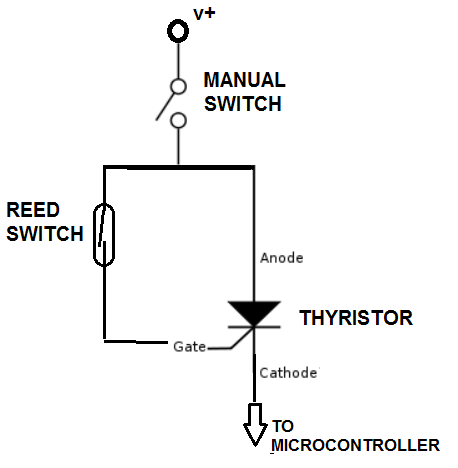
A thyristor is what I need, as shown in this (rather crude) schematic:
thyristor

When the manual switch is closed, the opportunity for current to flow through the thyristor exists. If a mouse enters the mouse trap, she activates the reed switch and current flows through the thyristor gate. Thereupon the thyristor allows current to pass from the battery to the microcontroller. The thyristor will remain on even when the reed switch is deactivated, and requires the manual switch to be opened in order to turn off again.

Thyristors are common, easily available parts. Here’s one at Radio Shack for just $1.19.

The sad news is that my rusty engineering education from almost forty years ago didn’t dredge up memory of thyristors. The happy news is that I found out all about them in mere seconds by googling ‘What electronic component is like a switch that turns on and stays on?’ Ask and you shall receive.

I’m still debating whether to actually build an electronic nonlethal mousetrap, but now more than ever I believe it can be done.

Posted in Uncategorized | Tagged , | Leave a comment

Stuart Appreciates Education

stuart reads

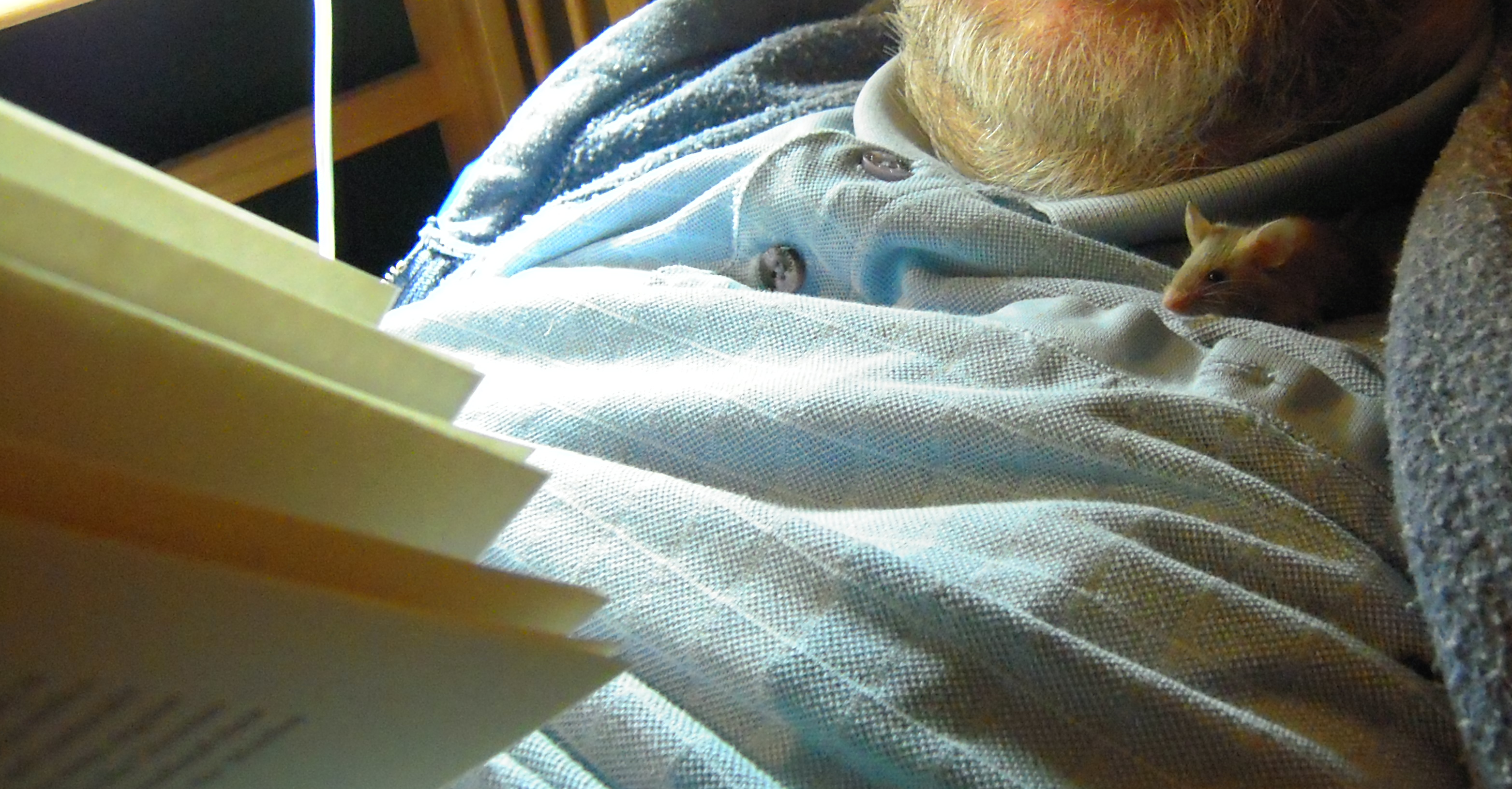
Easter is, above all else, a time of peace and joy toward rodents of all species and creeds. Hence I thought I’d show this photo of Stuart, my young apprentice mouse. Stuart may come to assist in the development of the Electronic Nonlethal Mouse Trap, though right now he’s leaning toward a career in foraging. If you’re interested, other photos of Stuart and mice I’ve had in the past are at Mousie Mousie. (Click to enlarge photo — Stuart is VERY photogenic.)

And now back to the lab . . . .

Posted in Uncategorized | Tagged | Leave a comment

Kids and rotary phones

So why do kids want to live in the Harry Potter universe, where there are no phones at all and you communicate by writing letters carried by owls?

Posted in Uncategorized | Tagged , | 2 Comments

3D Printing: The Next Technology Gold Rush

3D Printing: The Next Technology Gold Rush – Future Factories and How to Capitalize on Distributed Manufacturing

This book provides an overview of the 3D printing market. The most interesting and unique section is Part II: “Financial Implications and Opportunities.” This section describes various potential markets for 3D products which you, the owner of a 3D printer, might produce for. Much of the discussion focuses on making custom designs for what might be regarded as accessories for ‘toys’: doll houses, action figures, gaming miniatures, and the like.

Also the writer mentions his experience working with factories in China, and says it’s nowhere as easy as some have implied. So if you have new product ideas you want to manufacture, 3D printing might be more practical when you’re just starting out.

By itself, this book is probably not going to make you an additive manufacturing tycoon, but it is perhaps one of the stepping stones along that path.

Posted in Uncategorized | Tagged , | Leave a comment

Electronic Nonlethal Mouse Trap Slide Show

Click on first image to begin.

Posted in Uncategorized | Tagged , , | 4 Comments

Electronic Nonlethal Mouse Trap: Preliminary Design

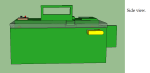
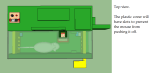
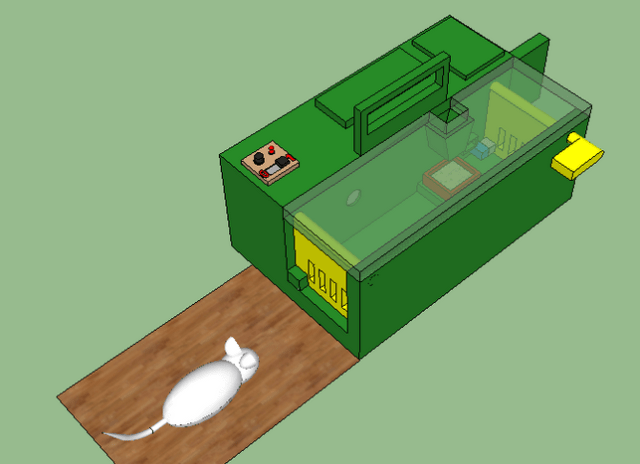
mouse trap 03

Why an electronic nonlethal mouse trap, you ask? Well, what if you forget to look in the trap? Then the poor mouse quickly starves. The electronic nonlethal mouse trap has an indicator light that blinks when the mouse is caught, and also it allows the mouse to escape after twenty-four hours. Your vacations can now be guilt-free!

(More details on the trap features will be forthcoming soon . . . .)

Posted in Uncategorized | Tagged , | Leave a comment

GMO versus pharmaceuticals: the case for stronger regulatory oversight

Here’s some stuff to consider about GMO.

1. GMO is not ‘the same as plant breeding,’ it is creating new protein sequences that have never before existed in nature.

2. An insecticide resistant GMO crop must produce heavy chemical doping in order to become resistant to what is otherwise a deadly poison, and antidotes have been known to have side effects as deadly as poisons.

3. Clinical trials for new drugs typically last twenty years, GMOs use three-month ‘feeding trials’ instead.

4. Despite extensive testing, new pharmaceuticals typically have fatal side effects but we are to believe that far less testing will result in GMOs that are perfectly safe.

5. Would you buy an ear of GMO corn if it came with a label warning of possible side effects such as ‘nausea, burning sensation, dizziness, vomiting . . . . ‘ yet such warning labels are typically attached to pharmaceuticals that have undergone decades of testing as ‘safe’ for a market of only a few thousand consumers, while GMO crops are being targeted to a market for millions.

Because GMOs aren’t simply shuffling around existing DNA protein sequences but rather are engineering protein sequences that have never existed before in nature, it stands to reason that they should be subjected to the same controls and testing utilized by an industry that already has extensive experience with creating new chemical compounds for human ingestion. That industry is the pharmaceuticals industry. Based on its experience — written in the blood of patients — the pharmaceuticals industry has adopted a system of lengthy clinical trials and extensive warning labels and a controlled distribution system that requires written authorization from a medical professional before the product can be obtained. And even so, people suffer unanticipated side effects and die from pharmaceutical drugs that were determined ‘safe’ via the exhaustive FDA review process.

In the case of GMOs, we’re disregarding all that industrial experience and saying, “Yep, the cows are still alive after three months, it must be okay to give it to billions of people.”

Pharmaceutical drugs can often be expressed in simple formulas less than one line in length. A child could construct a ball-and-stick model of most pharmaceutical drug molecules in a matter of minutes. In contrast, proteins are the equivalent of molecular robots with thousands of atoms folded into precise configurations. In the same way that a computer program of millions of bytes can be corrupted by the change of a single bit, so too are the functions of proteins radically altered by the change of a single atom.

Can GMOs be safe? Yes, with clinical testing, potential side-effects warning labels, and a distribution system controlled by licensed physicians. We do that with relatively simple pharmaceutical drugs, we should do that with far more complex protein modifications. Of course we won’t, because there isn’t going to be a market for corn that you need a prescription to buy. Especially if it has a peculiar ’roundup-resistant’ aftertaste.

But the question is not whether we want to be scientific about GMOs, because of course we do. The question is whether we want to lower the scientific standard for regulatory oversight of introducing complex chemicals to be ingested into the human body. And if we do that, the quality of human life is going to be very different in the years to come.

Posted in Uncategorized | Tagged | Leave a comment

Quirky Update: Privacy -Cover USB Drive

privacy usb 03

One of my ideas has reached Expert Review at Quirky. It’s my design for a Privacy-Cover USB Drive.

Posted in Uncategorized | Tagged , | Leave a comment

Ten Predictions for 2014

1. 3D printing of manufactured goods will drive factories out of business.

2. 3D printing of food will drive farmers out of business.

3. 3D printing of body organs will extend human lifespan indefinitely.

4. 3D printing of solar cells will provide unlimited, pollution-free energy.

5. 3D printing of 3D printers will make high living standards available to all.

6. 3D printing of sophisticated computers and robots will lead to mass unemployment.

7. Public will demand economic reform to share the material wealth created by 3D printing.

8. The .1% will print invincible army of AI-controlled drones to herd the 99.9% into ‘relocation centers.’

9. Software for invincible AI-drone army will crash.

10. Economy of scarcity will be replaced by economy of self-improvement and personal enrichment.

Posted in Uncategorized | Tagged , , | Leave a comment