My science fiction novel, The Wizard from Earth, is available on Amazon Kindle as an eBook. It’s selling for only 99 cents. If you don’t have a Kindle, you can still download the free Kindle Reader software, and read it on your computer and/or smartphone.
Matt was a typical twenty-second century teenager with a supercomputer implanted in his head. He was supposed to be launched toward the star Alpha Centauri, but ended up on another world, lights years and centuries removed from his family.
Carrot was a native of that new world, a mutant of superior strength, senses, and intelligence, alienated from her own family and locked in a deadly struggle with a global empire.
Together they would battle humans, mutants, and super-intelligent AIs in a war for the fate of a new world — and for the survival of humankind.
I’m looking into tutoring again and thought it might be useful to list a few links that illustrate what I’ve done. I may not have done the right stuff, but I have done stuff.
Rocket Ship Freedom is my YA novel about a teenager who gets an internship at a private rocket company and ends up going to the Moon, where he discovers a deadly mystery that threatens the survival of the human species.
Judging by the recent popular movies, the YA genre appears to be dominated by fantasy and dystopia. When science and technology do appear in a story, they often deal with really far out stuff like time travel and parallel worlds. Now, I like that stuff too, but I wondered how come there didn’t seem to be any YA novels that focused on hard technology and an upbeat vision of the future. So I tried to write a story that was scientifically accurate yet also fun and full of adventure.
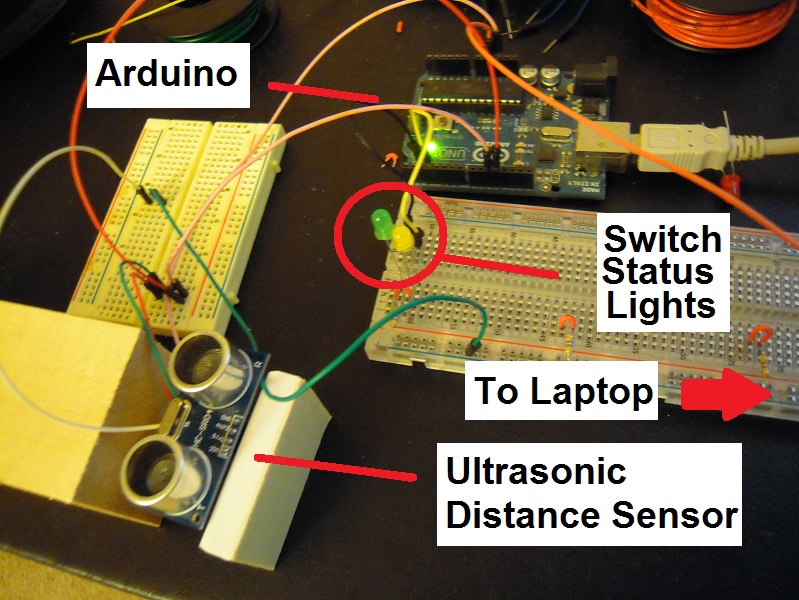
This is an idea for using an ultrasonic distance sensor (aka ‘pinger’) as a toggle switch. I’ll show it first and then explain:
As the hand approaches, the yellow light comes on to indicate that the switch is in aware mode.
When the hand is close enough, the green light toggles. That is, if it’s off, it goes on. If it’s on, it goes off. The yellow light, having done its duty, goes off.
The yellow light remains off while the hand is retracted to indicate that the aware mode doesn’t activate again until the hand is fully retracted. This is to prevent the ultrasonic equivalent of what is called ‘bounce’ in mechanical switches.
So what are the applications of such a switch? Suppose you have a runaway robot and you’re shouting at it but the background noise is high and so you take out your remote but there’s radio/IR interference too. You could chase after it and slam a mechanical switch on the back, but maybe that is getting too close for safety.
So here’s another solution: simply reach out toward the robot, and when you’re close enough (but still at a safe distance), the pinger detects your hand and deactivates the robot.
A more mundane application would be to turn fans and lights on and off more conveniently.
(In case you’re wondering, I had oatmeal for breakfast.)
The comment that I added to the previous post was not the full solution to having a row of touchless buttons, but it set me on the way. A second pinger IS necessary to discriminate against anomalous readings.
In the following video, I turn off the yellow lights but retain a comparison between the distances from the finger to the lower (or ‘green’) pinger and the upper (or ‘yellow’) pinger.
Two comments:
1. There is still some confusion between readings for buttons. This might be corrected by setting the buttons farther apart and increasing the separation of the pingers.
2. You can see the light flicker as the finger hovers over the button. This is the equivalent of ‘bounce’ for a mechanical switch, and the solution is likely to be ‘debounce’ code.
Anyhow, it looks like the best way to use pingers for touchless technology is one pinger per button. That’s where I’m going next.
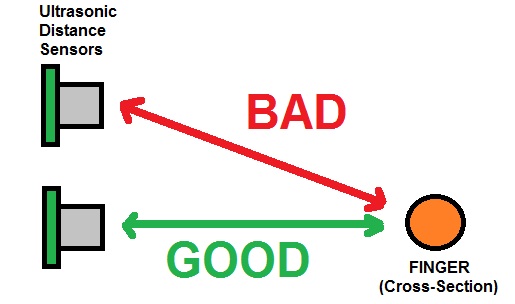
The concept behind this circuit design is that you can press buttons without touching them. As your finger lowers to the tabletop, the yellow light will come on, indicating that you are on the correct approach. Farther down, the green light comes on, which activates the button function.
Or so it’s supposed to work. What I find is that when my finger is on the lower level, the upper sensor will still detect its position, which is bad enough, but since it’s measuring at a diagonal, it will measure the distance as greater than it is.
Possible solutions would be to redesign the circuit so that there is a UDS pointing up from each button position. But that would require four sensors rather than two even for this circuit.
Hmm, I wonder how big the ‘spray pattern’ is for the sensor pings. If it’s fairly wide, then the position of the finger could be determined by triangulation.
I’m about midway in building this demo of touchless technology. The idea is that the user will be able to operate buttons without touching them. Confused? It will all make sense when I get this thing running in the next day or so.
This is the hardware for a game I’m developing that uses an ultrasonic distance sensor.
The microcontroller (Arduino, natch) randomly generates distances and then commences a ‘random walk’ from Point A to B. You, the player, hold your hand above the ultrasonic distance sensor (aka ‘pinger’) and the microcontroller compares the target distance with your distance. If you are within the ‘safe’ zone, you get a green LED light. If you are in the caution zones, yellow, and red is for when you’re way off.
In addition to lights, there is a piezo speaker which sounds increasingly high pitched tones when your distance doesn’t match the target.
Thus the object of the game is to move your hand so that it keeps in the green zone as much as possible. Points will be scored in the final version, and there will be different skill levels too. Following is a video of how it works so far. Please be patient, the gameplay is still in the development stage.
I’ve already gotten suggestions about generating oscillating waves and musical patterns in which distances correspond to musical notes. Please let me know if suggestions have occurred to you as well.
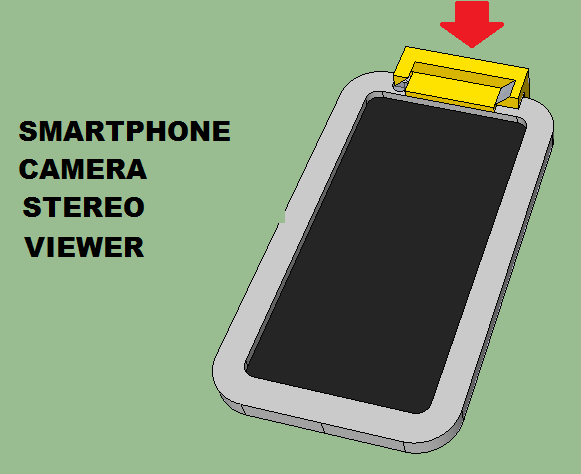
Imagine a ‘touchless touch screen’ for your smart phone. You hover your hand above the screen, and the phone detects the position and movement of your fingers so that you can ‘click’ and ‘swipe’ without actually having to contact the screen. This opens up a whole new realm of convenient and fun applications.
Someday smart phones will come equipped with two cameras in front, but in the meantime this tiny accessory that fits over the top of your phone will do the trick:
As you can see, it has two mirrored surfaces, which act as a sort of split-view periscope:
This enables the camera to see from two different perspectives, which can then be combined into one:
And of course it can be adapted to laptops and desktops, so that 3D viewing can be utilized in, say, drawing stuff in Sketchup!
Well, not exactly. Japanese soft drink maker Otsuka intends to send a can of ‘sweat powder’ to the Moon via one of Elon Musk’s Falcon rockets and Astrobotic’s Griffin lander.