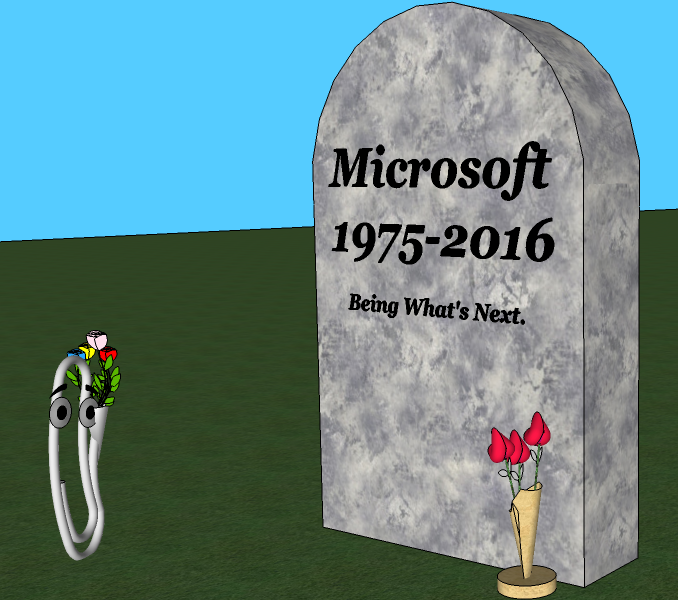
Why Microsoft Could Die Within Five Years

I was just watching a slide show presentation about the new Windows Phone 7. The effort looks competent. But that’s not enough to keep Microsoft from dying.

Whether it’s fair or not, people hate Microsoft. In order to overcome that hate and get people to buy its products anyway, Microsoft has always had to appear invincible and dominant. Well, that’s not going to happen this time.

A decade ago, Microsoft was the biggest company in the world. But now Apple is the biggest company in the world and Google is not far behind. Microsoft can’t win the Battle of the Smartphones by outspending its rivals.

Maybe that wouldn’t matter if Microsoft had brand loyalty. But it doesn’t. It has brand hatred.

First, everyone suspects that Microsoft is the ringleader of an Upgrade Conspiracy that forces everyone to buy new software and new machines with questionable improvement in performance. Then there’s Microsoft’s lackadaisical, ad-hoc approach to security issues as a profit center. And so there is zero brand affection for Microsoft.

As far as I can tell, Windows Phone 7 is competent. But with people actively hating Microsoft, it has to do better. Given a choice between two products that are equal in everything except that one of them is made by a company that consumers hate, hate, hate, the market will tend to not choose the product made by the company that everyone hates, hates, hates.

This time the company can’t outspend, it can’t dominate. It has to fairly compete with a superior product, or Phone 7 will go the way of Zune. And I don’t think it can do that. I don’t think it knows how.

“So Microsoft loses the smartphone market, how does that mean the end of the company?”

Well, because Microsoft could ignore and/or mock Linux when Linux was this tiny province of hacks at the fringe of computerdom. But with Android, Linux has a user base that is growing larger than Microsoft’s. Microsoft can’t ignore the challenge, it has to fight. But it can’t fight something better. Not when the bucks behind Android are bigger.

Android isn’t just smartphones, it’s also tablets. And that gives it a beachhead into the traditional computer market. If you have Android on your tablet, you’ll be more inclined to have it on your laptop and desktop as well. Assuming there are laptops and desktops for much longer.

Meanwhile, China has already embraced Linux because, frankly, the Chinese suspect that the US government makes Microsoft put stuff into Windows to spy on every PC user. And the Chinese aren’t the only ones who think this. Whether this is true or not, in marketing it is perception that matters. So there goes global marketing share.

So the writing is on the wall. Microsoft is outclassed financially, has a huge branding problem, is vulnerable to viruses, is suspected of snooping. To continue on top, Microsoft would need an original idea, and we’re talking Microsoft.

I think Microsoft is already dying, as it has lost its corporate primacy to Apple and where once it was renown for having no debt at all, it has started accumulating debt. The signs of decay have been there for years. It’s not just ‘Microsoft is Evil.’ The very idea of One Company Fits All has been outgrown by the global computer industry, and there’s no longer a place for a company whose de facto mission statement was Total World Domination.

Bill Gates must have seen this.

Microsoft could well be dead within five years. I won’t take bets on this because after all the government might bail out Microsoft as too big to fail, and I don’t want to parse endless verbal and legal technicalities of what constitutes ‘death’ for a corporation. Also, my nephew loves XBox Live, so maybe some parts of Microsoft will live on.

But the company as a whole is losing its grip on the computer industry as a whole, and it’s got a lot farther to fall, and that’s what it will be doing because it has nothing to grab onto to break its fall. Think of Microsoft as Napoleon and Android as Russia, and cue the orchestra for the 1812 Overture.

Posted in Uncategorized | Tagged , , , , | Leave a comment

PC control of RC toy via Arduino

Posted in Uncategorized | Tagged , , , | Leave a comment

China’s Drought and Spirulina

New York Times: U.N. Food Agency Issues Warning on China Drought

The state-run news media in China warned Monday that the country’s major agricultural regions were facing their worst drought in 60 years. On Tuesday the state news agency Xinhua said that Shandong Province, a cornerstone of Chinese grain production, was bracing for its worst drought in 200 years unless substantial precipitation came by the end of this month.

World wheat prices are already surging, and they have been widely cited as one reason for protests in Egypt and elsewhere in the Arab world. A separate United Nations report last week said global food export prices had reached record levels in January. The impact of China’s drought on global food prices and supplies could create serious problems for less affluent countries that rely on imported food.

China and the rest of the world may want to look into increasing the production of spirulina as a food source. As wikipedia describes, spirulina was identified in 1974 by the UN as the ‘best food for the future.’

In the words of one advocate:

Spirulina is a cyano-bacteria, 3 billion years old. Growing spirulina sees production doubling every 36 hours. It is made of 65% of highly digestible proteins, is the largest natural source of comestible iron, is full of beta-caroten , and contains all 8 essential amino-acids for human nutrition.

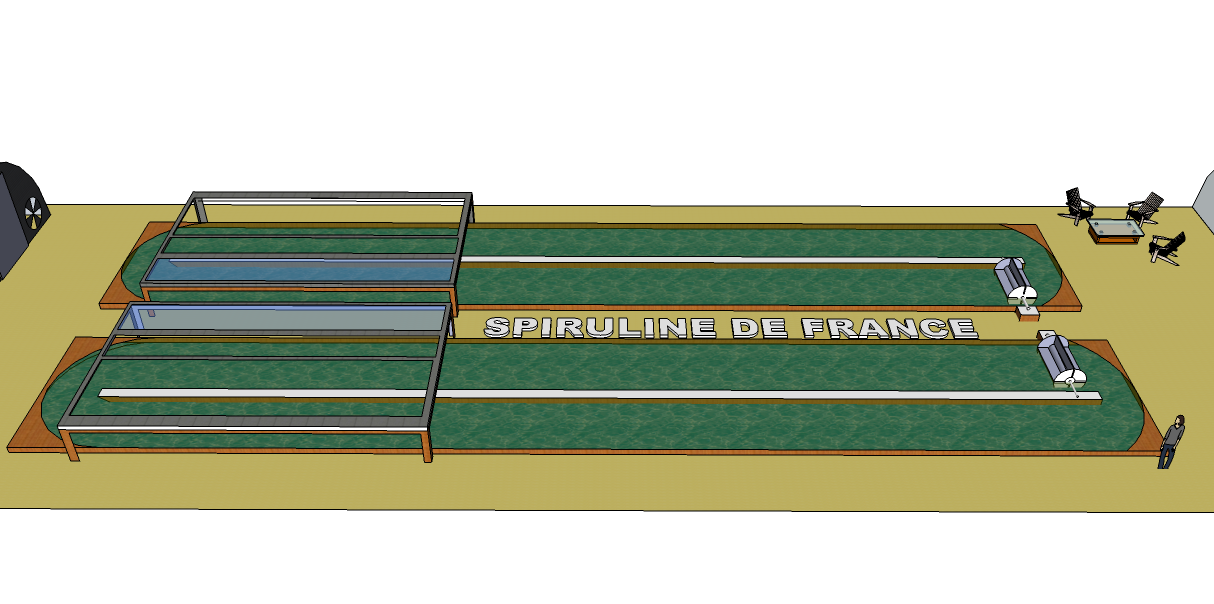
This is from his page in Google Sketchup 3D Warehouse, where he provides the following drawing of a Spirulina production plant which he says is actually in operation:

The alga is grown in a race-track shaped pool with a paddle device to keep the growth media stirred. Other than that, the setup looks pretty simple — something that could be temporarily constructed in a couple weeks at very low cost to feed millions in the event of a threatened global famine. The person who designed and built this plant has his website listed on the Warehouse page, if you’re interested in contacting him.

I bought some spirulina tablets (they look exactly like the picture at the top of this entry) at my local supplements store, and haven’t really noticed the taste, which is supposedly objectionable. Well, I am swallowing the tablets rather than chewing, but it seems to me that you could mix this stuff in with bread dough in order to stretch out the wheat, and no one would complain too much. At least not enough to riot about. Hint, Third World Leaders, Hint.

Posted in Uncategorized | Tagged , , , | 1 Comment

In Defense of Thomas Edison

Hey, it’s Edison’s birthday and Google’s doodle today is about Edison. And the Tesla Cult is angry about it.

When I was growing up, Thomas Edison was regarded as a hero. His reputation has been tarnished in recent years by what can almost be called a Tesla Cult. I was carried along by the Tesla Cult for a while, and then I realized one day that none of Tesla’s inventions actually worked.

Okay, that’s a little strong, but the Tesla Mystique is mainly flash and not much substance. You say, “But he invented AC electric power!” No, actually, others were experimenting with it at the time, and anyhow AC power is what comes naturally off a generator as the shaft spins between the poles.

Once you realize that Tesla didn’t even invent what is his primary claim to fame, the entire Tesla Myth quickly deconstructs itself.

After all, Tesla also claimed to have invented a death beam. Well, it’s been a hundred years, and where is it? And what about his claims to broadcast power economically, and about being able to extract energy from the atmosphere? He also claimed to have received intelligent signals from Mars. You would think that in a century afterwards, someone on this planet would have caught up with him.

Based on his propensity to make grandiose claims for inventions that never materialized, I have my doubts about Tesla’s character, frankly.

Now, you may have heard the story about how Edison once employed Tesla and said that he would give fifty thousand dollars if certain problems could be solved. Tesla solved the problems and instead of paying up, Edison replied, “You obviously don’t understand the American sense of humor.” And maybe you’re thinking that this story proves that Edison was the jerk and Tesla the great inventor.

All right, but who’s telling us this story? Tesla. And as we’ve just realized, Tesla was prone to make things up. So maybe the truth is that Edison decided to let Tesla go because Tesla wasn’t productive, and in order to salve his pride, Tesla made up the story about how Edison cheated him.

The typical response of the Tesla defender is, “It’s a conspiracy, man! He did invent all kinds of great things! He was a man ahead of his time! It’s just that the government confiscated all his plans when he died.” And so today his plans for a system to pull limitless free electrical power from the atmosphere reside in that warehouse next to the Ark of the Covenant.

When Tesla died, he had been living in a hotel room for years without paying the bill. Don’t you think he could have come up with just one little invention during that time to cover his expenses? How about consulting work? The greatest electrical genius of all time, and he can’t get consulting work? Something’s not adding up here.

I have a conspiracy theory too about Edison and Tesla. My theory is that the big financiers back in that day were trying to set up an electricity trust just like they’d set up a railroad trust and a steel trust. But to do that, you need to neutralize the dominant figure in the electrical power industry, Thomas Edison. And how do you topple a man who not only owns all the patents but is regarded as a planetary hero?

Well, one day you and your cronies are sitting around smoking stogies at the Gentleman’s Club, and one of you says, “Hey, you know, there’s talk in the engineering community about how AC power is better than DC power. And it just so happens that Edison thinks AC power is dangerous, so all his patents are for DC devices. If we could get someone to champion AC power, then we could build AC power transmission grids and run Edison out of business.”

In Tesla they found their man — someone who obviously despised Edison and wouldn’t let a little thing like truth get in his way. So the Trusters made Tesla their champion — and dare you question his reputation, why that just means that you’re stupid and evil.

Tesla had a good run as the poster boy for the Power Trust folks, but then Edison saw the writing on the wall and capitulated, and then the Power Trusters had no further use of Tesla and stopped financing him and promoting him, and so Tesla dwindled into an obscure old age of unpaid hotel bills and pigeon-love (not that there’s anything wrong with that, but it does suggest he had lots of free time on his hands whereas Edison was working diligently up to his death).

Now, the low point of the Tesla Cult’s attack against Edison is the assertion that Edison wantonly tortured animals by electrocuting them in order to claim that AC power was dangerous, so that he could continue to make money from DC power. “Torturing innocent animals for greedy profit! How low can you get!”

Well, in the first place, the animals selected were going to be put to death anyhow because they had either attacked humans or were approaching the end of their lifespans. What Edison was doing was more humane than the slaughterhouse — which is to say, what millions of people are complicit in every time they have a hamburger.

And even more importantly, Edison was tragically and prophetically right. He was trying to warn us as graphically as possible that AC power is much more dangerous than DC power. Literally, he was trying to stop a human genocide at the hands of the electrical power industry.

The danger was and is so great that in 2001, 411 people were electrocuted accidentally in the US. The number of deaths from accidental electrocution runs to thousands for the entire world each year, and perhaps totals around a million since the dawn of the electrical age. And most of these people died from being electrocuted by AC power, which even its proponents acknowledge is more lethal than DC.

“But we have to use AC power because it’s more efficient for transmission over long distances.” I have always accepted this as true, but then there’s this disturbing admission in the wikipedia article on power transmission lines: “High-voltage direct current (HVDC) technology is used only for very long distances (typically greater than 400 miles, or 600 km) . . . .”

Let’s admit it, I and probably you as well lack the training and experience and financial facts to know for sure whether AC or DC power is cheaper over long distances. We have to trust the electrical power industry cost accountants. And did they ever factor in the relative public safety risk that Edison was so concerned about?

But there’s one thing I do know for sure, and that’s which of these guys spent more time grooming his hair:

And I guess I also know which one of these dudes is proud of his extremely popular invention . . .

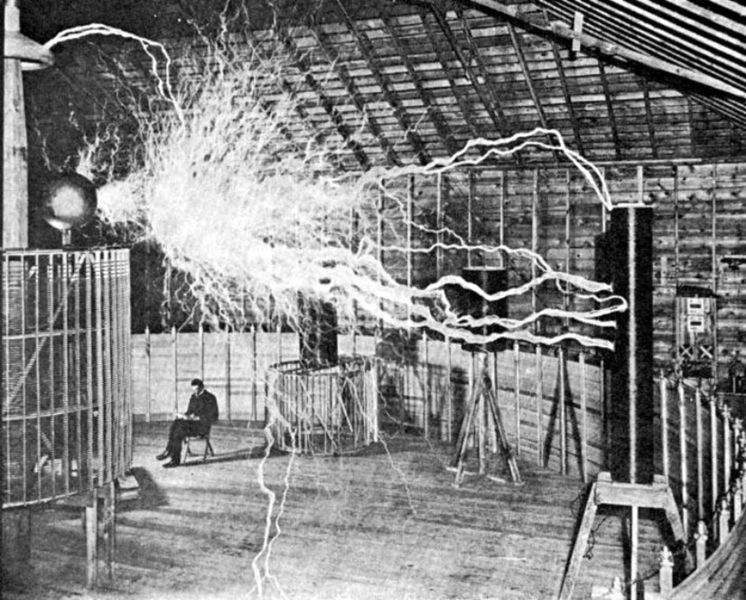
. . . and which is trying to distract with flash and noise from the fact that he doesn’t have a marketable invention . . .

Well, I do admit Tesla Coils are cool. But as far as jumping all over Edison versus Tesla, it’s been a century and we don’t know what really happened between the two men, so maybe we should just give it a rest. Then maybe we could take the time we save from not bickering and spend it instead on making inventions of our own. And you know, that might even be cooler than a Tesla Coil.

Posted in Uncategorized | Tagged , , , , , , | 8 Comments

Reed Switch and Transistor

Posted in Uncategorized | Tagged , , , , , | Leave a comment

Near Miss versus Near Collision

Just so everyone is clear, a near collision is a miss, and a near miss is a collision. But what are we to make of this Google count:

Anyhow, if the Internets are going to be that inaccurate, then I feel okay about putting up this image even though the shadows are wrong and all that:

Posted in Uncategorized | Tagged , , , | Leave a comment

Plane Near-Collision in Sketchup

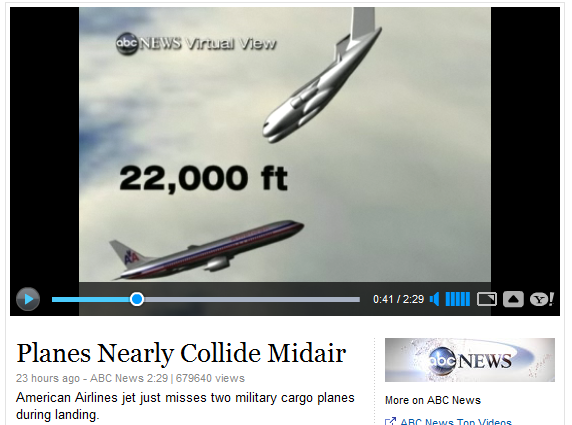
In the news this morning was a story about a near collision of a 777 American Airlines jetliner with a pair of US Air Force C-17 cargo planes. Here’s what the graphic looked like on ABC News:


Well, I realize that the important thing is that everybody is safe, but insofar as better graphics can help us better understand what happened and how to avoid it in the future, let’s talk about graphics.

The above graphic is fine for a major television network — twenty years ago. But compare it to what I can throw together in a few minutes after a visit to the Google Sketchup 3D Warehouse:

I would recommend that news media graphics departments look into using Sketchup resources. Now, there are a lot of graphics software packages that can render better than Sketchup, but consider the possibilities opened up by the resources available in Google Sketchup 3D Warehouse and Google Earth. I was able to not only download a model of a 777 jetliner, it was already in American Airlines livery too!

Also, there are third-party rendering engines that can make Sketchup models look very realistic, so perhaps even in rendering it’s Advantage Sketchup. I think the real advantages with Sketchup, however, is that you can easily move around in the model to get a more dramatic and informative view, and that with a little training anyone (even reporters themselves) can use Sketchup. And it’s free, that’s important too to the departmental bottom line!

(Perceptive observers will note that the C-17 wheel wells are missing both the wheels and doors. The model I downloaded was in wheels-down configuration and it wasn’t a simple matter of deleting the wheels to put it in wheels-up configuration as happened with the 777 model. I could fix this if I had the time — and if I was being paid.)

Posted in Uncategorized | Tagged , , , , , , , , | 3 Comments

Football on the Moon

My nephew was interested in the possibility of lunar basketball, but since this is the weekend of the Big Game (non-TM), I decided to go with lunar (American) football instead.

The simple part, of course, is to put it under a glass dome, since if Neil Armstrong proved anything other than that an 80 kg test pilot can do the job of an 8 gram microchip, it’s that spacesuits tend to limit the freedom of movement that is essential for the choreography known as Football.

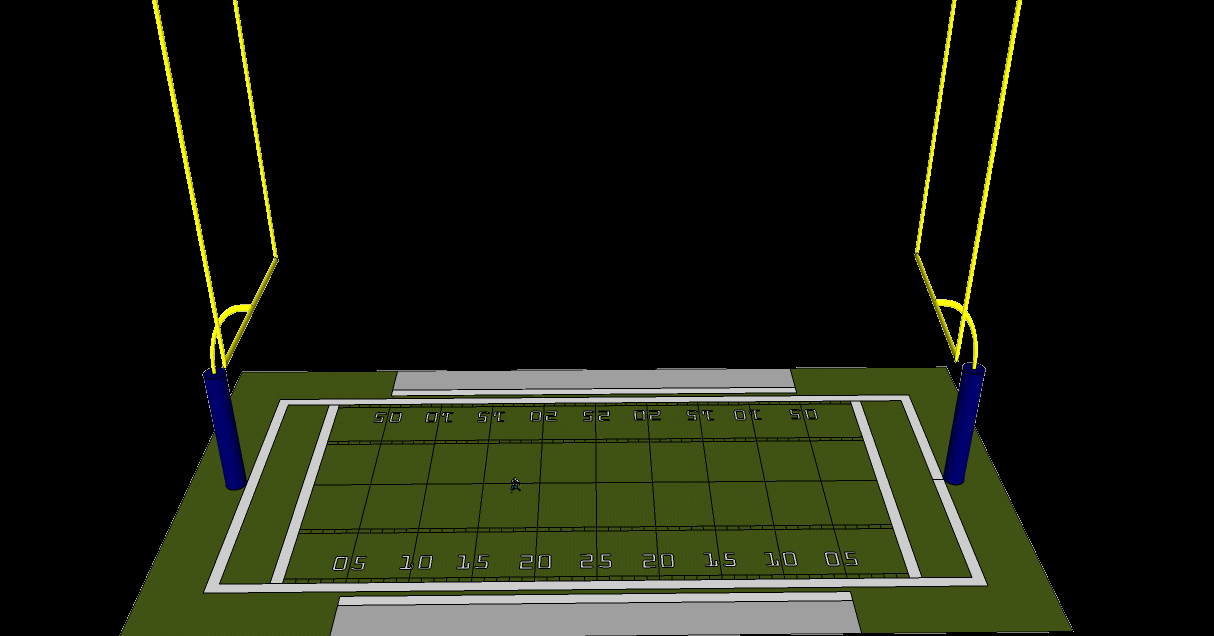
Next issue was gravity. Since lunar gravity is six times less than Earth, vertical distances are naturally six times higher. Hence the elongated goal posts:

But then it turns out that horizontal distances are another matter, because running is in some respects assisted by gravity. Too much gravity, of course, and you get squashed and aren’t capable of running very fast after that, but it turns out that gravity is actually a good thing at lesser levels, it gives you things like traction and all.

Anyhow, here are two sources for running speed on the Moon:

Energetics of Walking

“Walking, Running, and Jumping on the Moon,” New Scientist, 22 July 1965

The latter article concludes with the statement, “If a 100-yard race were tried on the Moon, nobody would approach the 10-second standard without (almost literally) a flying start. The whole distance would be used for getting up speed.” Since average speed would therefore be half of Earth sprint speed, I decided to shrink the dimensions of the field by a factor of two. (I also converted to meters, because this is happening in the Future, dude.)

Anyhow, while it would be slower in horizontal speed, the game would be much more spectacular in verticality. The human record jump of 28 inches on Earth would easily be exceeded by your grandmother on the Moon. Here is what a 140 inch jump would look like:

(Maybe you’re wondering, “Are they going to wear shorts on the Moon when they play football?” Well, I wanted to put a football player on the field for a sense of proportion, and while I found lots of European Football (= American Soccer) players in Google Sketchup 3D Warehouse, there were no American Football players save this one lone guy in his shorts. [I don’t know what that’s about and I don’t want to know.])

I’m not a football fan, but if there’s ever a Big Game (non-TM) on the Moon, I might just watch out of curiosity to see how the physics will work out.

Posted in Uncategorized | Tagged , , | Leave a comment

Amino acid progression

This slideshow requires JavaScript.

This is something that I’ve wanted to do for a while, and it will obviously take a lot more work.

The idea is that amino acids show a progression in complexity, and I’d like to put together a slide show of all the amino acids, showing this expansion.

The intention is not to show models with one hundred percent accuracy as far as angles are concerned, because after all I’m not planning to plug them into a simulation of the human cell (yet).

I don’t think a slide show is possible for all twenty amino acids, because there are branches. The progression of amino acid is tree-like, not simple linear. I’ve learned that at least.

And self-enlightenment is the goal of this exercise. Working backwards, it helps to explain how evolution might have started with utilizing one or two amino acids, and then expanded its repertoire to the twenty now in use. Working forwards, this exercise helps me to understand how different amino acids function in the construction of proteins, which has applications for nanotechnology.

I’ve got a long ways to go on this.

Posted in Uncategorized | Tagged , , , | 2 Comments

Engineer’s Dreams

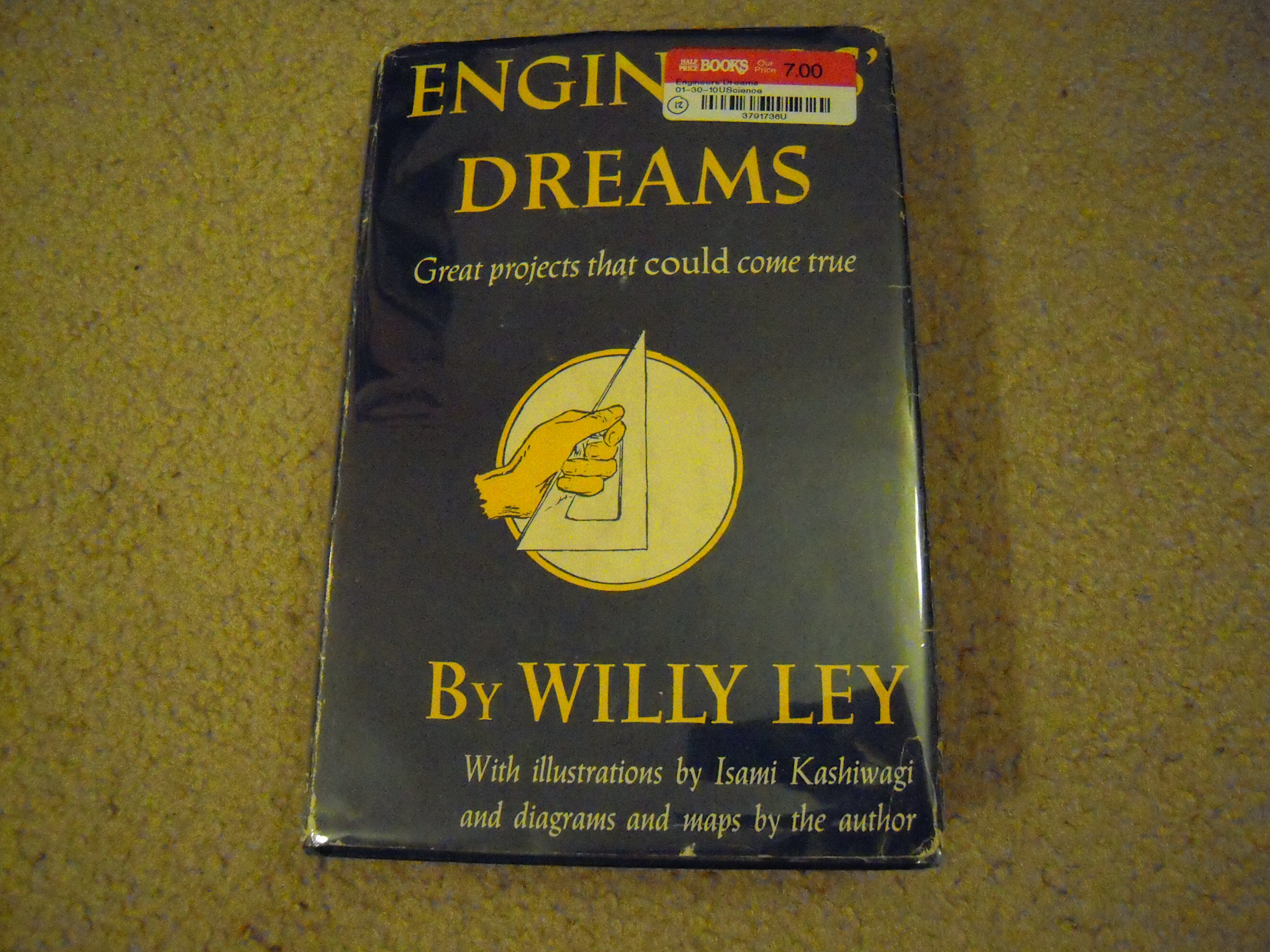
Engineer’s Dreams: Great projects that could come true, by Willy Ley (1954).

Here is a book that I found at Half Price Books that has been out of print for decades. Not only is it over fifty years old, it also is quite dated in its relevance. Which is why I found it all the more fascinating.

Willy Ley was a prominent science writer in the 1950s and 60s. Although there was some overlap, whereas Asimov concentrated on science essays, Ley was more engineering oriented. Much of his writing concerned astronautics, which is understandable since he was an associate in the German Rocket Club of the 1920s and early 30s with one Werner von Braun and other German expatriate scientists who were to lead the American space program to the Moon. Unlike the other German rocketeers, however, he headed for the door when Hitler came in, emmigrated to the United States, polished his English, and became a prolific science writer. Wonder about Werner but Willy was okay.

In this book, Ley puts aside his astronautics background and is down to Earth. Literally so, because most of the engineer ‘dreams’ concern moving earth. There’s nothing about rocket engineering, or nuclear engineering, or electronic engineering. It’s almost entirely civil engineering.

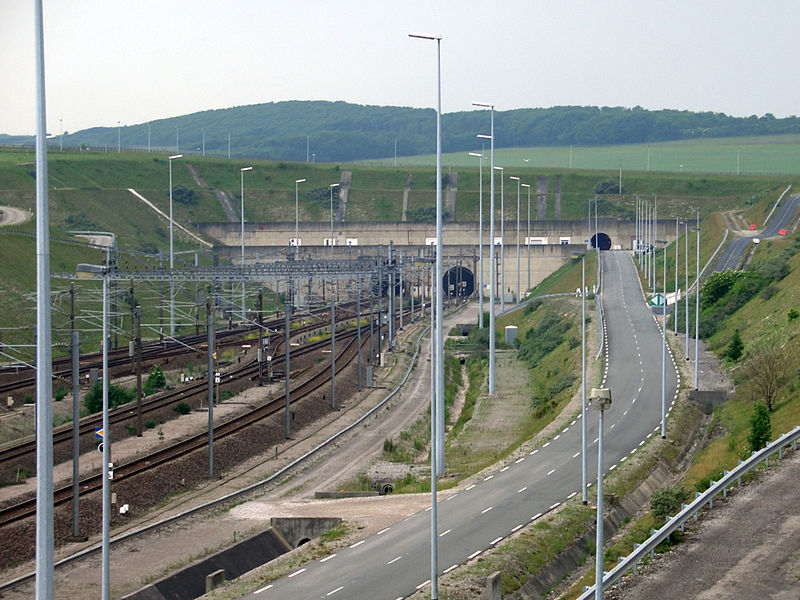
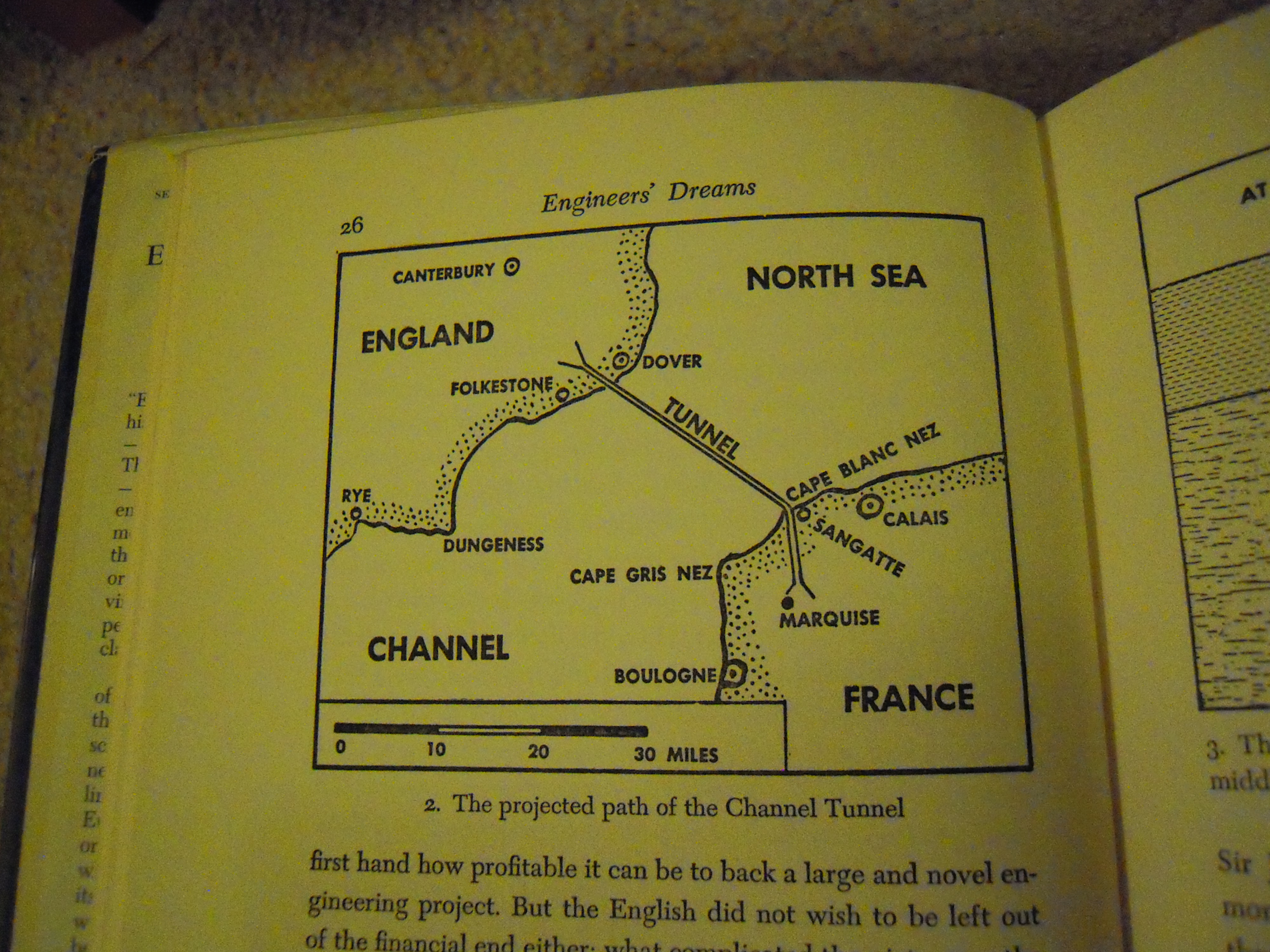
Chapter One, “Forbidden Tunnel,” is about building a tunnel under the English Channel. That’s the one ‘dream’ that really hit the Big Time, so let’s compare illustration with reality.

Hmm. Well, I don’t know about you, but it seems that some of the romance and wistfulness has been lost in the translation from dream to reality. The book’s illustrator, Isami Kashiwagi, does a great job in evoking the imagination with the sparse style forced upon him by the limitations of publishing technology in his day.

Anyhow, let’s compare ‘Chunnel’ routes:

It looks like that ‘dream’ hit the mark, albeit with a slight detour in the middle. By the way, the reason why he refers to the tunnel as ‘forbidden’ is because there was once substantial political opposition to its construction on the grounds (excuse semi-pun) that it could serve as a route for the invasion of England from the Continent. I suspect the real reason the Chunnel took so long to build, however, is because, frankly, ferry rides are more fun than riding a train through a tunnel. “Imagine, Jimmy, all the water above us!” “Right, Dad. Can I have my DS?”

I would love to show you many of the other drawings in the book, but it probably would violate some kind of fair-use copyright which serves no purpose since Ley died more than forty years ago, ironically only a few days before he could witness the Apollo Moon landing that he had anticipated for decades. But at least let me recount the contents.

Chapter Two, “Islands Afloat,” is about building a floating island out of an iceberg, or maybe a mixture of sawdust and ice. This was actually conceived in World War II as a mid-Atlantic landing field for anti-submarine patrol aircraft. Churchill himself was a strong supporter of the plan, but then the Germans lost the submarine war, and so no floating islands to this day, although there are plans afoot to build island communities out of old oil rigs.

Chapter Three, “The Tamed Volcano” is about geothermal energy and goes into detail about tapping volcanic heat in Iceland and Italy. According to wikipedia, the Nesjavellir Geothermal Power Station was built in 1987 and today delivers 120 megawatts of geothermal power. That’s fine for Iceland’s tiny population, but it’s kind of small for the output of a civil nuclear power plant.

Chapter Four, “The Valley of the Jordan,” and Chapter Five, “Africa’s Central Lake,” are all about flooding large land areas to provide hydroelectric power, transportation, and improved agriculture. And all we have to do is relocate a few million people!

Surprisingly there is no mention of doing this sort of thing in Egypt in what would later become the Aswan Dam Project.

But after you digest the thought of flooding the Middle East and Africa, the author presents us with a plan in Chapter Six, “Atlantropa — the Changed Mediterranean,” to expand Europe by damming and then lowering the Mediterranean Sea by several hundred feet. Italy doubles in size, as does the Peloponnese whose picturesque coastlines are so far inland you can longer see the beach even from the top of that cliff with that cool village with the white walls and blue domes, and even the Adriatic and Aegean Seas shrivel to become modest bays.

“How come these engineering projects reduce the Third World in size but expand Europe?” I think many of us would ask that question today, but I wonder if anyone in the American/British target audience gave it much thought back when the book was published.

The final three chapters of the book would seem quite politically modern, however, in that they discuss renewable energy.

Chapter Seven, “Power from the Sun,” is about solar energy. Photovoltaics is passsed over to discuss solar mirrors focusing on solar boilers to generate steam. I found this the most interesting chapter in the book, since hard data on power output from such systems has been hard to track down, even though such projects have become common.

Chapter Eight, “Waves and Warm Water,” is about tidal energy, the whole Bay of Fundy bit. I’m surprised Ley didn’t call it ‘Power from the Moon,’ given his background.

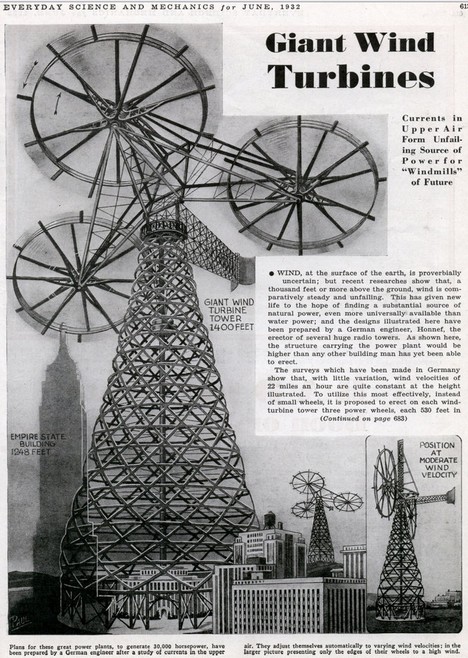
Chapter Nine, “Harnessing the Winds,” is about building big wind turbines, although the designs look nothing like the ones plaguing the English countryside today. One illustration, called the ‘Honnef Tower,’ looks like the Germans were planning to duplicate the Eiffel Tower by a factor of two and then top it off with a triangle of giant blades that are horizontal in orientation, like helicopters. I Googled, and via the Wayback machine and treehugger.com came up with this image:

[Yark!]

One can only imagine the course of World War II had the Germans during the occupation of Paris decided to transform the real Eiffel Tower into such a monstrosity. They still would have lost, but one can imagine Patton coming over the horizon and seeing that thing. “Lieutenant, get me General Eisenhower — and some scotch!”

Well, we did build the Chunnel, but wisely engineers have decided to fulfill other dreams over the past few decades than those described in Engineer’s Dreams. Wisely, that is, assuming that the Robot Armageddon doesn’t come to pass. Otherwise, we may well wish we had stuck with vacuum tubes and poured all that high-tech venture capital into a project to drain the Med. You can never have enough Peloponnese, I always say.

Posted in Uncategorized | Tagged , , , , , , , | Leave a comment