Japan Solar Energy Graphics

Sometimes it seems that nuclear power advocates are attempting to insinuate that Japan doesn’t have enough land area to use solar energy in place of nuclear energy. Here’s what the solar panel requirements actually look like.

Per person:

[Calculations: Electrical consumption per person is 8507 kwh per year. Daily consumption is 8507/365 = 23.3 kwh. Insolation at Tokyo is 4 kwh/day per square meter. PV panel efficiency is 15 percent. Panels per person = (daily consumption)/(insolation * efficiency) = 23.3/(4 * .15) = 40 sq. meters]

Here’s the graphic for all Japan:

[Calculations: Area per person = 40 sq meters. Population of Japan = 127 million. Total Area = (Area per person) * (Population of Japan)
= 40 x 127 million = 5080 square kilometers]

I don’t think it would be that difficult for the Japanese to dedicate this much land area to solar panels. Take the roofs of buildings and homes, then over roads and streets, and that should handle most of it.

At any rate, the required surface area is less than 1.4% of the total land area of Japan, and the extra crowding would certainly be less discomforting than the extra radioactivity they’re now experiencing.

(The radiation symbol is drawn to scale to cover the exclusion zone around Fukushima Nuclear Power Plant #1.)

Posted in Uncategorized | Tagged , , , | 1 Comment

Robot Arm in Sketchup

This design is based on the first iRobot photo shown here. Sketchup, by the way, is not for CAD, it’s for quickly illustrating concepts.

Sketchup can draw smooth curves as in the iRobot photo, but boxes are of course faster to draw, and also if I were to actually build this as an amateur, I would be using boxlike enclosures (rather than aesthetically-pleasing curves) to save on manufacturing costs. It would simply be a matter of cutting and welding sheet metal, which I figure I could learn how to do in less than a week.

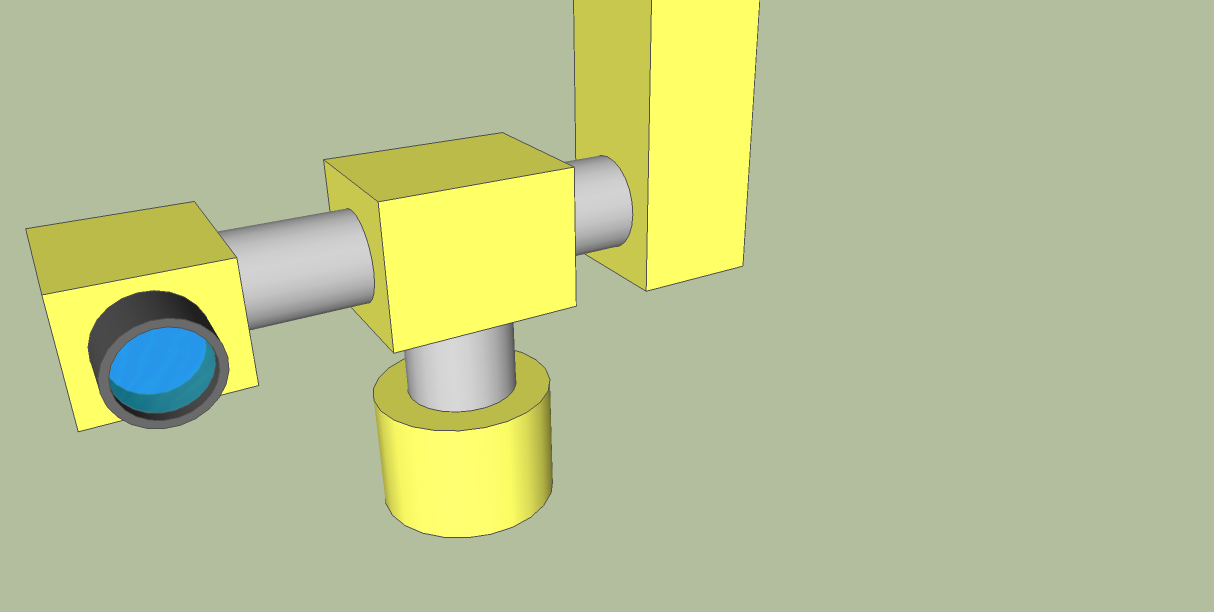
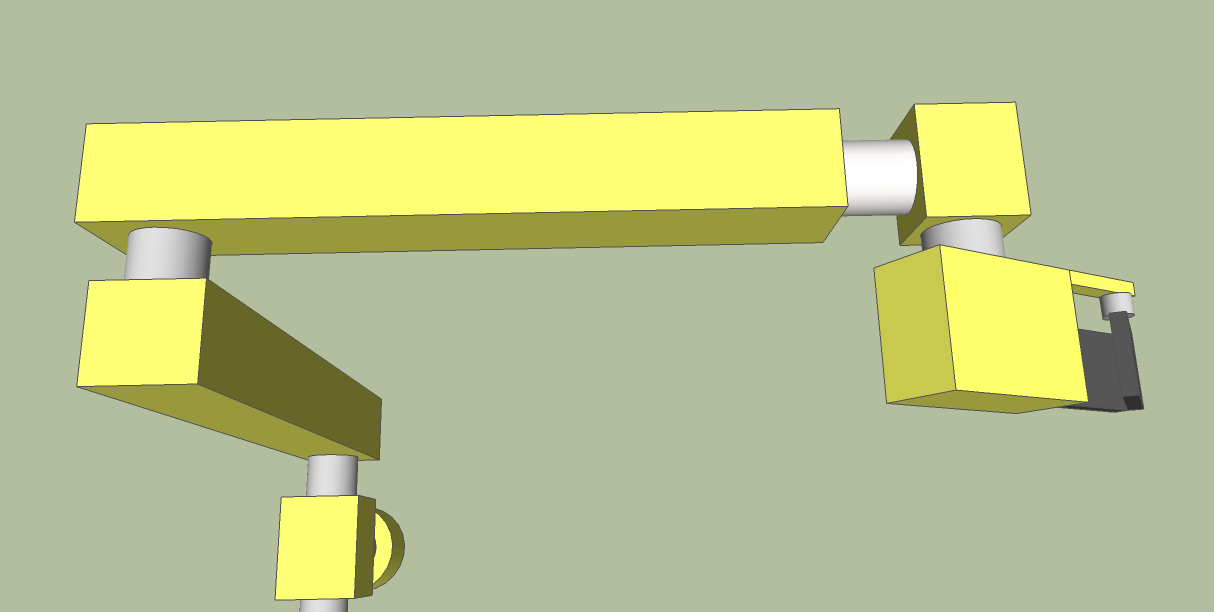
Here is the video camera. Note that the gray cylinder connectors rotate, which means that the camera box can be tilted up and down. The lower cylinder enables the entire mechanism to twist right and left, and the one on the right, of course, tilts the arm up and down.

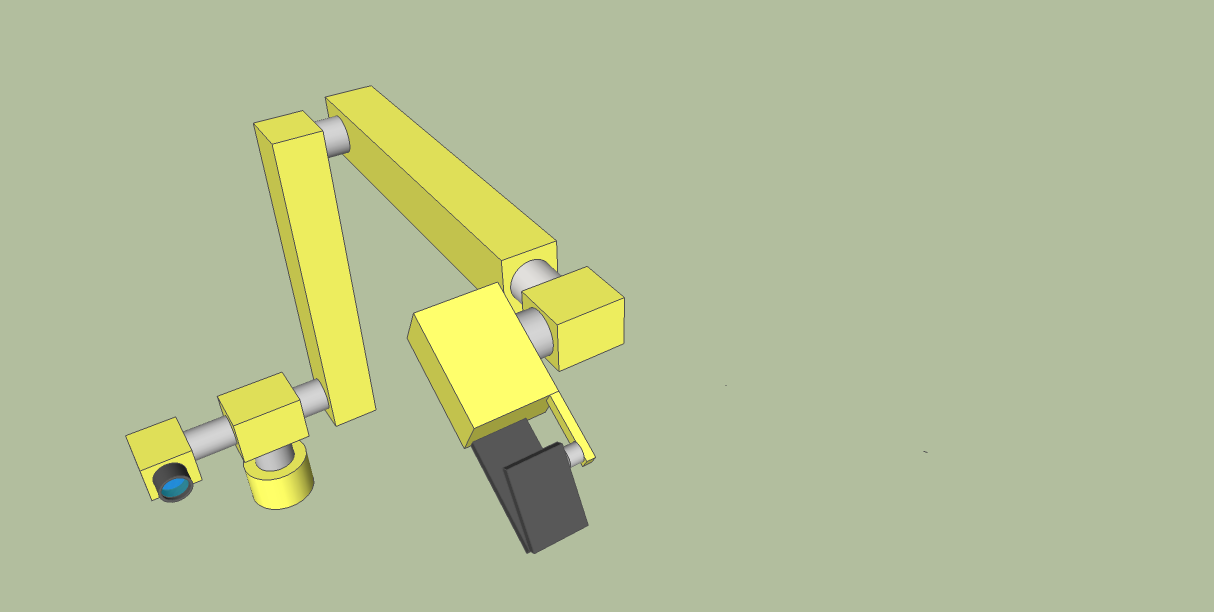
In this overhead view, we see that the cylinder on the left enables the forearm to be twisted independent of the base. This enables the arm to extend and contract its reach.

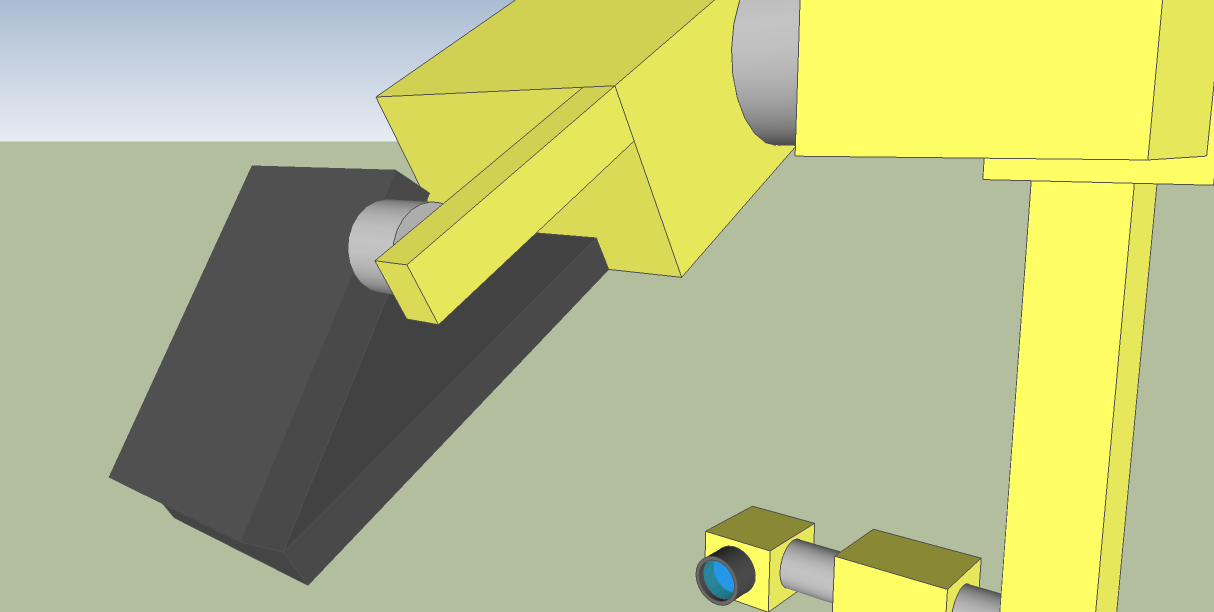
A detail of the ‘claw’ or ‘hand.’ According to the article, the iRobot is capable of lifting over two hundred pounds, which I find amazing because it doesn’t look that sturdy. If I can build an arm that can lift fifty pounds, I will be happy!

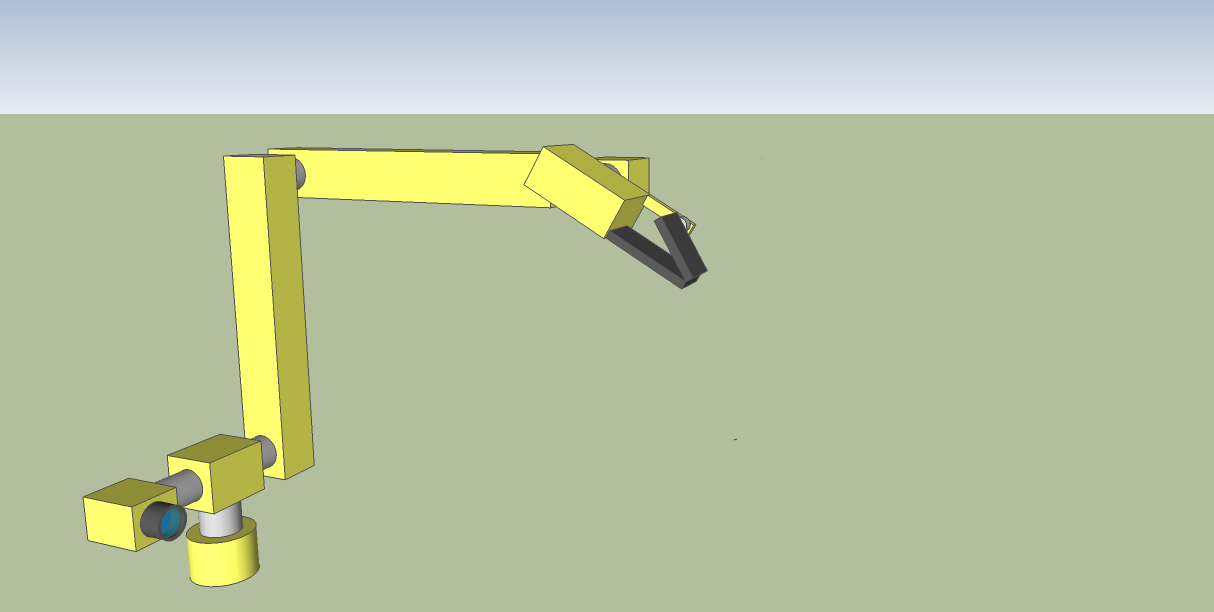
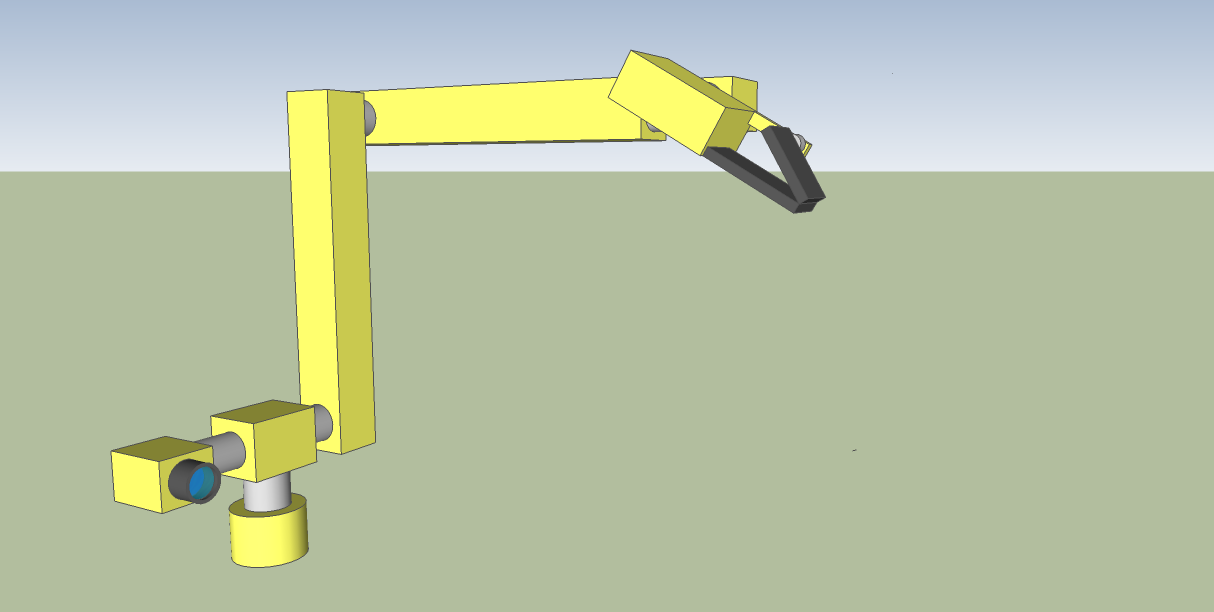
Let’s step back and again look at the side view, which suggests how easy it would be to put this on my existing robot design.

By the way, I note that one of the commenters on the aforelinked news article claimed that teleoperated robots aren’t really robots because they aren’t capable of independent action. I’m becoming aware that this is a matter of confusion with a large audience, so perhaps in the future the distinguishing term for this kind of teleoperated robot should be ‘telebot’ or ‘telbot.’ Unfortunately, if I were to use such a term now, the average person would go, “Say what?” So maybe I should stick with ‘teleoperated robot,’ but I suppose even that term is going to get puzzled stares.

I count seven cylinders in all, which is a number low enough that it can be handled by one Arduino. I guess I should read up on servos now.

Another thing I should do is learn how to do Sketchy Physics. Then I could really show off the articulation. Ah, so much to do, and so few brain cells to do it with!

Posted in Uncategorized | Tagged , , , , , , , | Leave a comment

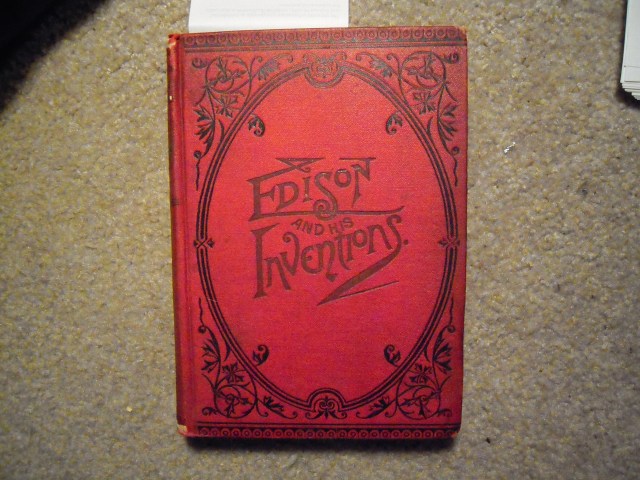
Edison and His Inventions (an 1894 book review)

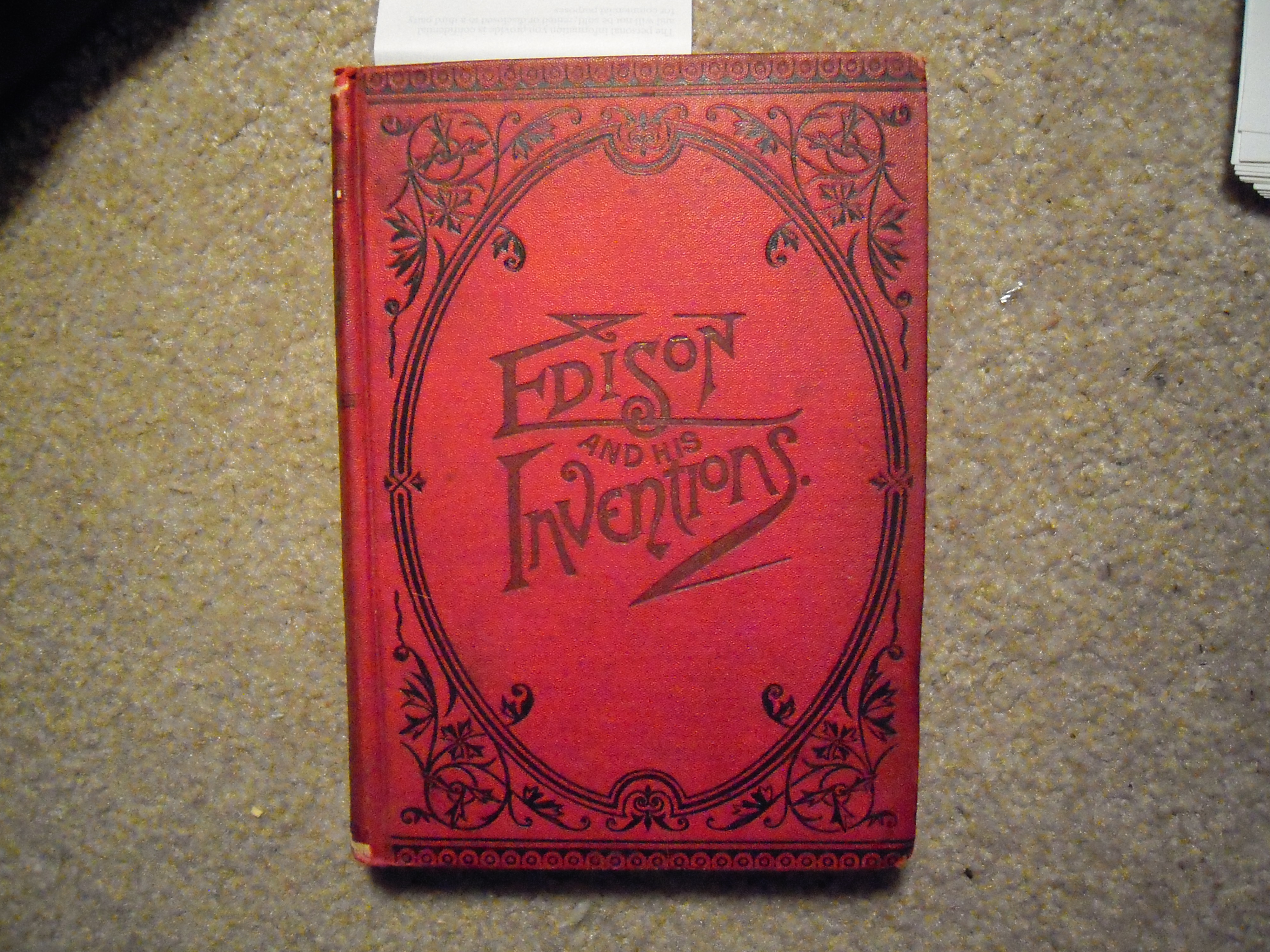
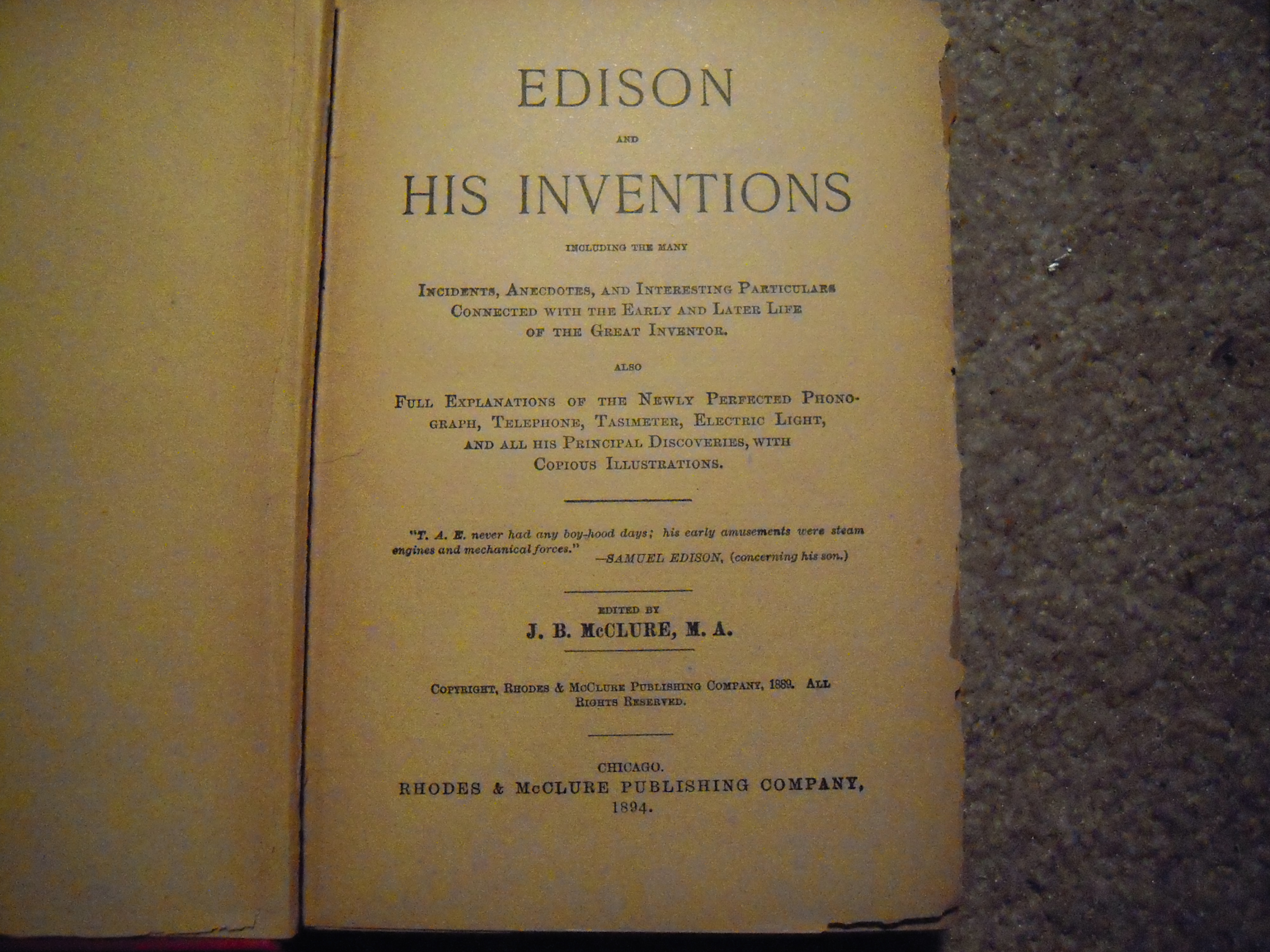
While prowling in the local Half Price Books, I came across this book. This is not a reproduction of an 1894 book, it is an original, and it only cost me $25. I feel pleased.

Here’s the title page, which gives you a taste of what it’s all about:
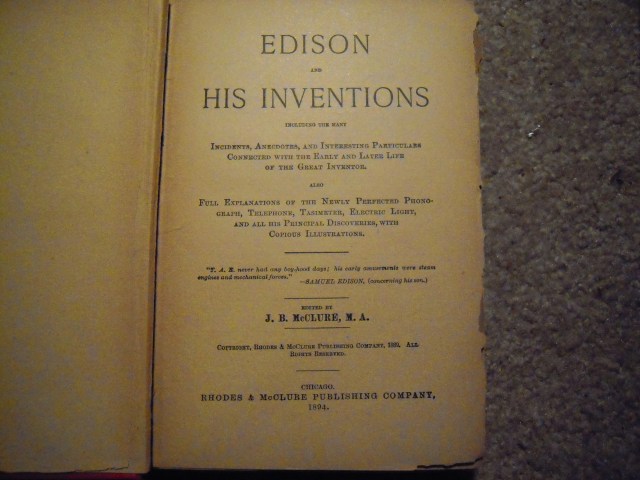
At the time of publication, Edison was still in his mid-forties, and the War of the Currents had been waged at the Chicago Colombian Exhibition the previous year. But you won’t find elaboration of Tesla here. This is a literary ode to Edison.

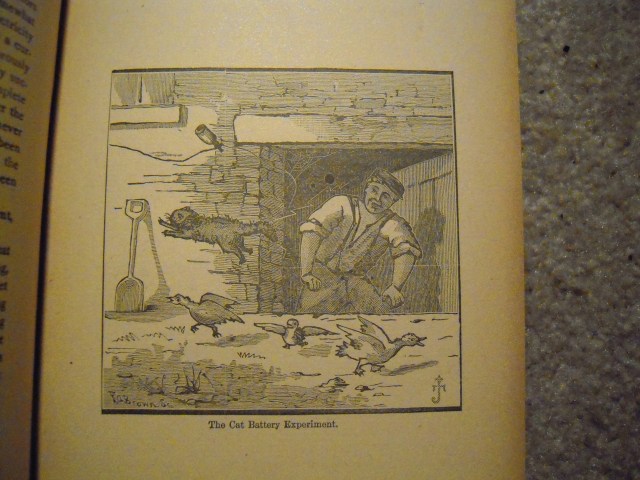
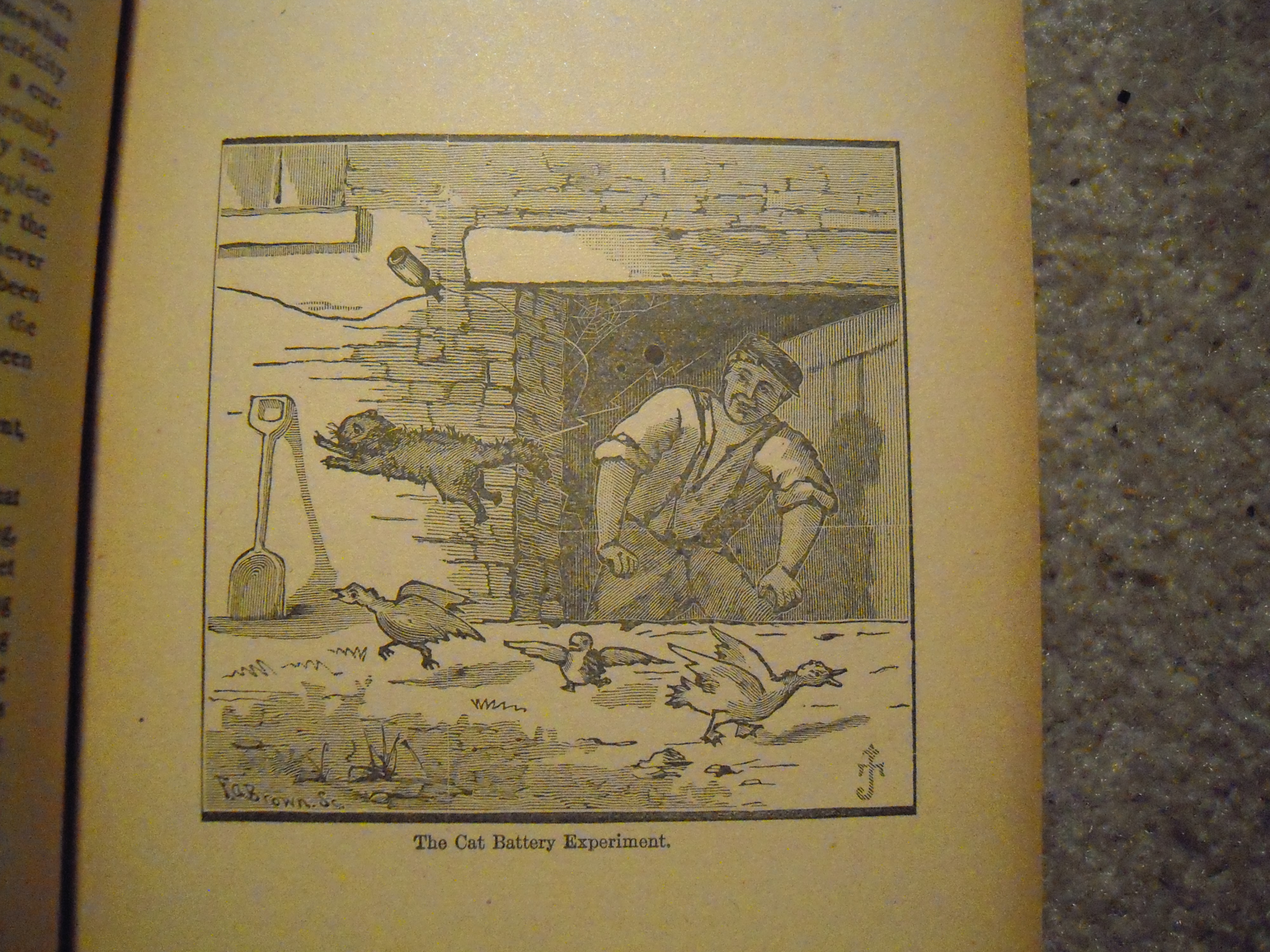
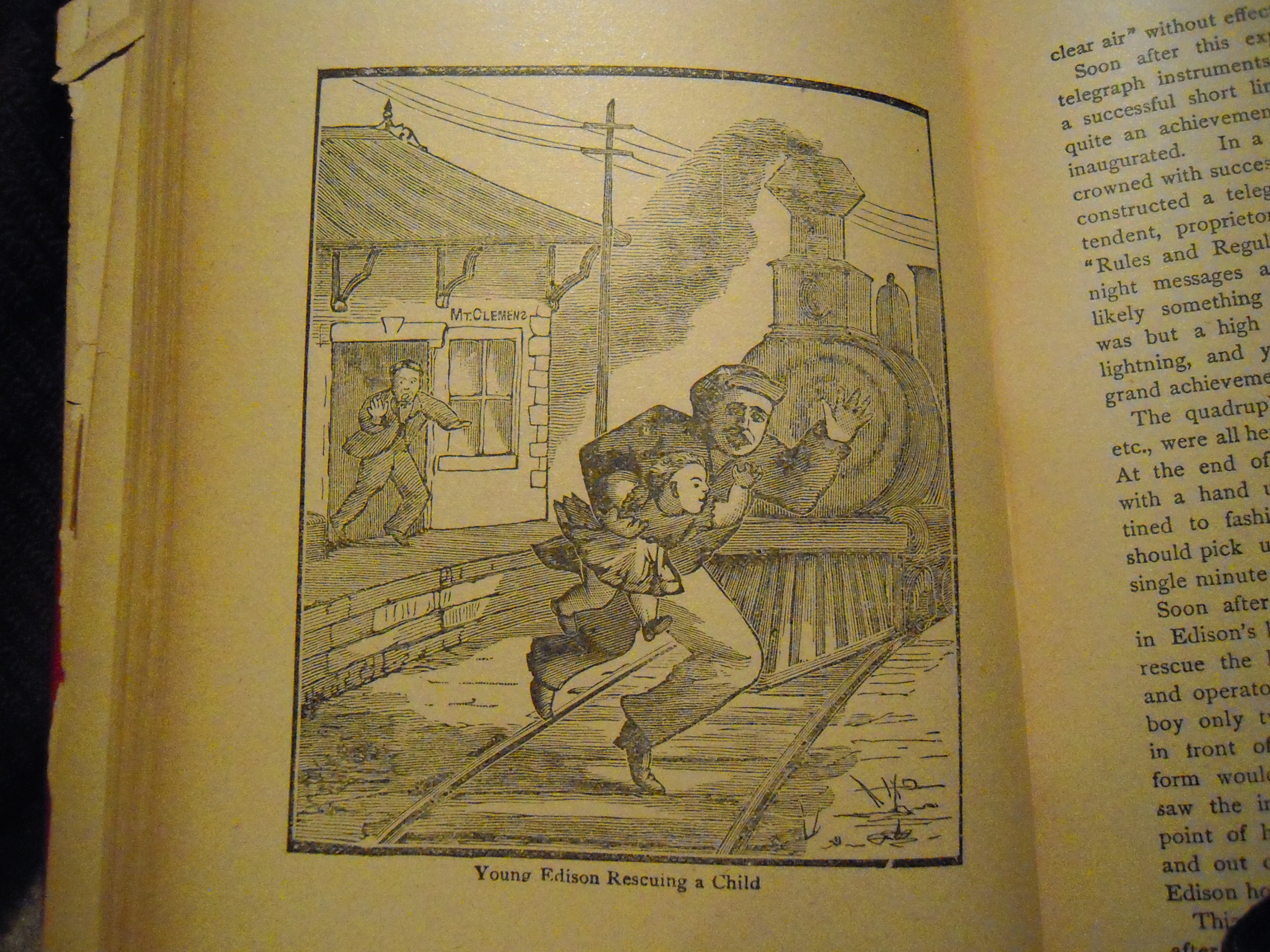
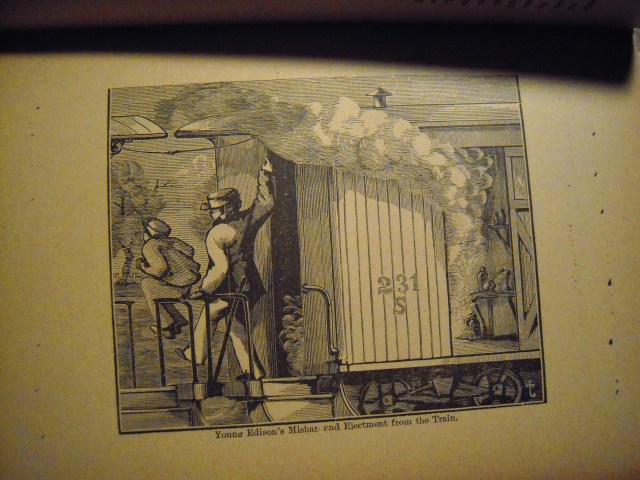
Edison, it seems, was quite the scamp as a child. He was always experimenting with things and causing mayhem with fires, explosions, etc. This did not ingratiate him with others, as we can see from these illustrations:
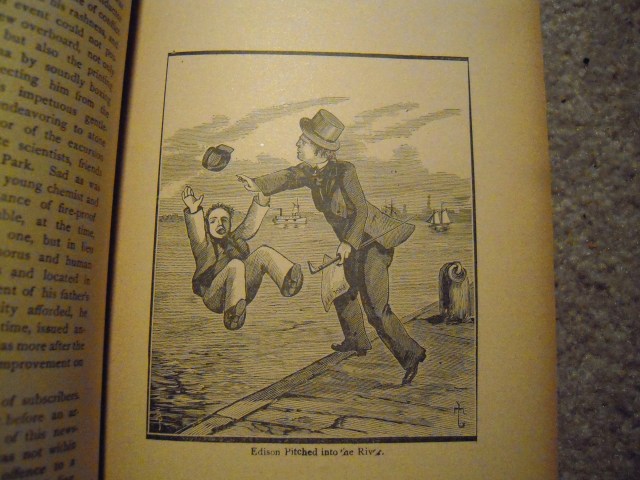
Well, at least the cat didn’t push him around. In any case, lest you think Edison was a juvenile delinquent, there is this charming tableau:

Okay, so what did Edison invent — I mean, besides crazy stories about his childhood?

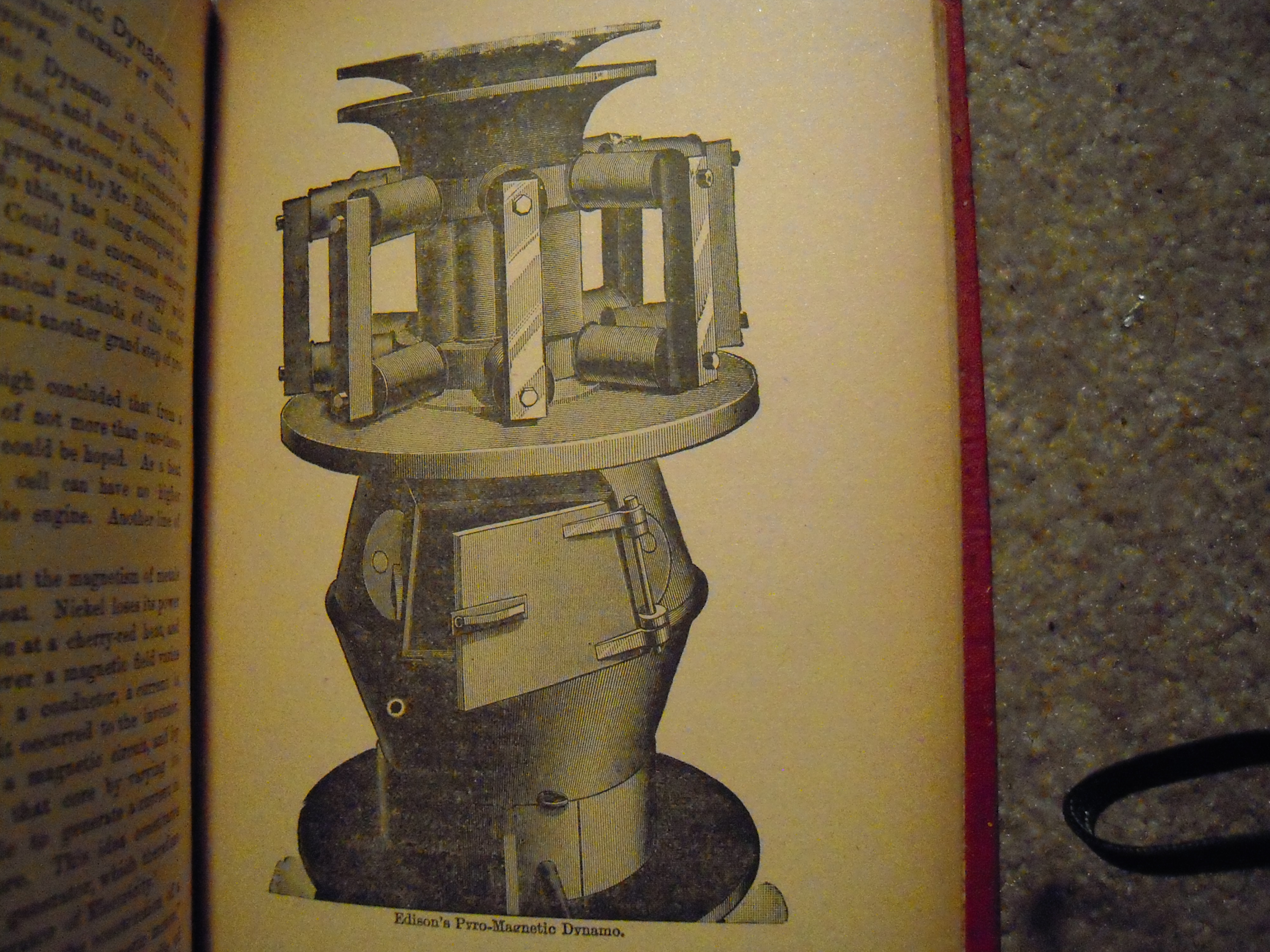
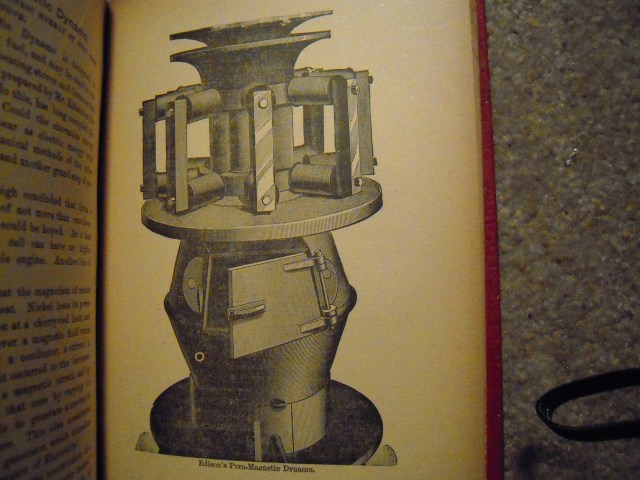
Well, he is credited with inventing the electric light, but as we all know by now, he was more an innovator in that. Still, the book recounts an impressive list: the New Edison Dynamo, the Pyro-Magnetic Dynamo, Train Telegraph, the Mimeograph, Etheric Force (“a new discovery”), Tasimeter, Harmonic Engine, Multiplying Copying Ink, and of course, The Sonorous Voltameter.

You know, there are times when I wondered if the author was making some of this stuff up. But at least with the saner stuff, there are schematics:
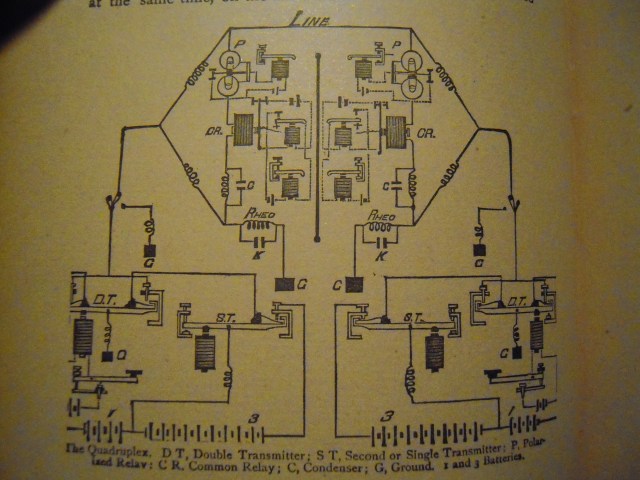
This is for the ‘quadruplex,’ which apparently allowed four telegraph messages to be sent at the same time on the same wire. Big deal a hundred and twenty or so years ago, but not so much in use now that even Third World countries have cell phone networks.

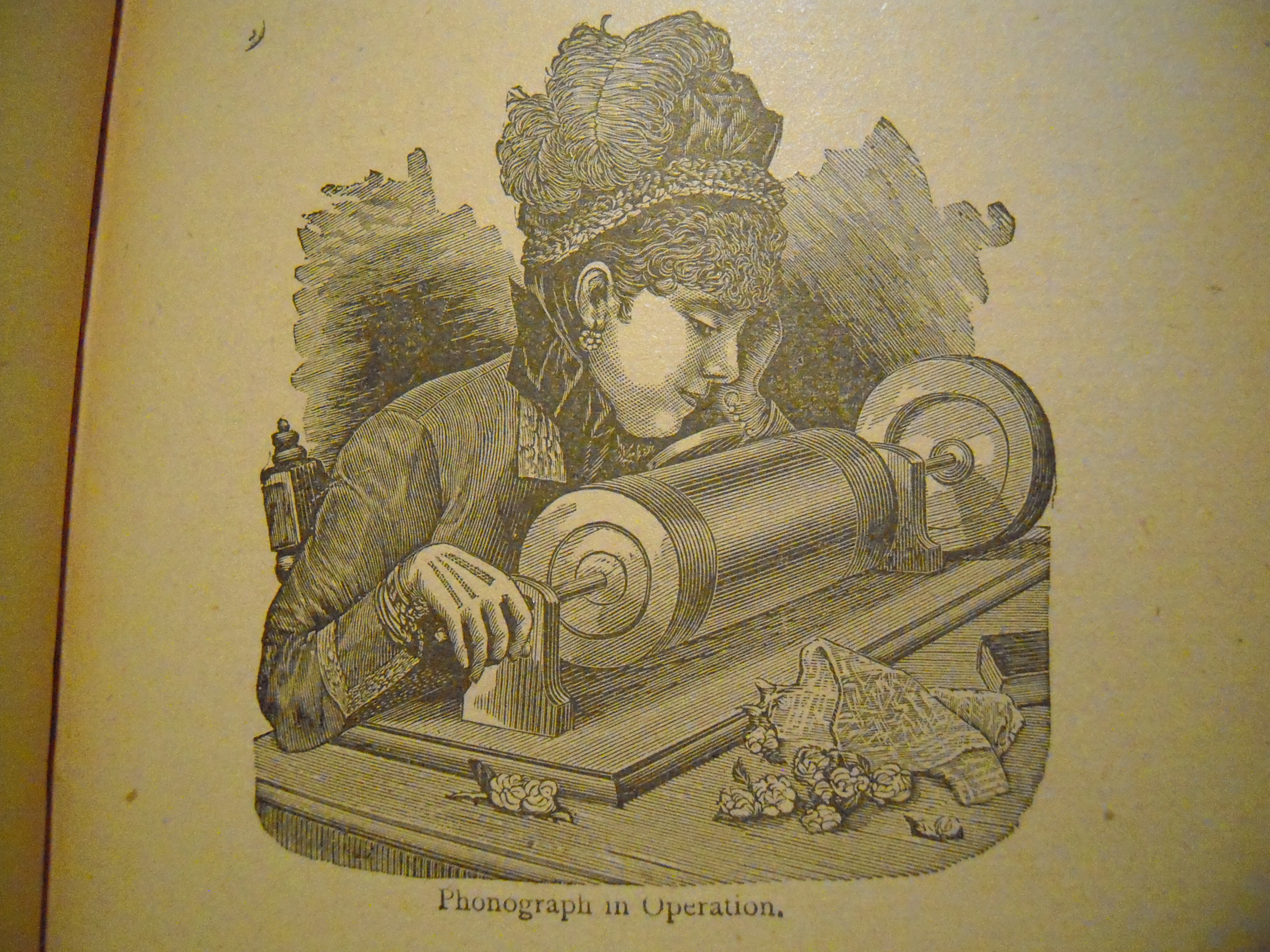
The biggest deal of all back then was the phonograph, and you can tell just how big it is by looking at the expression of this devotee:
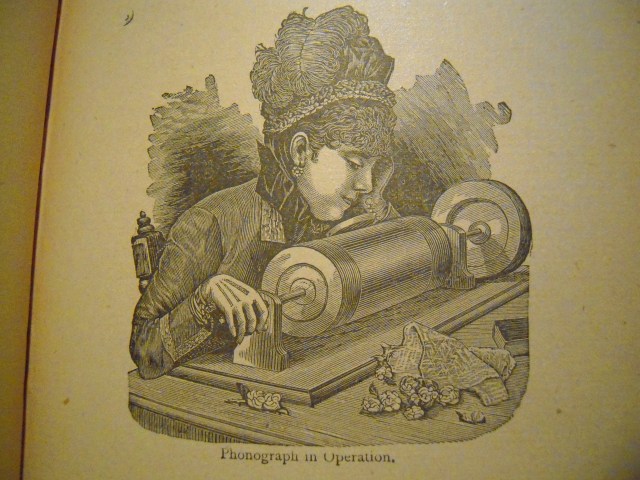
Well, I think she’s enamored of the phonograph. Are those poppies on the table?

This book gets so random sometimes. There’s a long section on jokes about the phonograph and the telephone, and some embarrassing jokes in ethnic dialect. I wouldn’t precisely call it racist, but it’s . . . embarrassing.

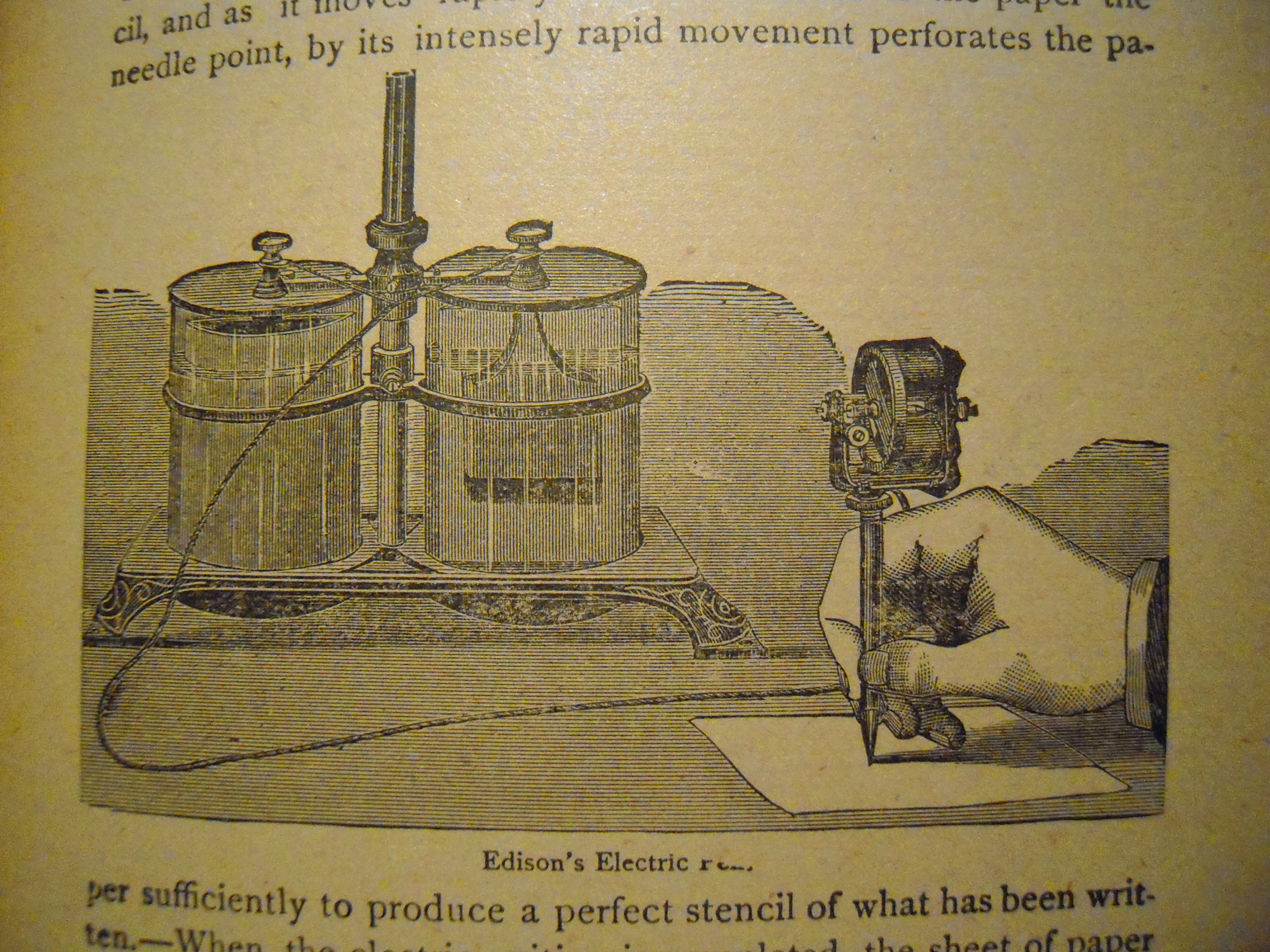
Anyhow, here’s the Electric Pen:
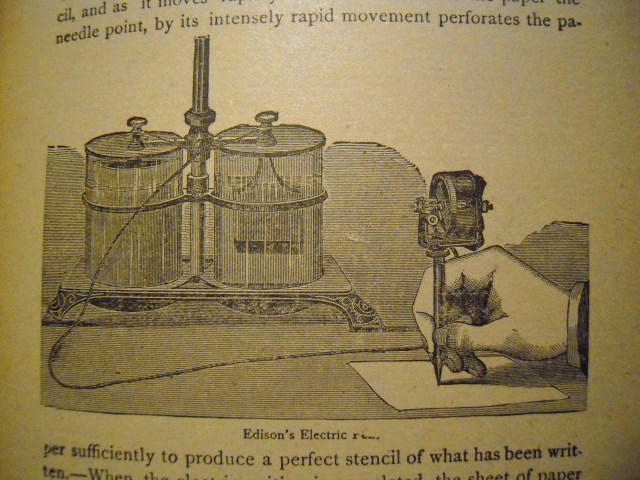
I never saw one of these while growing up. Just about everything Edison invented has become obsolete by now, and this was one of the earliest victims of the march of progress. Still, it looks kind of cool. The sort of thing that Make would have an article about.

Here’s a little flavor of how the focus of technological innovation in the nineteenth century differs from that in the twenty-first:

The clearness of the phonograph’s articulation, Mr. Edison says, depends considerable upon the size and shape of the opening in the mouthpiece. When words are spoken against the whole diaphragm, the hissing sounds, as in shall, fleece, etc., are lost. These sounds are rendered clearly, when the hole is small and provided with sharp edges, or when made in the form of a slot surrounded by artificial teeth.

I’m sure engineers at Apple encountered similar technical issues for the iPhone.

Now here’s the schematic for the electric light:
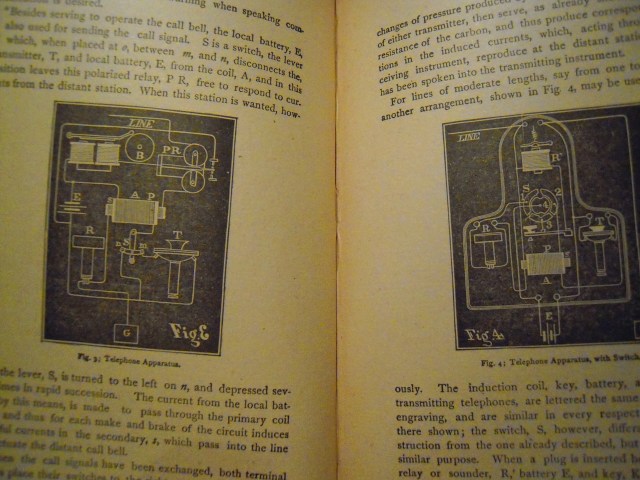
Notice, there’s nothing on the schematic about “Japanese Bamboo” for the filament, which modern technology historians identify as the real breakthrough which established Edison’s claim to fame for ‘inventing’ the electric light. Prior to JB, filaments burned out in a few hours, rendering electric lights as laboratory toys. After JB, filaments lasted for many days and electric lights spanned the continents.

The fun stuff in this book are the more obscure inventions, like the micro-tasimeter, which Edison invented to measure the temperature of stars. Did you know Edison was into astronomy? Quite a few pages in this book cover it, so evidently he was a proud father of this invention:
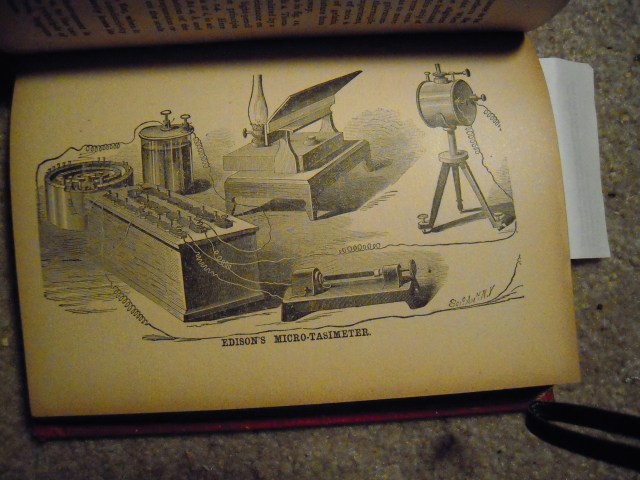
As you might have guessed by now, what I like most about the book are the illustrations. And not so much of the inventions as the glimpses it provides of A Lost Time. For example, here is a dynamo room, perhaps not so different than dynamo rooms today but consider that this was so novel back then that it appeared in a book aimed toward a popular audience:

Some of the shapes of this technology haven’t changed in a century — note the conduits on the ceiling — but obviously the proportions of the machinery have changed a great deal since Edison’s time.

The decision to include some illustrations in the book reveal far more about the intended reading audience than Edison. For example, the author thought that people would be interested in seeing illustrations of Edison’s buildings, like so:
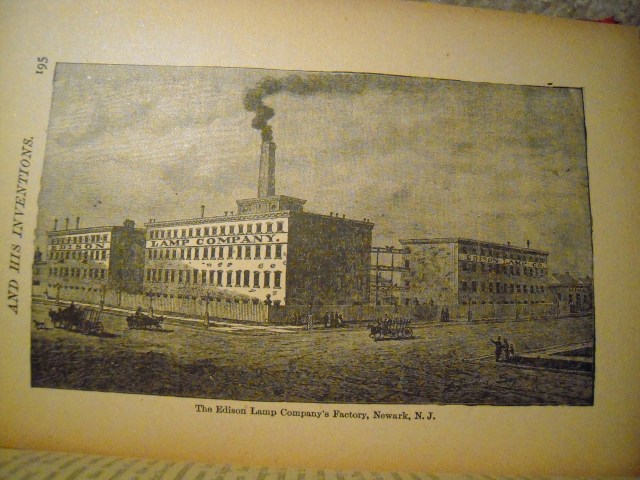
This picture reminds me of a Mystery Science 3000 episode, where Joel and the robots are watching a movie from the 1930s and there’s a scene in a stadium, and Tom Servo says, “Everyone in this scene is dead.” Yep. The little boy grew up, and now even his grandchildren are probably dead. I wonder where the dog went, or if it even existed other than in the illustrator’s mind as a counterpoint to the magnificence of the Edisonian edifice. Was this illustration based on a photograph or camera obscura? No matter, Edison’s legacy looms over all, saying, “You have been lost to oblivion, but I shall endure.”

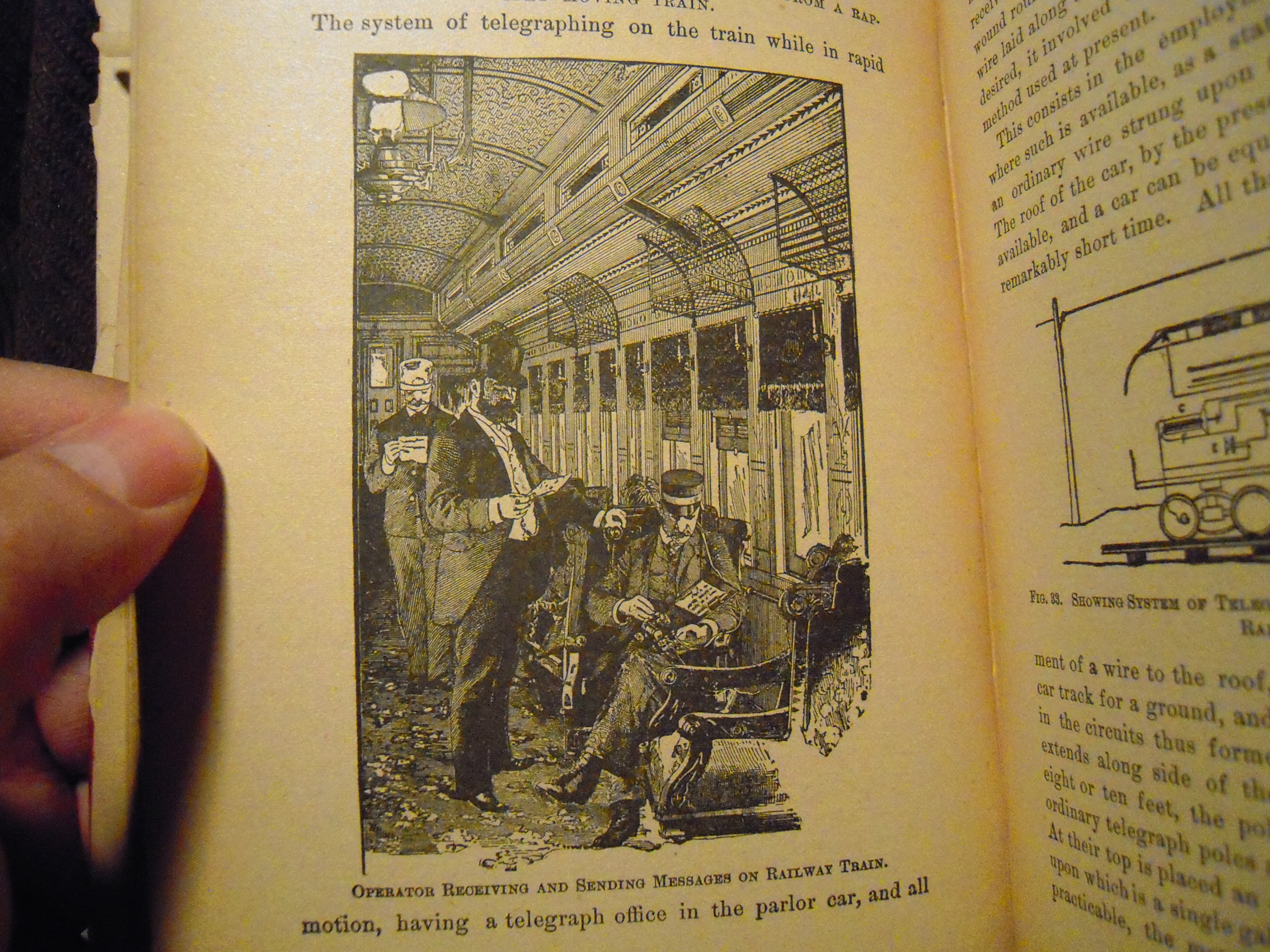
Well, for a while longer, perhaps. But then there’s this scene, in which a passenger aboard a train engages an Edison invention to telegraph while in transit:
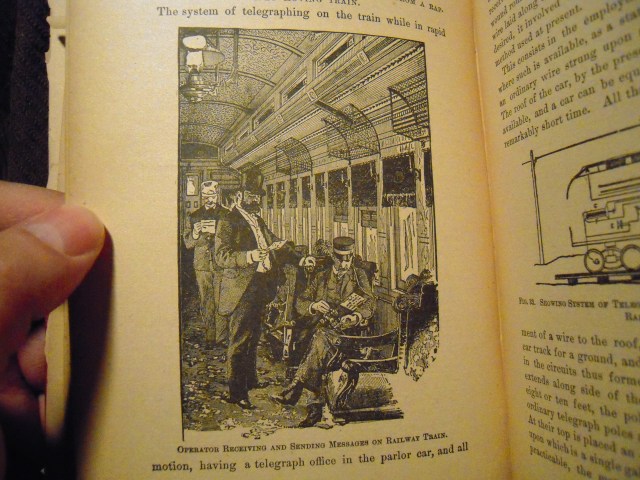
To be sure, a valuable innovation in its time, but not much use for it anymore — nor for the Edisonian process of reproducing sound waves by scratching vinyl. It serves as a reminder of the transitory nature of engineering glory.

Could the day come when Edison is forgotten? Maybe he should have spent a little time talking about death rays and communicating with Martians. That seems to have secured immortality for Tesla.

Tesla has also gained a lot of street cred in the anti-patent community, which is odd, because I don’t think Tesla ever spoke against patents. On the other hand, this book concludes with Edison’s anti-patent remarks: “I have become extremely skeptical as to the value of any patent, and so long as our patent law remains in its present iniquitous shape, I shall try to do without patents.”

And then he really lets loose:

The present law is a constant temptation to rascals, and virtually offers a premium on rascality. Under it the infringer of a patent is not interfered with until the real owner can show that he has the monopoly of the device in question. The process may take years, during which the infringer, who has money and audacity enough to secure another man’s invention, can go on and perhaps wear the rightful owner’s life out by litigation and annoyance.

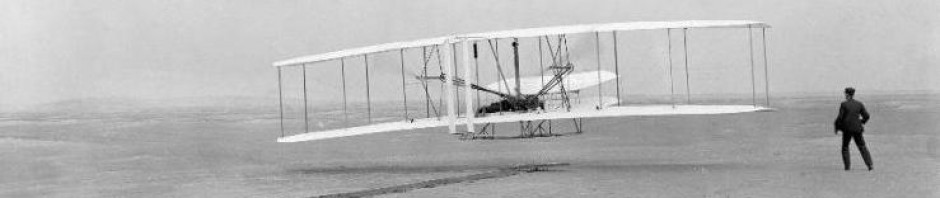
Indeed, Wilbur Wright is thought to have died prematurely in part because of the stress of patent fights over the invention of the airplane. But as for Edison, I suspect that the historical record is that he did not keep his resolve and there were many more patents to come in the decades he had yet to live.

Anyhow, this book is an interesting glimpse of a technological lost world of electric dynamos carried in horse-drawn carriages, of carbon diaphragms being state of the art, of sonorous voltameters, and incredulity that machines could reproduce voices and send them anywhere at the speed of light.

Which, when I think about it, is pretty incredible. Given that we take it all for granted now and have lost our sense of wonder, perhaps we deserve to have lost the secret of how to directly convert burning coal into electricity:
Well, to tell you the truth, there are some passages in this book that made me wonder whether the author wasn’t quite accurate in taking notes when he interviewed Edison, or maybe he didn’t interview Edison at all and just cobbled this book together from unattributed newspaper clippings from reporters who did talk to Edison but still weren’t quite accurate in taking notes — and may have committed a little ‘inventing’ of their own along the way.

But what the transcriptions indicate that I do find it credible is that for all his electrical inventions, Edison really had less of an understanding of the nature of electricity than the typical high school student today. Perhaps that’s why reading some of the ‘explanations’ of how his inventions work tend to be less than enlightening. And once again, I am confounded with just how far a person can go while having only the sketchiest idea of where he is going.

Anyhow, there’s a scanned version of this book on Amazon and at the time of this writing there is also a first edition (1879) available on eBay, where it’s bidding $124 at the moment — which kind of makes me wish I hadn’t crumbled so many pages while reading mine. But I doubt that my 1894 edition would command as much. Besides, it’s not for sale. I need it for guidance.
Posted in Uncategorized | Tagged , , | Leave a comment

Here come the robots

Daily Mail: Pictured: The robots called in to help prevent nuclear meltdown at Fukushima plant

As I suggested a week ago:

Posted in Uncategorized | Tagged , , , , | Leave a comment

The Nuclear Renaissance is dead and Moore’s Law killed it

Ramez Naam runs the numbers and finds that in ten years, while that nuclear power plant in your backyard will still be unfinished, solar power will have become cheaper than coal power:

Smaller, cheaper, faster: Does Moore’s law apply to solar cells?

Posted in Uncategorized | Leave a comment

Bottle Cap Buzzy Glow Toy

Take a plastic bottle cap and make it buzz and glow. Flip it over and here’s the internals:

The bottle cap I have in mind is the plastic one that comes on top of one-gallon water jugs.

The 3 volt motor sells for $4 at Radio Shack. That’s the big expense item. The biggest challenge, in my limited experience, will be concocting a battery holder.

And yes, this toy is similar to the hexbug nano. But I want to expand on that capability, not just make a DIY version of a pre-existing toy but also make it cooler as well.

I’d like to put some kind of translucent design on the top of the cap, and then I’d like to modify the circuit so it could blink and turn on and off when a flashlight beam is shone on a photoresistor.

Posted in Uncategorized | Tagged , , , , , , | Leave a comment

Would GE make more money by decommissioning reactors?

In the United States today, there are thirty-five boiling water reactors, of the same type as at Fukushima.

Nuclear decommissioning costs around $325 million per plant. So if all the GE plants were to be decommissioned immediately, GE (which would be awarded the decommissioning contracts since it’s its design), would have revenues of 35 x $325 million = $11.4 billion.

Of course, with a little discreet lobbying, I’ll bet that GE could choreograph Congress into ‘forcing’ it to engage in a more cautious decommissioning process, which could cause the cost to rise to $1 billion per plant.

In other words, by shutting down nuclear power tomorrow, GE could have short term revenues of $35 billion.

Alternatively, it could keep trying to build nuclear power plants. Over the past thirty years, it has been able to clear political hurdles in order to have only one new reactor built. Let’s see, cost of new reactor is $6 billion, divided by thirty years . . . is $200 million/year.

And let’s face it, the political hurdles just got a lot higher.

So if I were the CEO of GE, I think I would now suddenly have the ‘courage’ to call not just for a moratorium on building new reactors, but also for the immediate decommissioning of all GE reactors. That would boost profits by approximately 1500%.

But how do you phase out nuclear power without causing a renewed energy crisis that leads to economic collapse? Well, that’s the sweet part. All you have to do is get out of the way, and solar energy will take over the energy market within the next five to ten years.

According to wikipedia:

As of 2010, solar photovoltaics generates electricity in more than 100 countries and, while yet comprising a tiny fraction of the 4.8 TW total global power-generating capacity from all sources, is the fastest growing power-generation technology in the world. Between 2004 and 2009, grid-connected PV capacity increased at an annual average rate of 60 percent, to some 21 GW

In other words, global solar power is .5% of total power, and at a 60 percent annual growth rate, it will reach ten percent in five years and 100 percent in ten years. So even at current trends, solar power was going to make new nuclear plant construction unnecessary within the next decade.

Breakthroughs in solar power technology will soon render solar power as cheap as paint (because it will be paint). How is the nuclear industry going to compete with that? Big as GE is, I don’t see it winning a battle against the Sun.

Now, there are some things that GE could do to speed up the process. It could for example, promote solar power boondoggles. No, wait, that would actually slow solar power development.

How about, GE promotes tax legislation to provide deductions for home solar power installation? And deregulating and streamlining the home installation process? And maybe, ahem, licensing patents on key solar technologies rather than hiding them in the vault in the vain hope of promoting nuclear power instead?

I don’t know. I’m just looking at the numbers. Thirty-five billion dollars for decommissioning US nuclear plants, versus maybe nothing for building another nuclear plant after all the legal fees are paid.

And of course, if one of those reactors goes haywire, will the public demand that GE pay? And if a city is irradiated, will the government be able to let the CEO off the hook like it did with the Banking and Gulf Spill crises? Or will it need a scapegoat this time?

Maybe the CEO of GE won’t back down from nuclear power because of human pride. Well, suppose a group of hedge fund managers were to get together, and use their GE stock leverage to oust the CEO. Then they put in a new CEO, who declares he wants to shut down all reactors. GE stock will plummet, at which time the hedge fund managers buy up all the outstanding shares of GE. Then the government announces $35 billion (or more) in decommissioning contracts to GE, and GE stock bounces back and goes through the roof, and the hedge fund managers are looking pretty sharp at that point.

Well, I’m just a little engineer and don’t know anything about the world of high finance. I really don’t even have much of an idea of how the world is really run or who really runs it. But I do know that, in the aftermath of Fukushima, a little radioactive rain falls upon us all. And for whoever is running the world, it’s also falling upon his lawn. And that’s probably annoying to him. I wouldn’t want to be the person or persons held responsible for causing that annoyance.

Posted in Uncategorized | Tagged , , , , | Leave a comment

Fukushima: Cooling pools successfully doused

The Nuclear Energy Institute reports:

UPDATE AS OF 10:00 A.M. EDT, SUNDAY, MARCH 20:
A two-part operation to spray water into the used fuel pool at Fukushima Daiichi reactor 4 ended just before 7 A.M. EDT. Japan’s defense ministry announced that the Self Defense Force discharged more than 100 tons of water at the pool, and concluded that much of it reached inside the reactor building.

read more here.

Posted in Uncategorized | Tagged , , , , | 1 Comment

Robots at Fukushima: a clash of cultures

From Salon Magazine: Where are the robots at the Fukushima Daiichi power plant?

Japan employs more robots than any other country . . . So why are human beings manually pouring water over the reactors at the Fukushima Daiichi power plant?

Well, it’s complicated.

The article proposes that robots aren’t being used because of cultural bias. “The case against robots being used for critical duties is buried deeply in Japanese culture . . . . ”

You’ll have to read the whole article to believe it, and by that I mean: to believe it was actually written and actually published. Sometimes Americans have appalling ideas about other people’s cultures, and I will stop there.

No, as soon as the Japanese Self-Defense Force came on the scene, the offer to use robots from iRobot in the United States was quickly accepted. The Japanese government, obviously, is not impeding the use of robots.

If there’s a cultural problem in Japan against using robots in this operation, it resides entirely within the corporate culture of that nuclear plant. And that corporate culture was imported from America along with the design of the Fukushima nuclear plants.

I was briefly in the nuclear power industry about thirty years ago as a civilian employee in the navy nuclear program. Since military personnel often go on to jobs in the civilian nuclear industry, I’ll assume the culture works much the same on the civilian side too. Without going into my own failures and frustrations too much, I’ll say that the nuclear training program emphasized rote memorization of hundreds of pages of reactor plant procedures. There’s basically a procedure for everything, and originality is discouraged.

So what happens if the situation goes off script?

Well, along with the people who just have poor memories (me), all the free spirits and creative types and risk takers left the program a long time ago. What you have left are a bunch of people who are basically acting as meat robots.

Now, part of their delusion is to believe they are ‘effing animals’ (as one such engineer described himself, with the actual word of course), and they do use outrageous obscenity and gross humor a lot and cut loose when they’re off the job — but on the job, they’re basically meat robots, following every line of the reactor plant manual to the letter. They define professionalism as rigid adherence to the script.

Now the situation has gone off script, and they don’t know what to do.

It’s not that they’re anti-robot, and it’s not that they’re anti-creative, either. It’s just that when it comes to their profession, they’ve had all the creativity and initiative programmed out of themselves by the nuclear power industry’s corporate culture.

I hope the military will take charge, and think outside the box. Because the solution to this one sure isn’t in the manual.

Posted in Uncategorized | Tagged , , , , , , , | Leave a comment

The Best SuperMoon Photo Ever (or am I biased?)

Taken with my cell phone around 9:30 last night. Hey, at least it’s not a ‘file photo!’

Posted in Uncategorized | Tagged , , | Leave a comment