
Blogroll
-
Recent Posts
Archives
- March 2025
- February 2025
- January 2025
- December 2024
- March 2023
- February 2023
- November 2022
- September 2022
- August 2022
- April 2021
- July 2018
- June 2018
- May 2018
- December 2017
- September 2017
- August 2017
- February 2017
- June 2016
- May 2015
- April 2015
- March 2015
- December 2014
- October 2014
- September 2014
- June 2014
- May 2014
- April 2014
- March 2014
- February 2014
- January 2014
- December 2013
- November 2013
- October 2013
- September 2013
- August 2013
- July 2013
- June 2013
- May 2013
- April 2013
- March 2013
- February 2013
- January 2013
- December 2012
- November 2012
- October 2012
- August 2012
- July 2012
- June 2012
- May 2012
- April 2012
- March 2012
- February 2012
- January 2012
- December 2011
- November 2011
- October 2011
- September 2011
- August 2011
- April 2011
- March 2011
- February 2011
- January 2011
- December 2010
- November 2010
- October 2010
- September 2010
- August 2010
- July 2010
- June 2010
Meta
Fukushima and Teleoperated Robots (Video)
Posted in Uncategorized
Tagged fukushima, meltdown, robotics, telebots, teleoperated robots
3 Comments
Nuclear Expert: “Get a camera in there!”
Frank von Hippel, a genuine nuclear expert, talks with Rachel Maddow:
He mentions that the problems are that ‘too much’ of the roof is intact to get hoses in, and they can’t see where to shoot the water until they get a camera in.
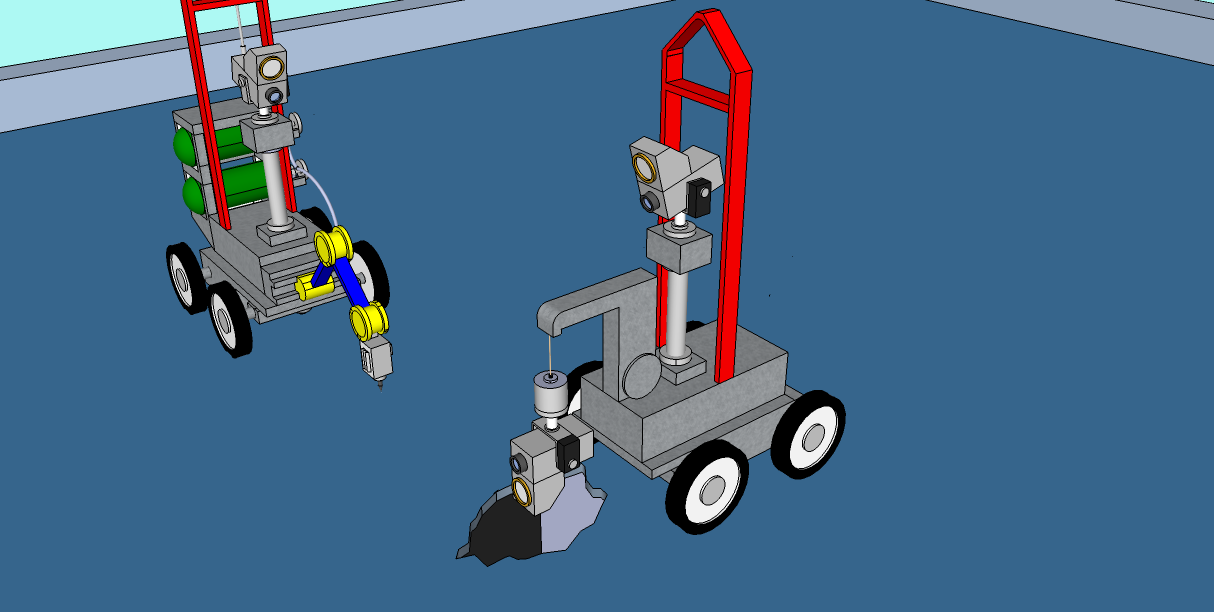
So here’s the plan with teleoperated robots. First, we bring them to the containment roof via helicopter.


Make a hole in the roof with hammerbot (mark 2):

Then lower a camera with cambot (Tom Servo says hi!):
Posted in Uncategorized
Tagged fukushima, meltdown, nuclear meltdown, spent fuel, teleoperated robots
Leave a comment
Radiation hardening for telebots

I was asked whether teleoperated robots could function in a high-radiation environment. I found a link here, which indicates that microelectronics can survive thousands of rads before degradation. That would be many times a lethal dose for humans.
The electronics should be kept in accessible pull-out/push-in modules that can quickly be replaced, so that the mechanical hardware could stay in service as much as possible.
Posted in Uncategorized
Tagged control room, fukushima, meltdown, radiation hardening, teleoperated robot, teleoperated robots
Leave a comment
Nuclear Teleoperations isn’t a new idea
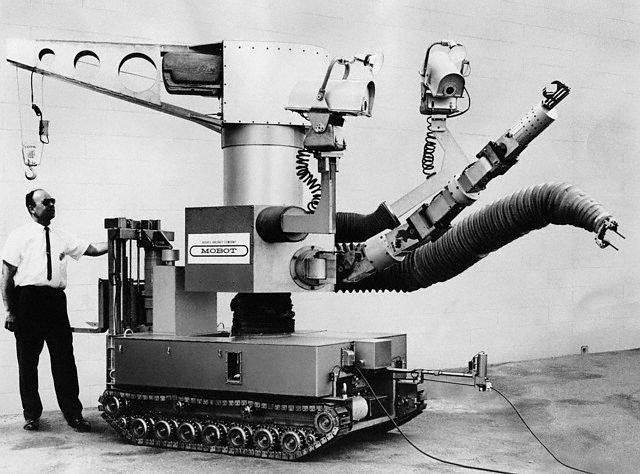
In 1963 came Mobot.
Fukushima: constructing containment buildings out of shipping containers

Containments for the damaged reactor buildings can be rapidly constructed out of intermodal shipping containers. Shown here are forty-foot units. Approximately 1500 are used to build the walls. At $5000 per unit, the walls can be constructed for $7,500,000 in materials.
As for the roof, cables can be strung across the roof and metal plates can be placed on top of the cables.
A single container ship will carry enough containers for this job. Going by standard shipyard loading operations, this entire structure can be built in less than a day.
A venting and condensation chamber (not shown) can be built alongside the containment building so that steam ventings are not released into the environment.
Containers are stacked eight high on ships, where during storms they experience movements far stronger than earthquakes. The design here is shown twelve high, but these containers are (a) empty and (b) joined with welding.
For safety purposes, it is recommended that teleoperated robots be used in place of human personnel as much as possible.
Posted in Uncategorized
Tagged containment, fukushima, meltdown, Shipping Container, shipping containers
1 Comment
Fukushima: How to Cool the Fuel Rods
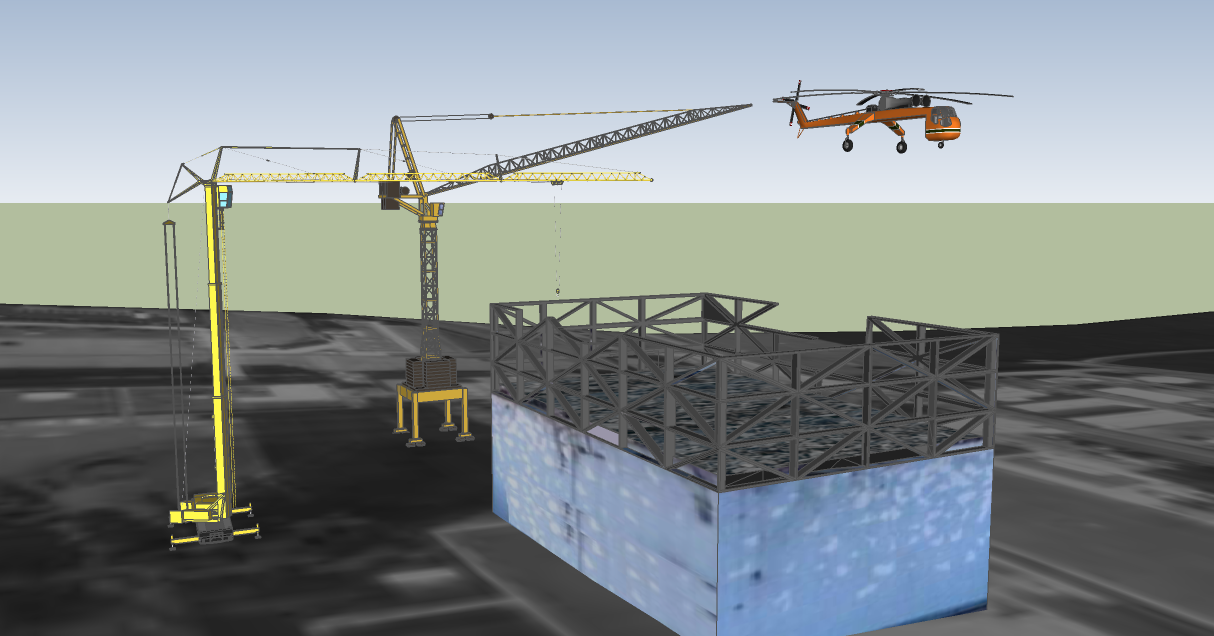
I read this morning that the expended fuel rods at Fukushima are stored in a pool above the reactor core. If the reactor has a meltdown, the pool is damaged and will leak, exposing the fuel rods to air, which will cause them to heat up and release far more radiation into the atmosphere than could a mere meltdown.
Currently the Japanese government is planning to keep the spent fuel rods cool by dumping water from helicopters. This was done to put out the fire at Chernobyl, but I recall that at least one pilot died from radiation exposure.
Another way, as shown in the above sketchup image, would be to use tower cranes to position water hoses into the damaged pool. I show both stationary and mobile tower cranes. If Google Sketchup Warehouse has the proper dimensions for the equipment and buildings, this technique appears workable.
I think the flow rate from hoses directed by a fleet of tower cranes would be considerably higher than that provided by helicopters taking turns. Moreover, with the aid of teleoperation, the hose spray could be directed toward the areas with the worst damage and highest levels of heating, whereas dumping water from helicopters might be hit-or-miss in regard to its targeting. Also, hoses from tower cranes could provide an adjustable flow rate, whereas helicopter dumping entails the risk of a transient temperature shock causing an explosion when the rods heat up excessively between dumpings and then are abruptly cooled during the dumpings.
(NOTE: It is beyond the scope of this blog to discuss why it appears that GE deliberately designed Japanese nuclear power plants to be doomsday devices.)
Posted in Uncategorized
Tagged fuel rods, fukushima, helicopter, nuclear power accident, tower crane
Leave a comment
International Pi(e) Day
Yes, there is an International Pi Day, according to wikipedia and even the United States Congress. And Google too — so that makes it official.
In case you didn’t bother to check the link and couldn’t guess, the reason this is Pi Day is because it’s March 14. Third month, fourteenth day — 3.14. And so Geeks everywhere are celebrating.
Pi Day is easy to celebrate. One buys a pie and eats it, usually in a collaborative effort. So that’s what I and my guests did. This year’s pi(e) of choice was Marionberry:

A brief ceremony, but fun. And we’re all looking forward to the big blow-out on International Pi To Four Decimal Places Day, in 2015. Parades and Pizza! Parades and Pizza!
And Merry Circumference to all!
Minor DIY surgery on a TV set
My nephew bought a TV at Goodwill for just fifteen dollars the other day, so that he and his friend can play XBox games side by side with their own screens in my apartment. I’m such a pushover that I let him do this, but anyways, the little prong on the yellow video input plug broke.
Why is this a big deal? The prong broke inside the jack, so we had to unscrew the TV housing in order to get to the rear of the jack and push the prong out. This was not cut and dried and both my nephew and I have come to appreciate how much of modern consumer electronics is designed so that you can’t easily get at the innards.
This is the TV:
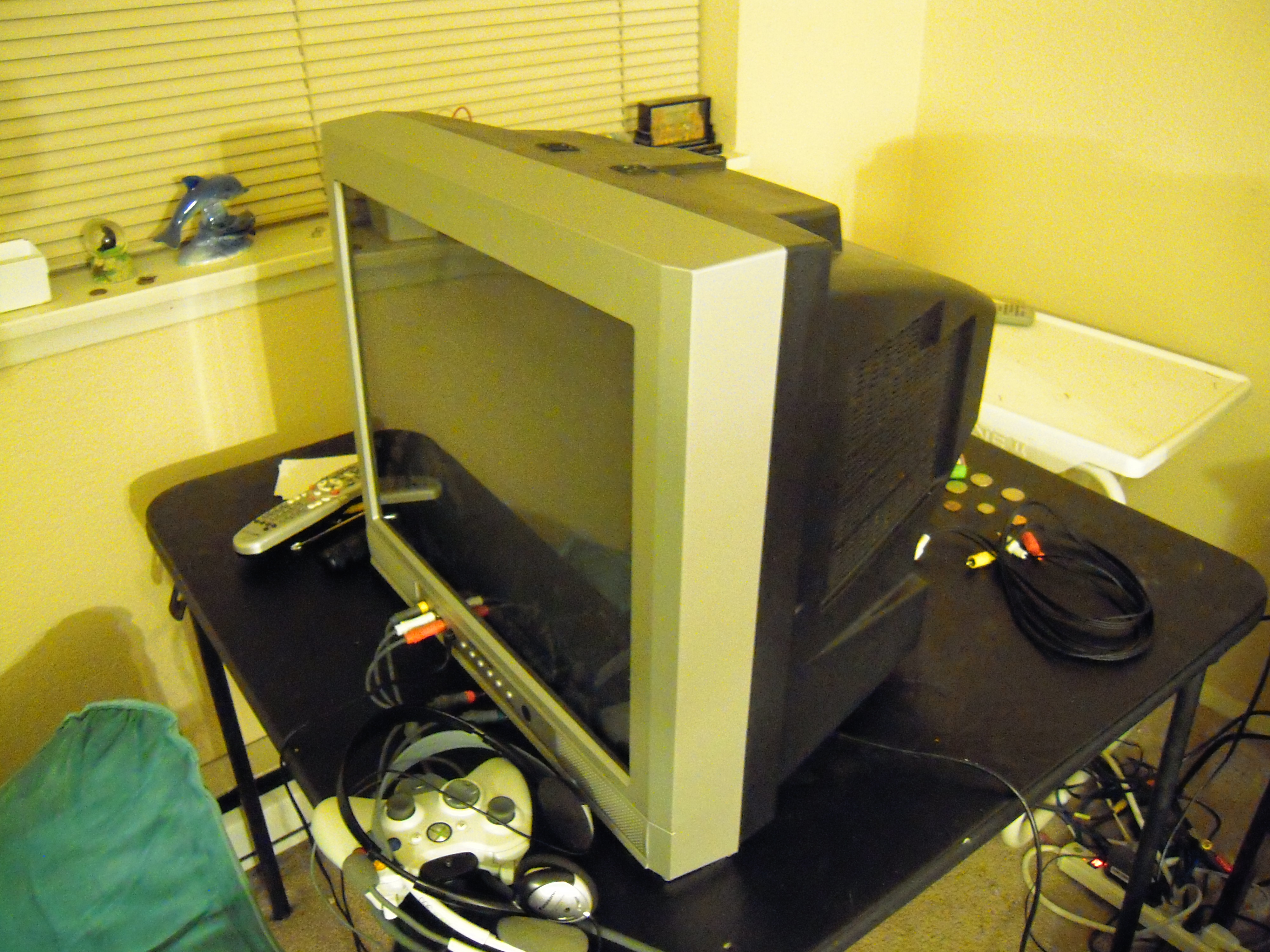
A cable with working prongs is inserted into the jacks beneath the screen in this ‘post-op’ photo.
And this is the broken prong:

You’ll notice the solder where we tried to attach the prong back to the plug. The plug cable is cut because we also tried to attach a conventional video input plug to the damaged XBox cable, but that didn’t work either.
This is how a cross-section of the cable looks:
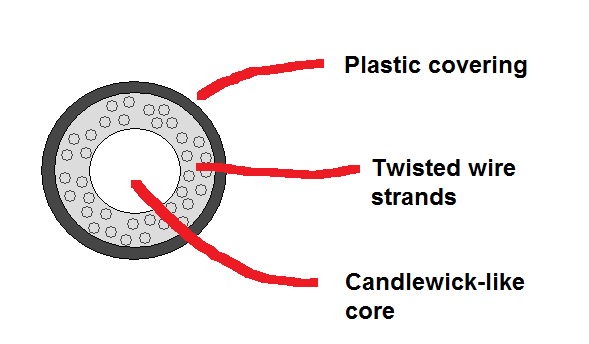
Now that I think about it some more, I wonder if there is a connector that will join severed pieces of cable together. If so, we may yet be in business. Otherwise, my neph will have to buy a new cable.
This item on ebay looks like it’s what we want. And at the time I’m reading this, the Buy It Now selling price is $10.98 with free shipping. That’s not so bad. But I’m sure my nephew would rather not spend any money at all.
Sorry I don’t have any pictures of the TV housing opened. After we screwed it back together, I said to my nephew, “You know, I should have taken a picture.” And he agreed. But I’m still new to this concept of DIY photoblogging.
Anyhow the amazing thing is not that we took the TV apart, but that we put it back together and it still works. Since we got the broken prong out of the jack, we did actually fix the TV. It’s the Microsoft custom cable that is the problem child. Why am I not surprised?
How to provide pump power at Fukushima
Normally, I wouldn’t think myself qualified to offer insight on how to cool a reactor plant in meltdown, but then I read this in the “New York Times:
Christopher D. Wilson, a reactor operator and later a manager at Exelon’s Oyster Creek plant, near Toms River, N.J., said, “normally you would just re-establish electricity supply, from the on-site diesel generator or a portable one.” Portable generators have been brought into Fukushima, he said.
Fukushima was designed by General Electric, as Oyster Creek was around the same time, and the two plants are similar. The problem, he said, was that the hookup is done through electric switching equipment that is in a basement room flooded by the tsunami, he said. “Even though you have generators on site, you have to get the water out of the basement,” he said.
— “Radioactive Releases in Japan Could Last Months, Experts Say” (New York Times, March 13, 2011)
Yes, it never occurred to nuclear power safety engineers that an earthquake might cause a tsunami, and a tsunami might flood a basement.
Normally, I wouldn’t offer the following obvious suggestion, but maybe thinking about the obvious is something that is lacking here. Anyhow, here is a diagram which I hope clarifies the situation and offers a simple solution.

They want to attach the portable power generator at Point 1, which they can’t do because it’s underwater. Well, how about cutting the power lines at Point 2, and connecting the portable power generator there? Then you don’t have to bother with pumping out the basement or repairing the switching equipment.
Just cut the cables, clamp on the jumpers and go.
Any electronics hobbyist, to say nothing of an electrician or an electrical engineer, would know how to do this. And again, it seems so obvious that I wonder why it isn’t being done. But then, I would have thought that the earthquake/tsunami/basement-flooding progression would have been obvious too, and no one saw the potential problem for all these years.
Neighborhood Power Plants: An Alternative to Catastrophe and Collapse
Today was a gloomy day here in the Seattle region. The sky was overcast and it was nonstop raining. I happened to be driving through downtown around noontime when I saw a sign which gave the solar flux: .23 kw.
A square meter of standard photovoltaic panel generates only about 150 volts of power, max, and a kilowatt-hour per day of energy. At .23 flux, we’re talking about 35 watts per square meter max, and .23 kilowatt hour per day per square meter.
Well, I just measured my two bedroom apartment. It’s about 70 square meters. It’s in a two story building, so I have to share roof space with the people below me, but still that’s 35 square meters.
All right, then that’s 35 square meters of roof space times .23 kilowatt hours per day per square meter, which equals 8 kilowatt hours per day. That’s about half my energy usage in winter, but with better insulation, energy conservation, and above all, a smaller and more practical refrigerator, I might just be able to get to that.
Actually, I wouldn’t be allowed to put solar panels on my rooftop. The apartment complex management wouldn’t allow it. But what if my community were to build a solar array so that it didn’t have to tap off a state or national power grid?
The city of Bellevue, Washington, has a population of 122,000. Let’s say we have 100 square meters of photovoltaic paneling per person. That would require 12,000,000 square meters total, or 12 square kilometers. This would be only 14% of the land area of the city — which is surrounded by more rural areas, by the way.
For the entire United States, 300 million people would require 30 billion square meters for residential usage, or 30,000 square kilometers. This is only .3% of the surface area of the US. Total power usage for industry as well would require about one percent of US land area — about what we have paved over. And all those median strips are presently going to waste.
Back to my community of Bellevue. If we were to build enough solar panels on rooftops, on freeway median strips, and on sidewalk awnings, then we wouldn’t have to tap into state- and national- power grids.
What about snow days of complete overcast? Well, batteries do allow for a reserve of several days, but then there is also the possibility of generating auxiliary power with fossil fuels.
You see, I’m a practical shade of green. If it gets really dark and cold, then fine, let’s use fossil fuels. But the rest of the time, let’s use solar power. Okay, you might reply, but even if we only use it for a few days a year, don’t we still have to build a big giant fossil fuel plant and support all the infrastructure as well?
I thought so too, then I priced portable power generators. Not the small home ones, but the big ones. I would send you to the page for a 22,500 watt beauty, but it’s not working from yesterday. Hmm. So let’s go with this 10 kw generator at Amazon. It costs a thousand dollars and provides enough power for twenty house holds. That’s fifty dollars per household.
Imagine one of these on every street. You know, where the state-wide electric company already has a house-sized switching station. Anyhow, it would sit in a shed until needed. And it would only be needed a few days every year.
With neighborhood solar arrays and portable power generators, electrical power in Japan would have been restored in no time. I know from personal experience that there’s nothing more agonizing than waiting days for power to be restored at the whim of a large regional power authority. And in my case, that was just from a wind storm.
But what about the infrastructure cost of all this? Solar panels are nothing more than silicon wafers, just like computer chips, and so they are likely to follow the same decline in price as computer chips, and eventually cost pennies per square meter. I see that happening in the next ten years.
But what about now? What would it cost now, say, for the nation of Japan to abandon its national nuclear power initiative and embrace instead a paradigm of local solar arrays and neighborhood power generators?
Well, I haven’t done the calculations, but I suspect it would be less than the cost of replacing Japan.
Posted in Uncategorized
Tagged earthquake, japan, meltdown, nuclear power, portable power generators, solar power
Leave a comment

