Football on the Moon

My nephew was interested in the possibility of lunar basketball, but since this is the weekend of the Big Game (non-TM), I decided to go with lunar (American) football instead.

The simple part, of course, is to put it under a glass dome, since if Neil Armstrong proved anything other than that an 80 kg test pilot can do the job of an 8 gram microchip, it’s that spacesuits tend to limit the freedom of movement that is essential for the choreography known as Football.

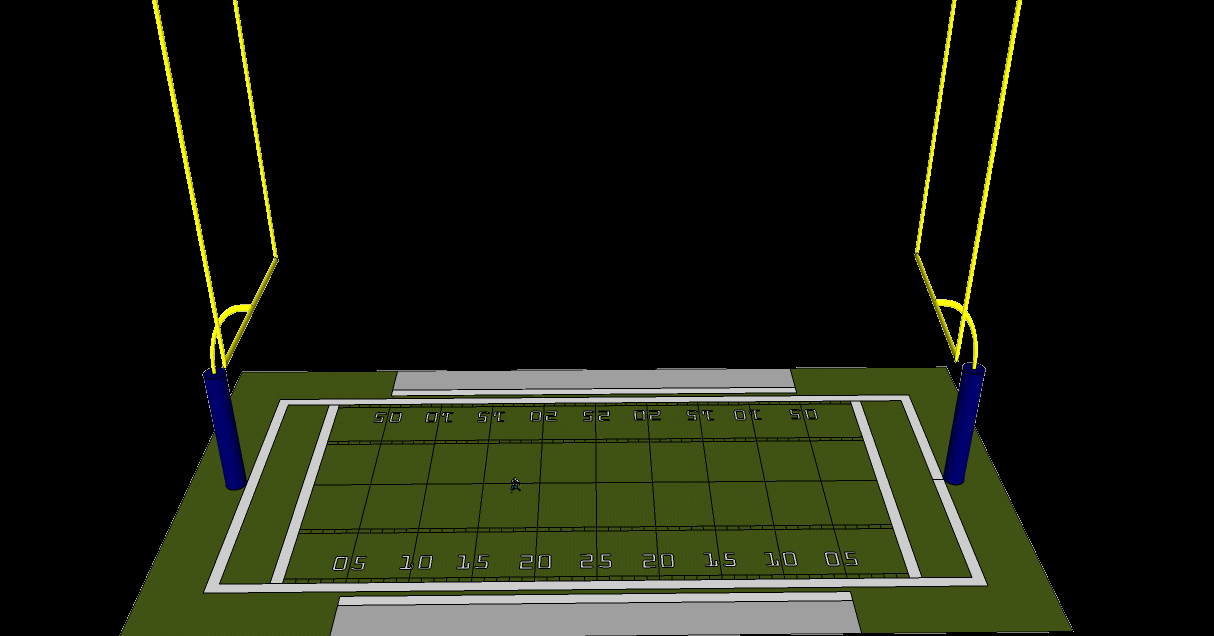
Next issue was gravity. Since lunar gravity is six times less than Earth, vertical distances are naturally six times higher. Hence the elongated goal posts:

But then it turns out that horizontal distances are another matter, because running is in some respects assisted by gravity. Too much gravity, of course, and you get squashed and aren’t capable of running very fast after that, but it turns out that gravity is actually a good thing at lesser levels, it gives you things like traction and all.

Anyhow, here are two sources for running speed on the Moon:

Energetics of Walking

“Walking, Running, and Jumping on the Moon,” New Scientist, 22 July 1965

The latter article concludes with the statement, “If a 100-yard race were tried on the Moon, nobody would approach the 10-second standard without (almost literally) a flying start. The whole distance would be used for getting up speed.” Since average speed would therefore be half of Earth sprint speed, I decided to shrink the dimensions of the field by a factor of two. (I also converted to meters, because this is happening in the Future, dude.)

Anyhow, while it would be slower in horizontal speed, the game would be much more spectacular in verticality. The human record jump of 28 inches on Earth would easily be exceeded by your grandmother on the Moon. Here is what a 140 inch jump would look like:

(Maybe you’re wondering, “Are they going to wear shorts on the Moon when they play football?” Well, I wanted to put a football player on the field for a sense of proportion, and while I found lots of European Football (= American Soccer) players in Google Sketchup 3D Warehouse, there were no American Football players save this one lone guy in his shorts. [I don’t know what that’s about and I don’t want to know.])

I’m not a football fan, but if there’s ever a Big Game (non-TM) on the Moon, I might just watch out of curiosity to see how the physics will work out.

Posted in Uncategorized | Tagged , , | Leave a comment

Amino acid progression

This slideshow requires JavaScript.

This is something that I’ve wanted to do for a while, and it will obviously take a lot more work.

The idea is that amino acids show a progression in complexity, and I’d like to put together a slide show of all the amino acids, showing this expansion.

The intention is not to show models with one hundred percent accuracy as far as angles are concerned, because after all I’m not planning to plug them into a simulation of the human cell (yet).

I don’t think a slide show is possible for all twenty amino acids, because there are branches. The progression of amino acid is tree-like, not simple linear. I’ve learned that at least.

And self-enlightenment is the goal of this exercise. Working backwards, it helps to explain how evolution might have started with utilizing one or two amino acids, and then expanded its repertoire to the twenty now in use. Working forwards, this exercise helps me to understand how different amino acids function in the construction of proteins, which has applications for nanotechnology.

I’ve got a long ways to go on this.

Posted in Uncategorized | Tagged , , , | 2 Comments

Engineer’s Dreams

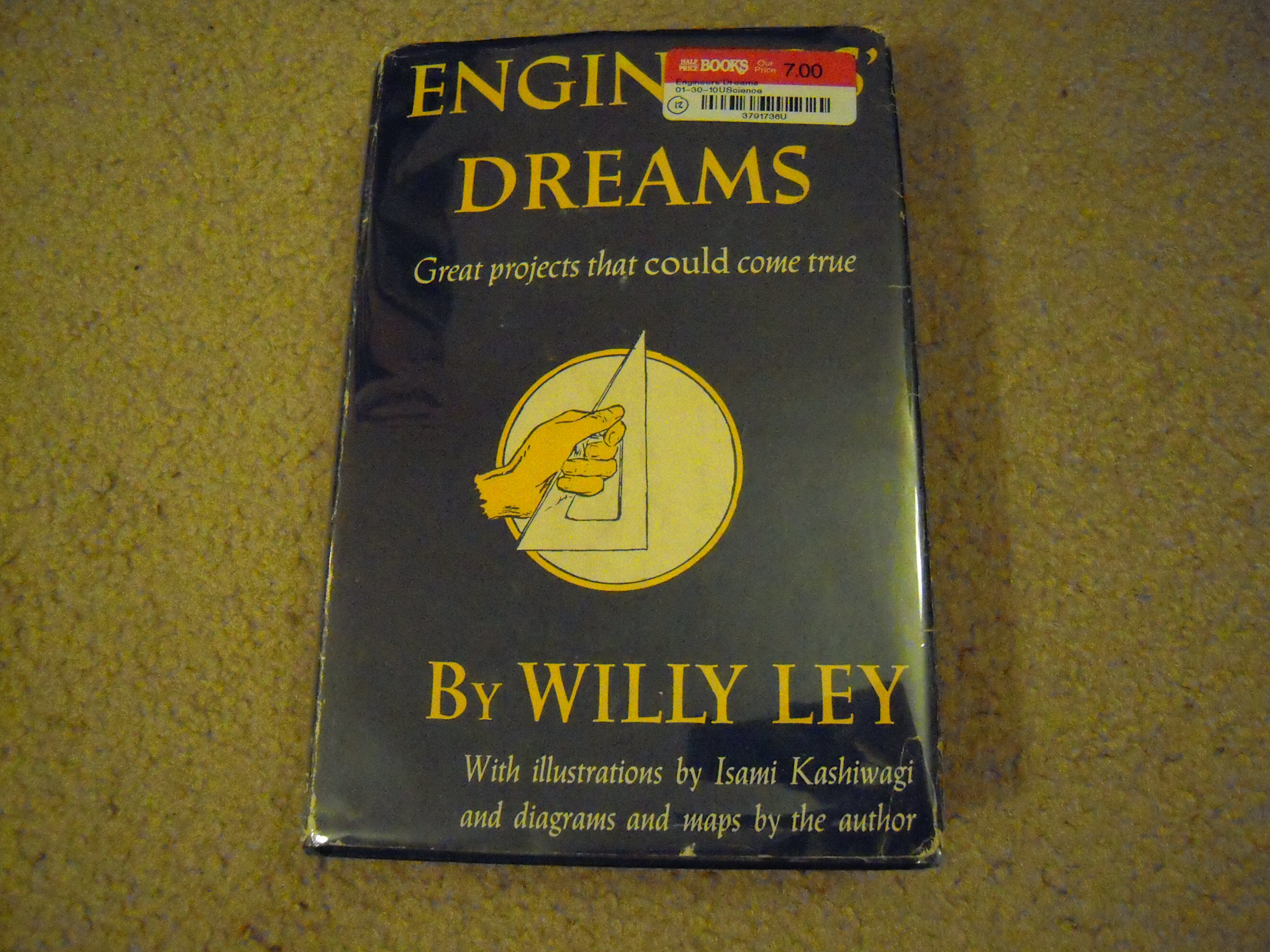
Engineer’s Dreams: Great projects that could come true, by Willy Ley (1954).
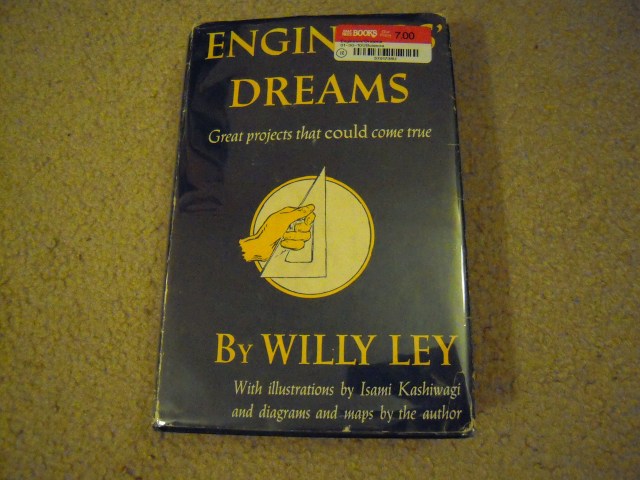
Here is a book that I found at Half Price Books that has been out of print for decades. Not only is it over fifty years old, it also is quite dated in its relevance. Which is why I found it all the more fascinating.

Willy Ley was a prominent science writer in the 1950s and 60s. Although there was some overlap, whereas Asimov concentrated on science essays, Ley was more engineering oriented. Much of his writing concerned astronautics, which is understandable since he was an associate in the German Rocket Club of the 1920s and early 30s with one Werner von Braun and other German expatriate scientists who were to lead the American space program to the Moon. Unlike the other German rocketeers, however, he headed for the door when Hitler came in, emmigrated to the United States, polished his English, and became a prolific science writer. Wonder about Werner but Willy was okay.

In this book, Ley puts aside his astronautics background and is down to Earth. Literally so, because most of the engineer ‘dreams’ concern moving earth. There’s nothing about rocket engineering, or nuclear engineering, or electronic engineering. It’s almost entirely civil engineering.

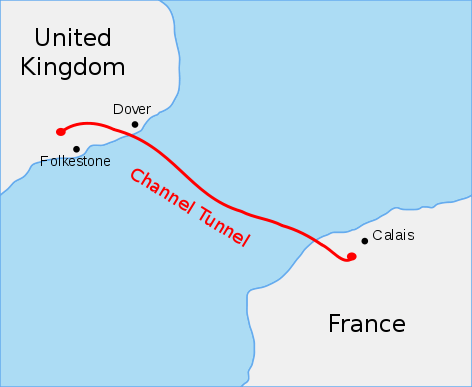
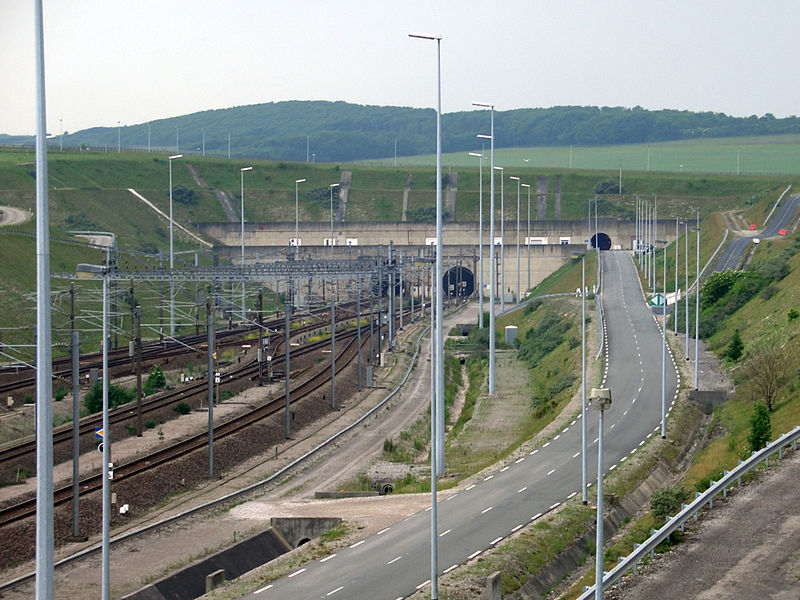
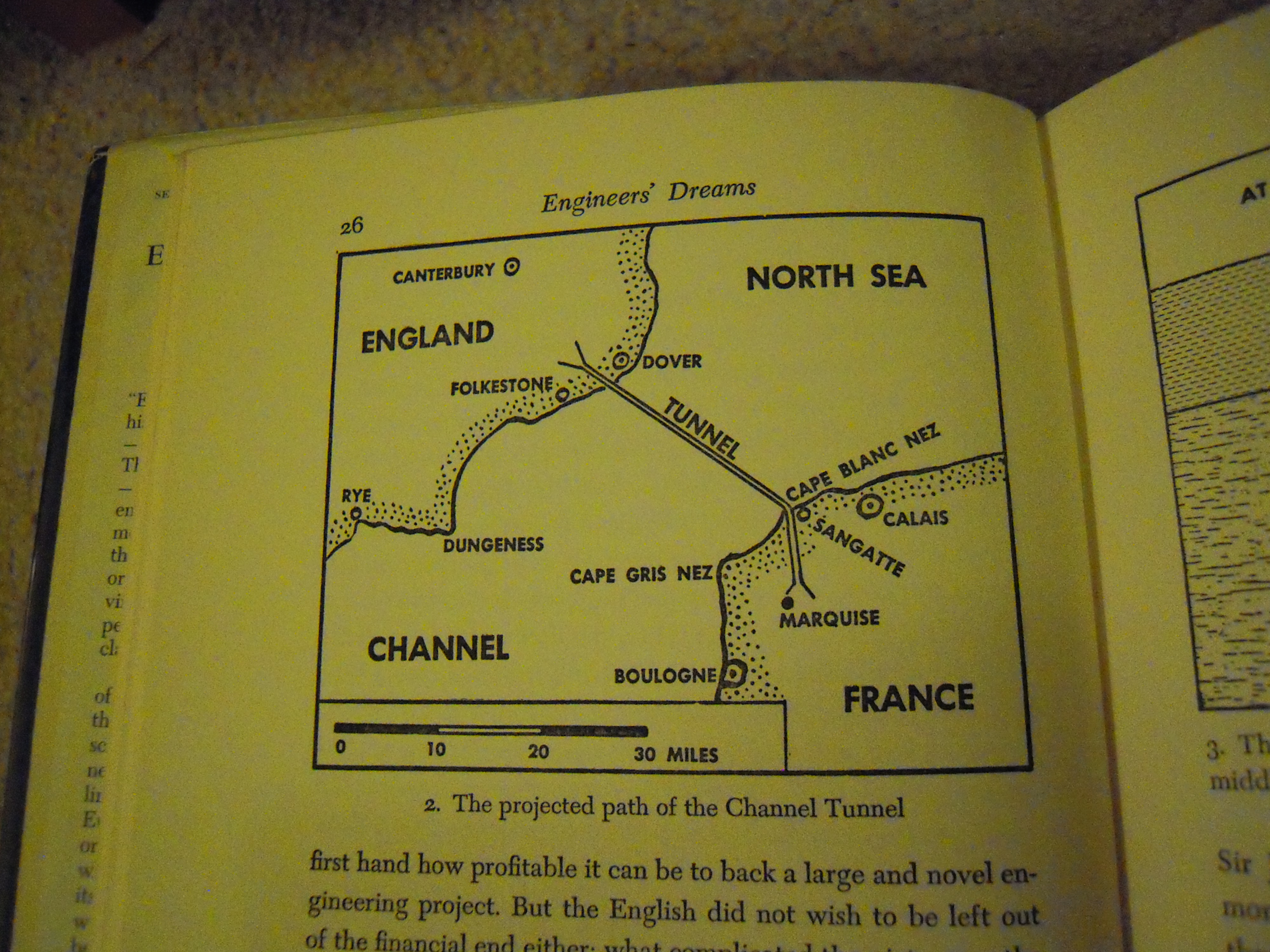
Chapter One, “Forbidden Tunnel,” is about building a tunnel under the English Channel. That’s the one ‘dream’ that really hit the Big Time, so let’s compare illustration with reality.
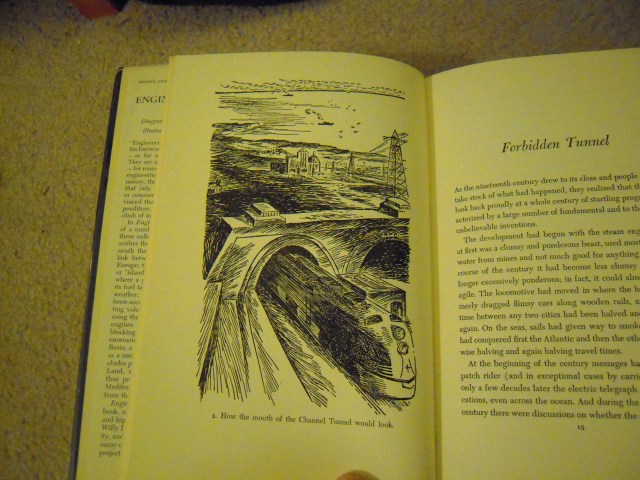
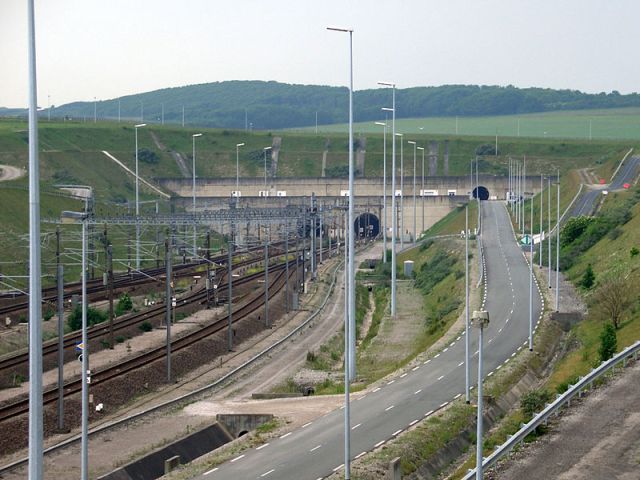
Hmm. Well, I don’t know about you, but it seems that some of the romance and wistfulness has been lost in the translation from dream to reality. The book’s illustrator, Isami Kashiwagi, does a great job in evoking the imagination with the sparse style forced upon him by the limitations of publishing technology in his day.

Anyhow, let’s compare ‘Chunnel’ routes:
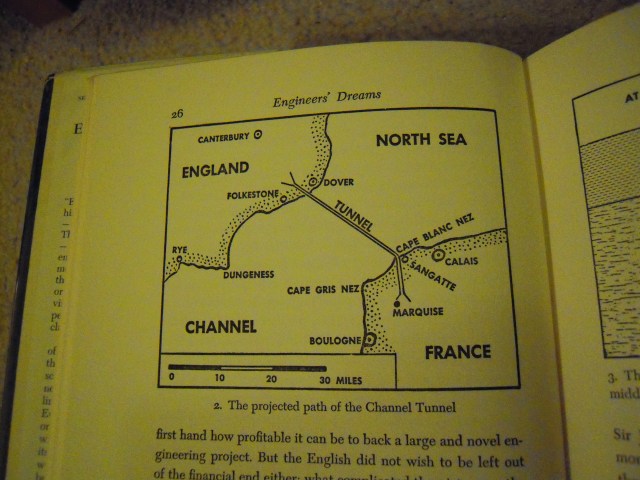
It looks like that ‘dream’ hit the mark, albeit with a slight detour in the middle. By the way, the reason why he refers to the tunnel as ‘forbidden’ is because there was once substantial political opposition to its construction on the grounds (excuse semi-pun) that it could serve as a route for the invasion of England from the Continent. I suspect the real reason the Chunnel took so long to build, however, is because, frankly, ferry rides are more fun than riding a train through a tunnel. “Imagine, Jimmy, all the water above us!” “Right, Dad. Can I have my DS?”

I would love to show you many of the other drawings in the book, but it probably would violate some kind of fair-use copyright which serves no purpose since Ley died more than forty years ago, ironically only a few days before he could witness the Apollo Moon landing that he had anticipated for decades. But at least let me recount the contents.

Chapter Two, “Islands Afloat,” is about building a floating island out of an iceberg, or maybe a mixture of sawdust and ice. This was actually conceived in World War II as a mid-Atlantic landing field for anti-submarine patrol aircraft. Churchill himself was a strong supporter of the plan, but then the Germans lost the submarine war, and so no floating islands to this day, although there are plans afoot to build island communities out of old oil rigs.

Chapter Three, “The Tamed Volcano” is about geothermal energy and goes into detail about tapping volcanic heat in Iceland and Italy. According to wikipedia, the Nesjavellir Geothermal Power Station was built in 1987 and today delivers 120 megawatts of geothermal power. That’s fine for Iceland’s tiny population, but it’s kind of small for the output of a civil nuclear power plant.

Chapter Four, “The Valley of the Jordan,” and Chapter Five, “Africa’s Central Lake,” are all about flooding large land areas to provide hydroelectric power, transportation, and improved agriculture. And all we have to do is relocate a few million people!

Surprisingly there is no mention of doing this sort of thing in Egypt in what would later become the Aswan Dam Project.

But after you digest the thought of flooding the Middle East and Africa, the author presents us with a plan in Chapter Six, “Atlantropa — the Changed Mediterranean,” to expand Europe by damming and then lowering the Mediterranean Sea by several hundred feet. Italy doubles in size, as does the Peloponnese whose picturesque coastlines are so far inland you can longer see the beach even from the top of that cliff with that cool village with the white walls and blue domes, and even the Adriatic and Aegean Seas shrivel to become modest bays.

“How come these engineering projects reduce the Third World in size but expand Europe?” I think many of us would ask that question today, but I wonder if anyone in the American/British target audience gave it much thought back when the book was published.

The final three chapters of the book would seem quite politically modern, however, in that they discuss renewable energy.

Chapter Seven, “Power from the Sun,” is about solar energy. Photovoltaics is passsed over to discuss solar mirrors focusing on solar boilers to generate steam. I found this the most interesting chapter in the book, since hard data on power output from such systems has been hard to track down, even though such projects have become common.

Chapter Eight, “Waves and Warm Water,” is about tidal energy, the whole Bay of Fundy bit. I’m surprised Ley didn’t call it ‘Power from the Moon,’ given his background.

Chapter Nine, “Harnessing the Winds,” is about building big wind turbines, although the designs look nothing like the ones plaguing the English countryside today. One illustration, called the ‘Honnef Tower,’ looks like the Germans were planning to duplicate the Eiffel Tower by a factor of two and then top it off with a triangle of giant blades that are horizontal in orientation, like helicopters. I Googled, and via the Wayback machine and treehugger.com came up with this image:
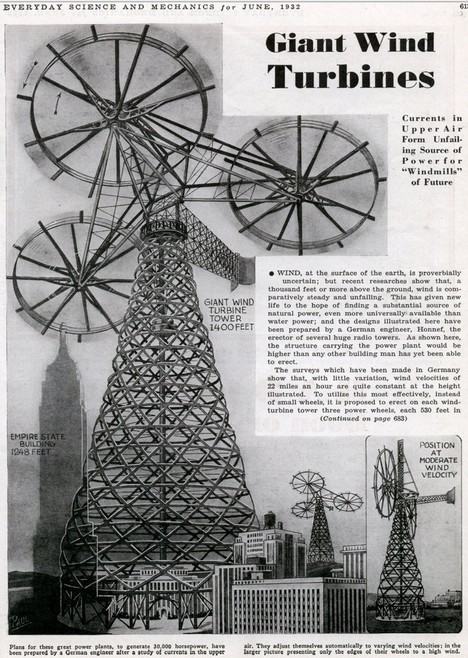
[Yark!]

One can only imagine the course of World War II had the Germans during the occupation of Paris decided to transform the real Eiffel Tower into such a monstrosity. They still would have lost, but one can imagine Patton coming over the horizon and seeing that thing. “Lieutenant, get me General Eisenhower — and some scotch!”

Well, we did build the Chunnel, but wisely engineers have decided to fulfill other dreams over the past few decades than those described in Engineer’s Dreams. Wisely, that is, assuming that the Robot Armageddon doesn’t come to pass. Otherwise, we may well wish we had stuck with vacuum tubes and poured all that high-tech venture capital into a project to drain the Med. You can never have enough Peloponnese, I always say.
Posted in Uncategorized | Tagged , , , , , , , | Leave a comment

Tapping into an RC Circuit

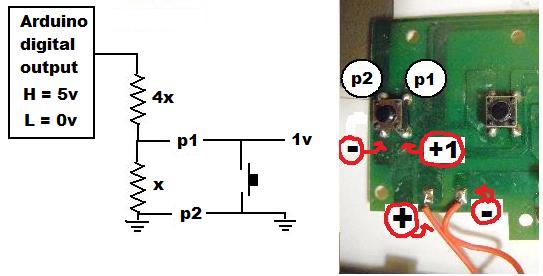
The Neph came over and we probed the RC circuit with the analog multimeter that I purchased from Radio Shack. I was astonished to find that the voltage on the high side of the push button wasn’t even a single volt. Actually it’s so low that a diode across p1 and p2 won’t even light up.

I’ve come up with the idea shown for an Arduino/RC board interface circuit. The resistor values (TBD) are such that one is four times greater than the other. Then, when the Arduino digital output (pin TBD) goes high, it generates 1 volt at p2. Counterintuitively, that is the equivalent of the button being unpushed.

To simulate the button being pushed, the Arduino digital output has to go to low — ie, ground. The RC circuit is operating on two AA batteries, so I’m pretty sure the current won’t burn out the Arduino. Indeed, other way around, I should choose resistor values so that the Arduino doesn’t burn out the RC circuit. Next time.

It also occurs to me that while transistors switches probably won’t work here because of the low voltage, a mechanical relay could. So I should look for some relays on the Internet too.

Posted in Uncategorized | Tagged , , , , , , | Leave a comment

Zerobot Chronicles: Remote Control Pad

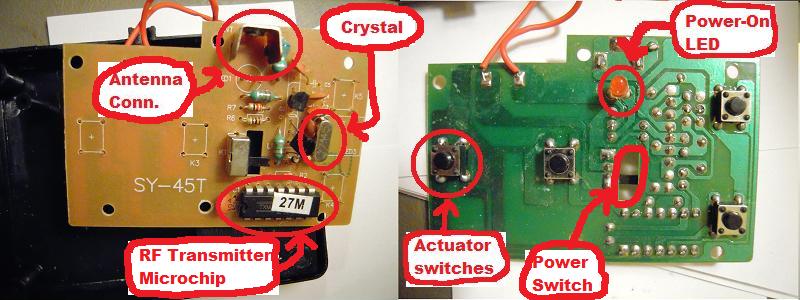
Here are photos of a RC toy vehicle’s remote control pad circuitry exposed. I reversed the back side so that the points would correlate with the components on the front.

The chip identifier number under the sticker is unreadable, which is unfortunate since the chip is the most interesting thing on the board by far.

Anyhow, the plan is to connect this to the Arduino so that I can control it from my computer with a variation of the LED-color switching program that I wrote.

By the way, I think I should mention that I am an utter newbie when it comes to programming in Processing, but there is so much stuff online to copy and paste that it was really quite easy to get up to speed.

Also BTW, the big digital multimeter with PC interface that I bought a couple years ago and never took out of the box only gives me a backwards 7 for display. Anyway, it cost more than the Arduino, so it was open to question whether it made financial sense to risk connecting it to the RC circuit in lieu of just connecting the Arduino without testing first. So I bought a cheap analog multimeter, which I will use on the circuit when my nephew comes over again tonight.

Posted in Uncategorized | Leave a comment

Password Key Chain

Tired of coming up with random computer passwords, then having to remember them and/or find a place to hide them when you write them down? How would you like to be able to keep your computer passwords written in plain sight — but no one but you can read them?

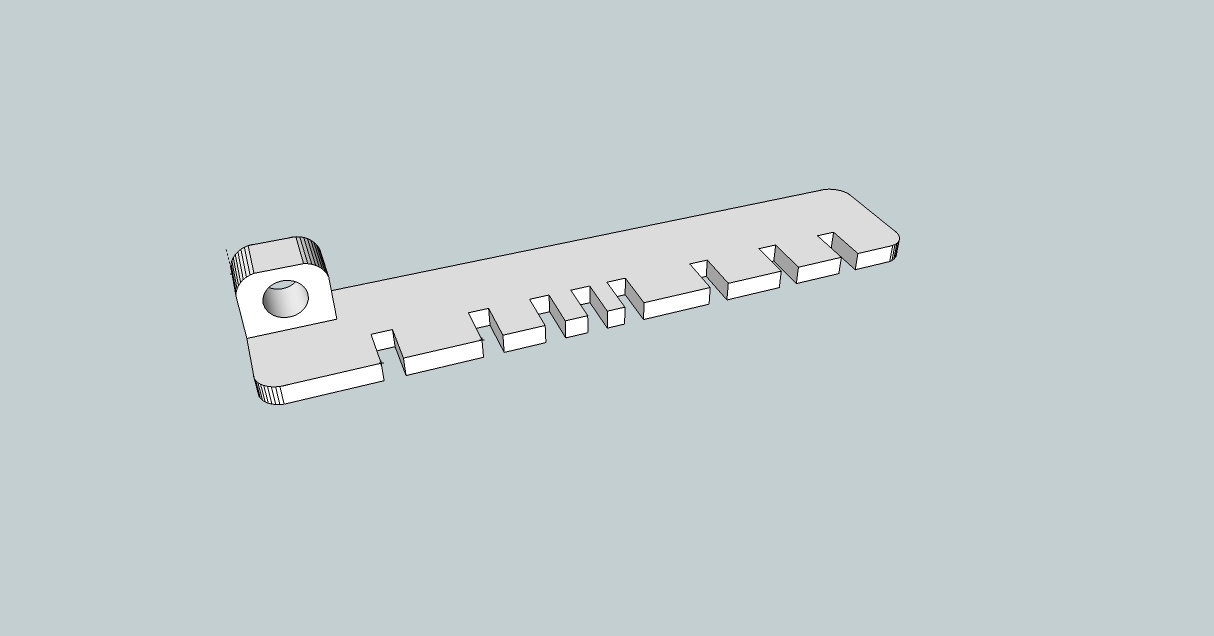
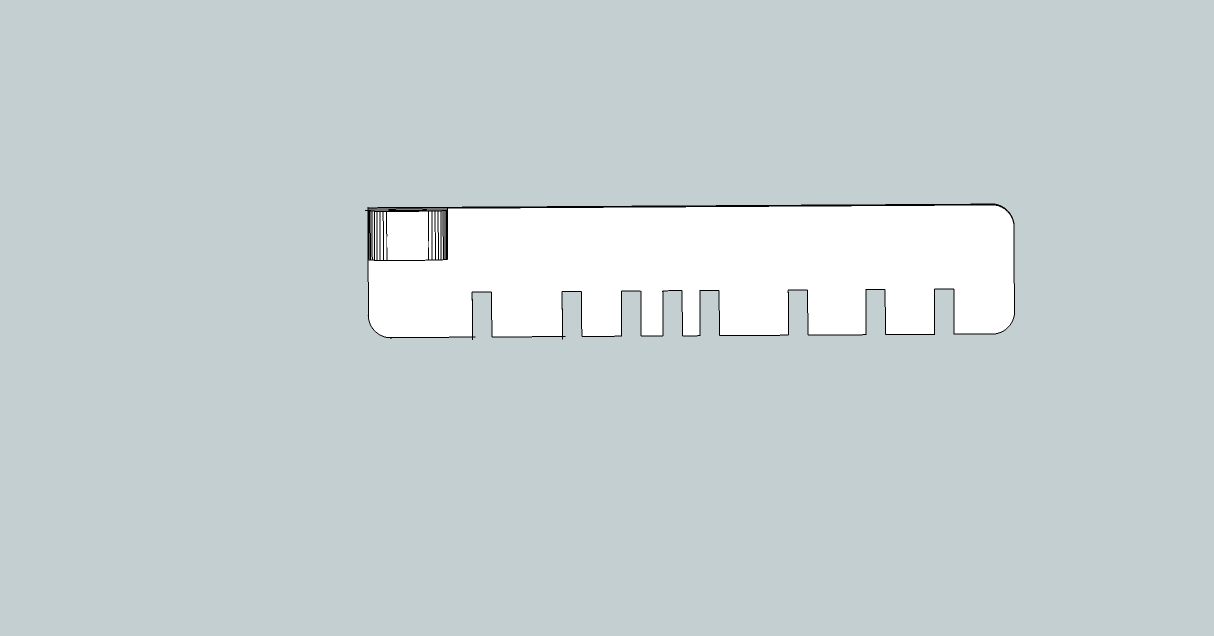
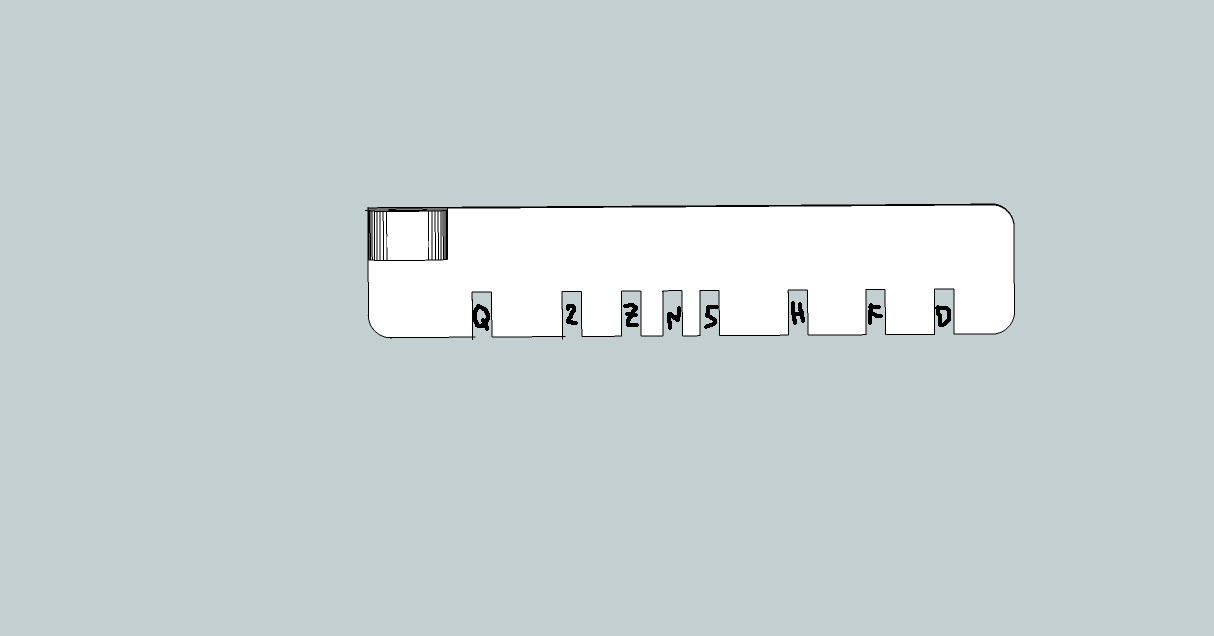
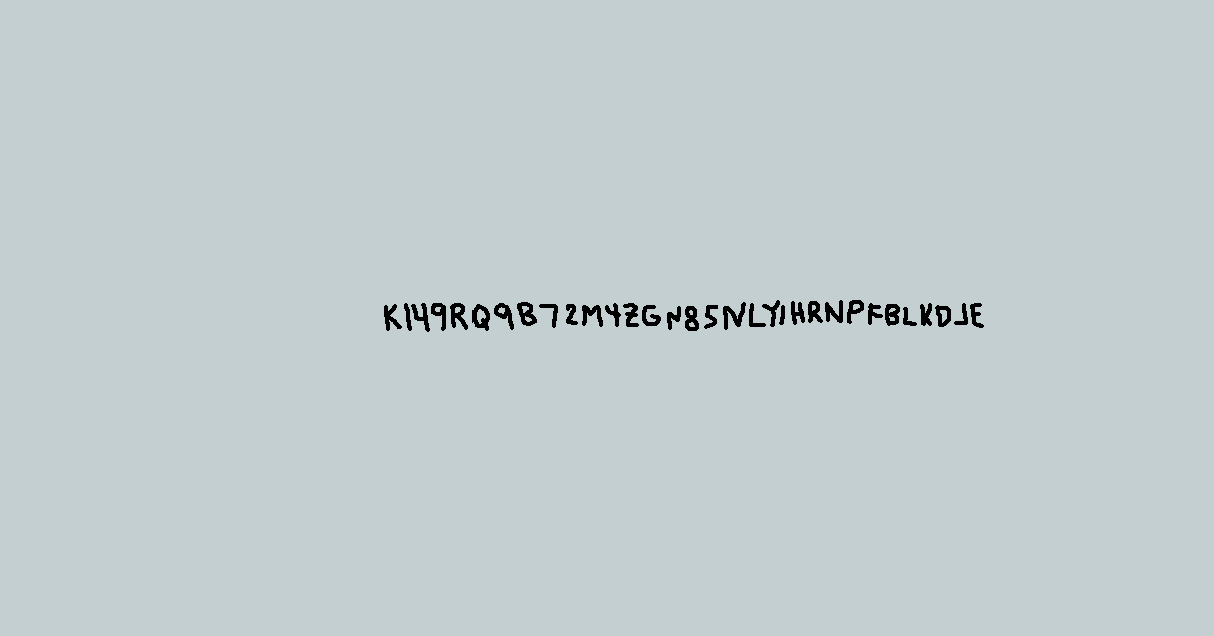
This is an idea I came up with a while back. The idea is to place it flat against a sheet of paper and write a computer password in the slots. Then remove the key chain and fill in the spaces between the password letters.

The result isn’t unbreakable, but a would-be codebreaker would need to try millions of combinations to figure out the password without the help of the key.

In action, it works like this:

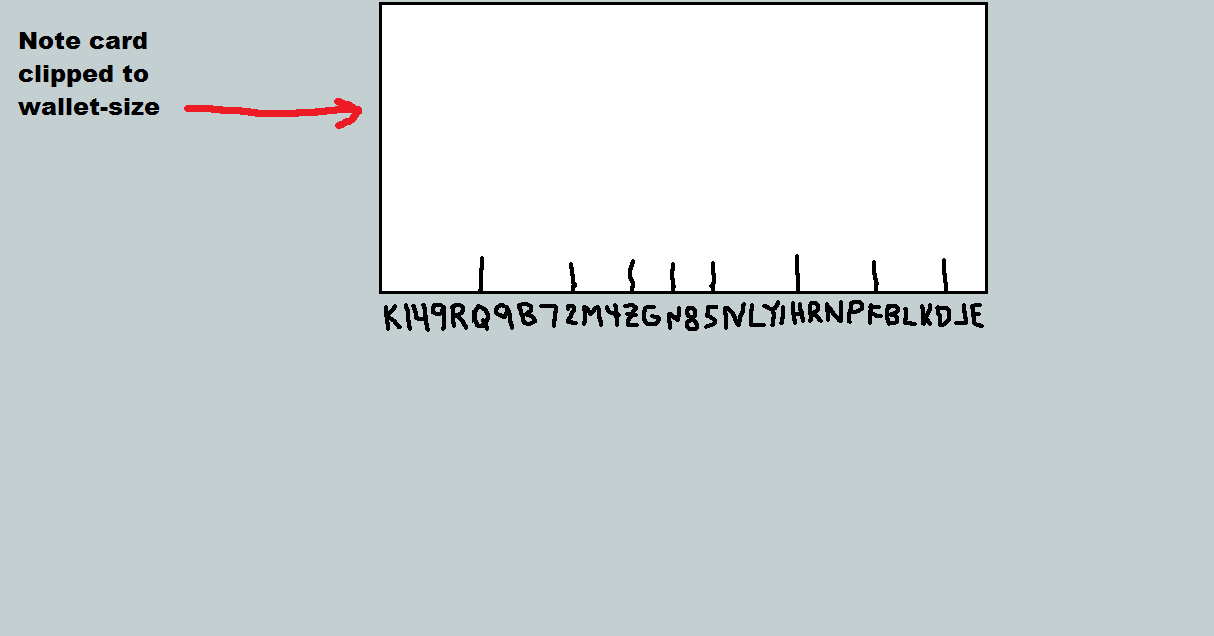
Originally, I intended this to be 3D printed for the Makerbot, which still sounds like a fun idea, but then I realized that all you really need is to cut a 3×5 notecard down to wallet size and write (scrawl?) ‘tick’ marks along the lower edge, so that it would work like so:

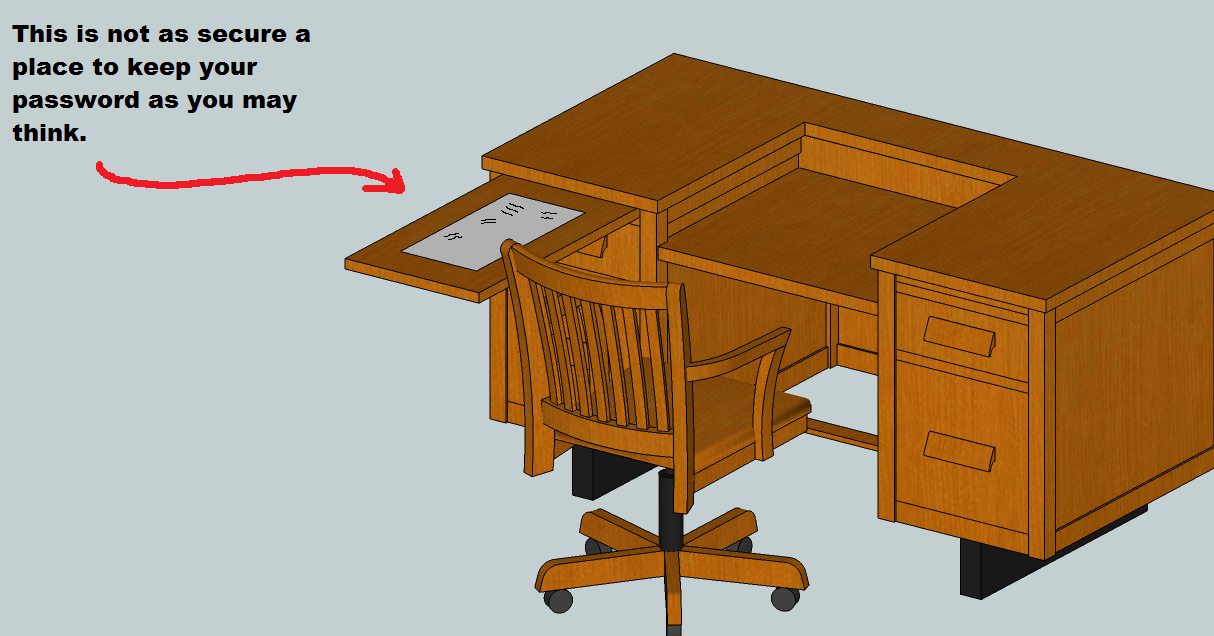
Of course, if someone finds your password key chain and/or card, they can read all your passwords. But when I was working in a corporate office, a lot of people kept their passwords openly written on sheets of paper taped to those little slider tables that pull out from desks.

Or they used 123456789 for a password. That’s ineffective too.

Posted in Uncategorized | Tagged , , , , , , | 1 Comment

Electric Car Battery Swap Station

I viewed a video on Youtube of a ‘battery switch’ station, and the facility looked like it cost a couple million dollars. That didn’t seem very practical. If you want this idea to take off, battery swap stations have to be much lower in cost.

The battery probably needs to be larger, and so correspondingly the robot. There should be support for the cradle when it extends, perhaps provided by another robot. Anyhow, a first attempt.

Posted in Uncategorized | Tagged , , , | Leave a comment

PC to Arduino to LED Control

As I’ve mentioned in previous posts (like the slideshow here), I want to build a teleoperated mining robot. Since I’m somewhat short of both cash and experience, I have to start small.

One key part of the system will be to create an interface to control the robot via computer. And to do that, I have to first be able to control anything, anything at all, by computer.

Hence, the following project.

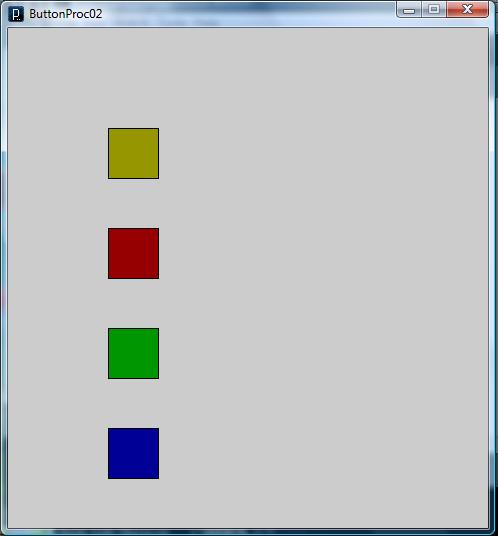
First I wrote a program — or ‘sketch’ as it is called — in the Processing computer language. Here’s what the sketch window looks like on the computer screen:

You take your mouse cursor and click on a square. The color of the square goes from dim to bright. At the same time, an LED of the same color lights up. Click the square again, and it goes dim and the LED goes off.

The whole circuit looks a little like this:

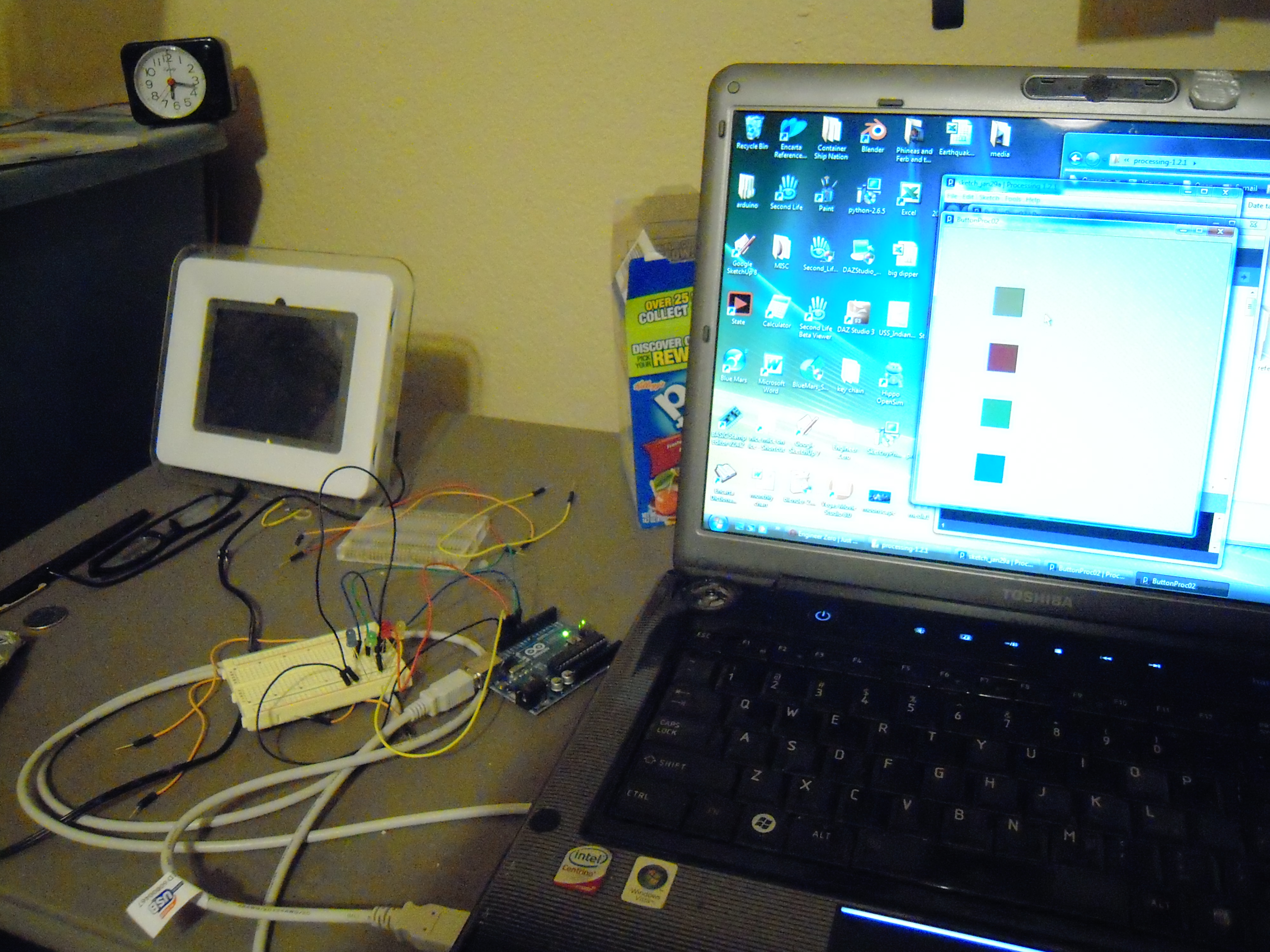
The laptop runs a Processing sketch, which produces the screen image of colored squares, which the user then clicks with the mouse. The Processing sketch reads the clicks and converts them into one byte commands which are then sent over the USB cable to the Arduino.

The Arduino has its own sketch which reads the commands from the USB cable and interprets them to turn the respective LEDs on and off.

Although the USB cable can send data back from the Arduino to the computer, I’m not using that capability here.

Here’s the physical layout in my elaborately equipped and tidy laboratory:

And here’s a closeup of the Arduino and the poor suffering breadboard:

BTW, the LEDs and the jumpers came from the Getting Started with Arduino kit. I’m not sure if this breadboard or the one in the background came with the kit.

Anyway, here’s the raw video:

Although not shown in the video, I can turn on more than one LED at a time, but I’m not sure that’s good for the Arduino. Haven’t burned it out yet, though!

The next step in the project is to interface the Arduino with a remote controlled toy ‘stunt’ vehicle, which coincidently has four on/off inputs. My nephew (to whom I’m assigning the designation Engineer One) needs to come over and we’re going to take it slow because I don’t want to burn out the Arduino. Which as surely as rain falls and the sun rises . . . .

BTW, I notice the diodes I downloaded from Google Sketchup 3D Warehouse look really nice, but lack a couple package details that are typically found in real-world diodes and helpfully explain to newbie electronics hobbyists (such as moi) which side is which. Hence I modified like so:

Just remember to connect ‘flatter’ and ‘shorter’ toward ground, and you too can be confident that your circuit will burn out for some other reason.

Posted in Uncategorized | Tagged , , , , , , , , | 8 Comments

Whatever is wrong with America, it’s not lack of violin lessons

In the 1960s, the US was worried about the Missile Gap. Now we’re worried about the violinist gap?

You know what I’m talking about, it’s being hyped all over the media, there’s a Chinese-American woman who calls herself the Tiger Mom, and has written a book about how tough she is in raising her children. For example she makes them practice violin for hours every day.

This strict discipline is held up as the ‘Traditional Chinese Way’ to raise children, and is presented as an explanation as to why China is doing so well economically while the US is faltering.

Well, I have an alternate theory. China is run by engineers who invest in engineering and science infrastructure. Meanwhile, America is run by financiers and lawyers who invest in speculating over money and then fighting over it.

Hence China builds cities and America can’t fill potholes.

By the way, Tiger Mom is a law professor. She teaches financial law.

Posted in Uncategorized | Leave a comment

Arduino Park on Youtube

Posted in Uncategorized | Tagged , , , , , , , | 5 Comments