Google Sketchup 8: What’s in it for me?

I just downloaded Google Sketchup 8 and don’t see much to commend. It’s slower and the capabilities are the same while the controls have apparently been moved around a bit. Sort of like the typical Windows ‘upgrade’ then.

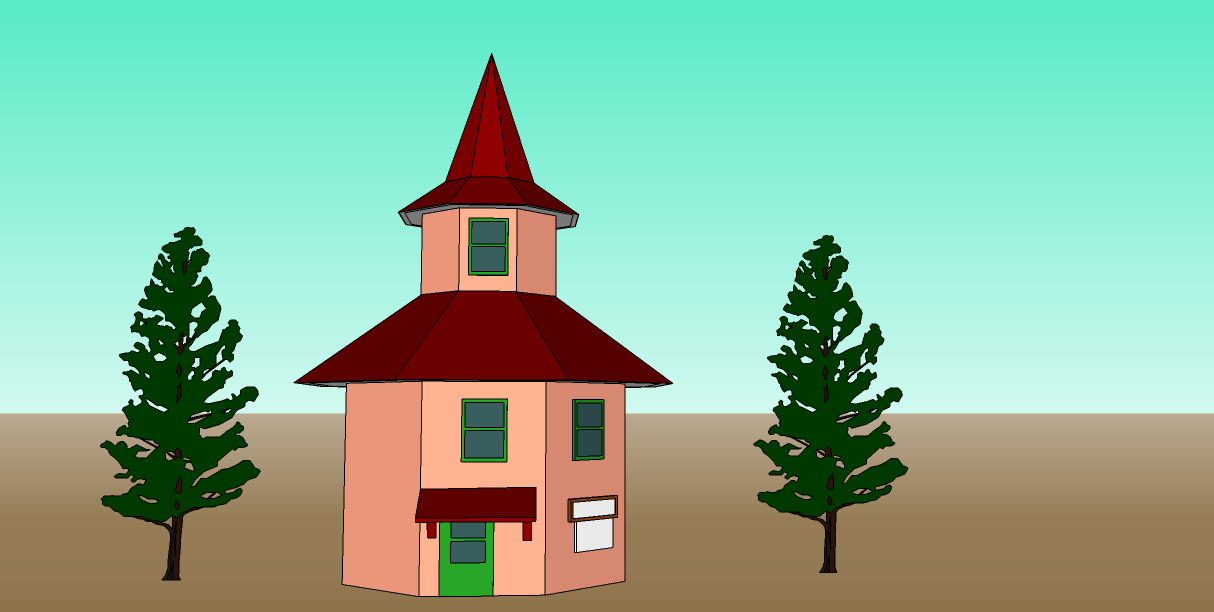
Here’s the monkey house exported in Version 7:

And here it is in Version 8:

I don’t see much difference in rendering, do you?

I was hoping for 3D printing support, but I don’t see it. Anyhow, I can get that from CADspan for free too. And usually plug-ins don’t slow down general application operations like upgrades do.

I think I’ll skip version 8 and see what they have for version 9.

Posted in Uncategorized | Tagged , | Leave a comment

It came from the Future

Lots of movies talk about time travel, but this one finally did something about it:

(Or maybe the ‘D’ fell off.)

Posted in Uncategorized | Leave a comment

Welcome to the Monkey House (From Dayton to Sketchup)

Or, “What happens to monkey houses when you forget to use components.”

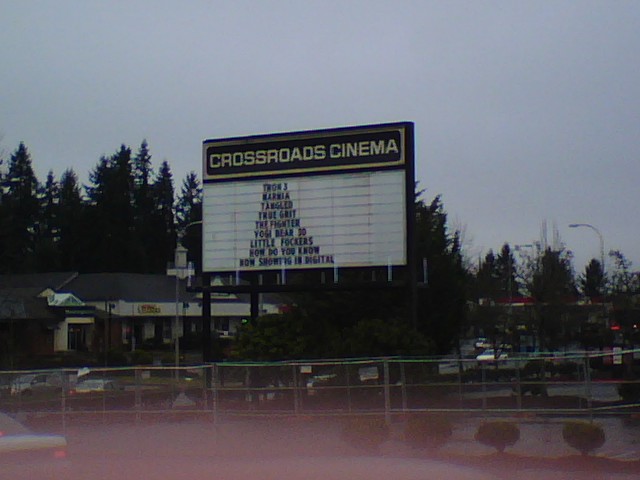
Perhaps you’ve read of this place in the news. It’s a 140 year old monkey house in Dayton, Ohio, kind of a local landmark. I guess they’re spending federal funds on it and everybody is upset. Anyhow, I looked it up on Google Maps and did a Prtsc on streetview. I don’t know about spending government money on it, but I’m a sucker for unorthodox architecture.

Then I went to Warehouse and searched for it, and didn’t find it. I couldn’t believe that omission, so I tried to make my own octogonal monkey house. It didn’t get very far, because after making the base, I tried to make the upper part by shrinking a copy of the base and loading it on top. But I forgot to make the base a component, so the top got stuck to the bottom like so:

*Sigh.*

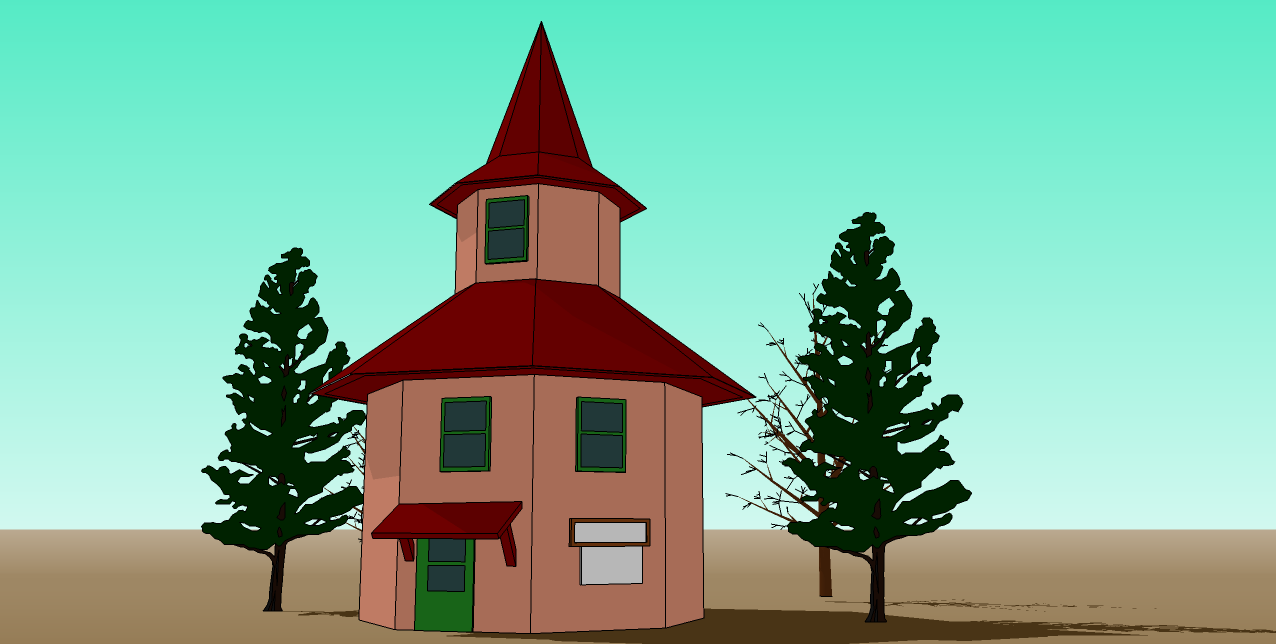
Anyhow, I was able to remove the second stage (not story, notice there are three) and do the following:

Sheesh! That render looks like it was done in MS Paint. Here’s another, this time with shading and shadows and more trees:

Just in case they decide to tear the thing down, it would be cool if someone archived it photographically. Then maybe someday it could pop up in a hypergrid world.

Anyhow, I just finished reading From Elephants to Mice, which discusses the intelligence and personalities of chimps in great detail. So I hope the monkeys were treated well here. Perhaps, back in the 1870s, there was wilderness enough in the Dayton area for them to roam free, coming home in the evening only to eat and rest peacefully for another day. That would be cool.

Dayton, by the way, is where the Wright Brothers grew up, so there’s an interesting tie-in with this site (ie, blog header photo). Come to think of it, it was built around the time they were born, so they probably went to it as kids.

Posted in Uncategorized | Tagged , | 1 Comment

Designing robots in sketchup

My education in sketchup continues.
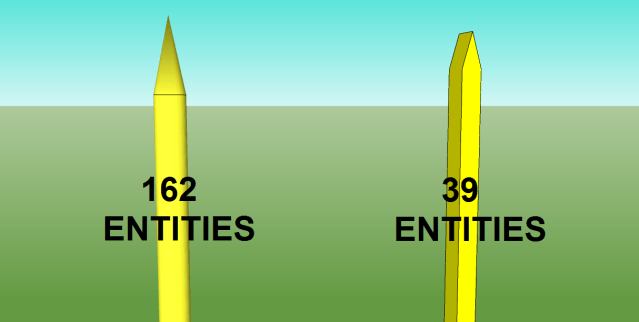
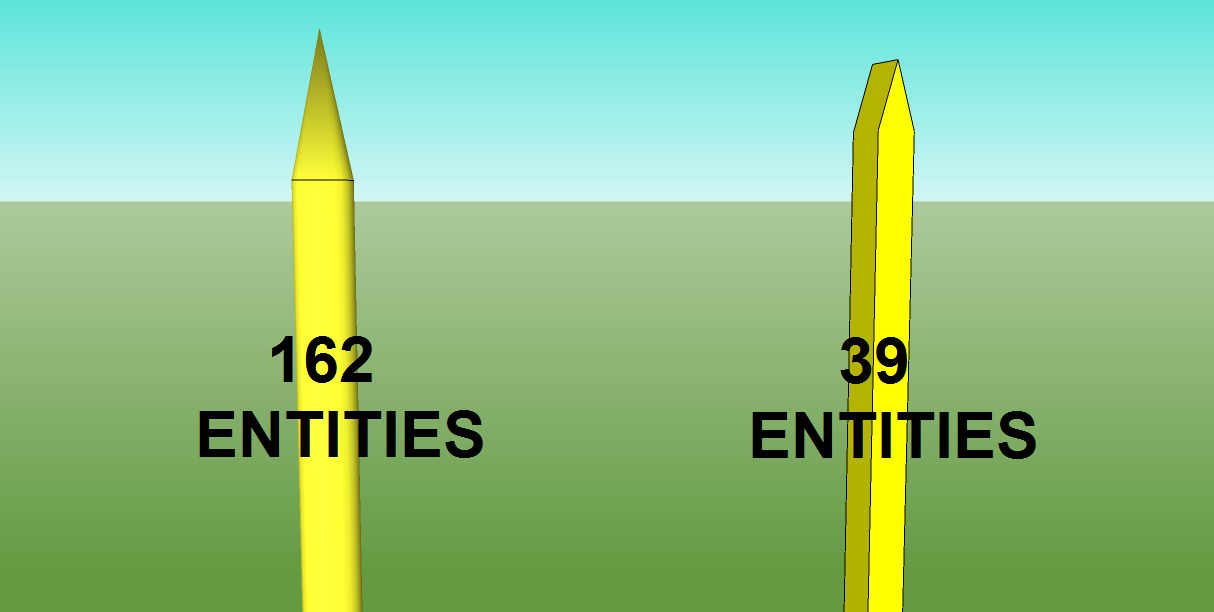
1. If you’re going to replicate a shape a hundred times, make sure that it has a low polygon count. Hence I redesigned the prong component from a cylinder to a rectangular profile and got the ‘entity’ count down appreciably. Sketchup was starting to get slow and jerky until I did that.

2. Don’t mess around with styles. You’ll spend hours tinkering away your life and you’ll realize in the end that default is best. The same goes with colors. When it comes to robots, anodized aluminum is best where realism is concerned. I’ve shown the parts in different colors here because I wanted to hilight them.

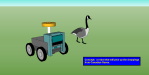
3. It’s always a good idea to check the size of the goose. I discovered that my goose was eight feet tall, so I shrunk it by half and then I felt safer. I know my robot did too.

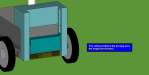
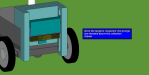
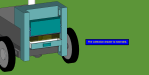
4. Sometimes it is good to re-invent the wheel. I tried to base the design for this ‘bot on my old shovelbot design, and there was no end to trouble. Shovelbot dated back to my pre-component days, and there were lots of flaws. One thing that really drove me nuts was that I couldn’t get the drawer to align with the face of the robot. I thought I was doing something wrong with the drawer, but it turned out that shovelbot had become slightly misaligned over the course of its short life. And that was only one problem among many. In the end, I probably could have saved a lot more time just by building a robot from scratch. Except the tires. Those are good.

5. See those little red wedges along the side of the lifter tower? When you’re working with something like a robot that has multiple configurations, you need some kind of reference mark for each pose.

6. I exported virtually all the images and then realized that the scene didn’t include the maximum lower extent of the prongs. So I had to reposition for another scene, and export all the images again. So it’s good to think about the degree of movement of your ‘bot before exporting.

7. Paper is not obsolete, even with pad computers. I found that the time came when I had to sketch out what I wanted to do on paper before I could do so on the computer. Is it because I’m a child of the twentieth century and my brain is not fully wired for the computer age, or is it because paper doth have its charms? I prefer to think the latter. At any rate, I probably could save myself some trouble by making a rough drawing on paper before I start moving the mouse. But . . . must . . . click . . . push/pull . . . the urge is strong. I will try to resist. No guarantees.

8. Finally, the design evolved as I built it, and it evolved because I built it. You can either see that as frustrating, or as a blessing. For once you can see how the robot’s parts interact in ‘3D,’ you realize both the design flaws and the possibilities for building a better design. And yes, thanks to this exercise in sketchup, it has occured to me how to make this a better bot. But I think I’ve spent enough time on goose poop for now . . . .
Posted in Uncategorized | Leave a comment

Goose-ba in action

Why goose-ba? A riff on a certain robotic vacuum cleaner. Otherwise a clumsy name, I’ll have to think of something else to call it.

In case you’re not familiar with how WordPress galleries work, click on the images to continue . . . .

Posted in Uncategorized | Leave a comment

Call it a ‘goose-ba’ for now

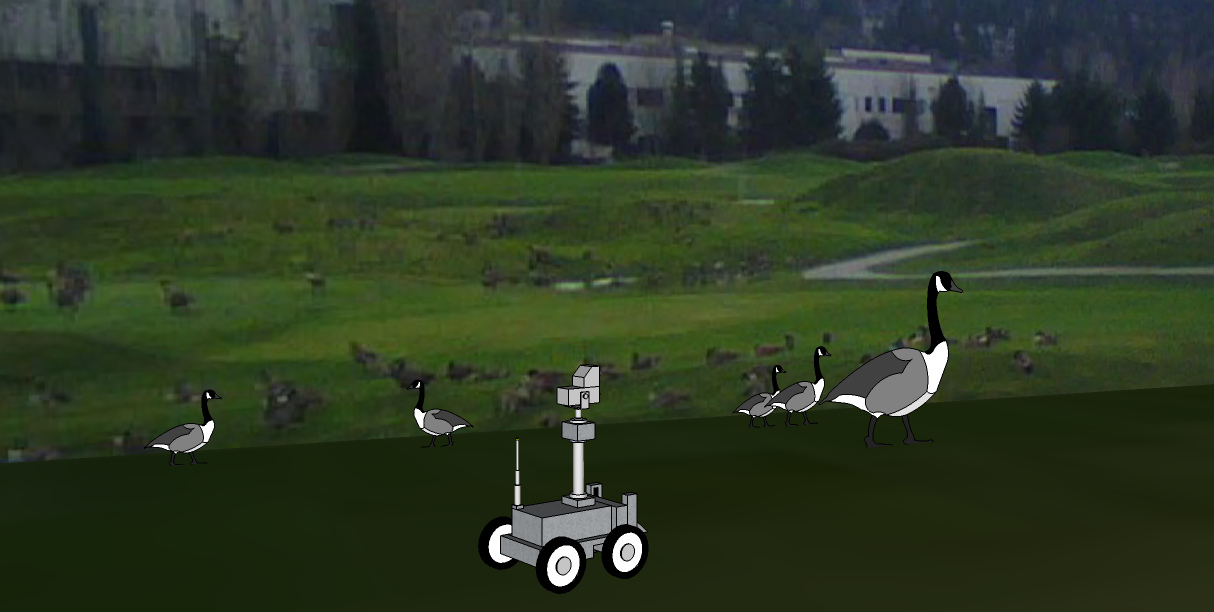
I’m not sure how far I want to go with this idea in terms of graphic portrayal, but anyhow here’s a shrunken shovelbot picking up after the mess that Canadian Geese leave. The background photograph was taken on Saturday in Redmond by the cell phone of yours truly. The camera is lo-res, the day was dreary, and the geese far away, so you can see why I had to sketch in some of my own.

Hey, it’s a work in progress.

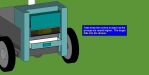
Here’s a frontal view of the modifications (so far):

I think the camera is going away. Unlike shovelbot, goose-ba isn’t remote controlled.

Posted in Uncategorized | Leave a comment

Tracing Canadian Geese in Sketchup

Further adventures while climbing the Google Sketchup learning curve . . . .

I’m thinking about a design for a little robot that will clean up lawns after Canadian Geese have made their messes. So I thought that in order to make an illustration of the device in operation, I should show Canadian Geese as well. However, when I went to Google 3D Warehouse, the only image of a Canadian Goose I could find was of one in flight. Time for Plan B.

Plan B was to (1) search on the internet for a photo of a Canadian Goose that is walking, and (2) import the photo into Sketchup, and (3) trace over it.

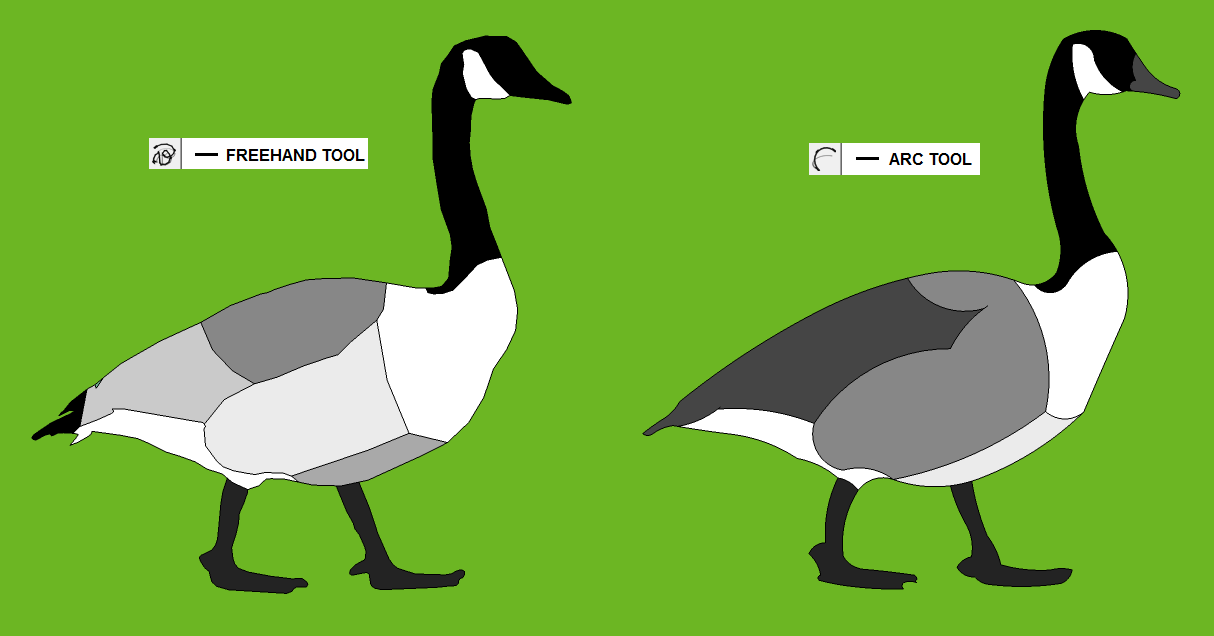
I tried the trace two ways, first with the freehand tool and then with the arc tool. Here are the results:

It was a good photo, but nonetheless given that Canadian Geese feathers are basically graytones it was hard to tell where the shading left off and the marking began, hence the difference in ‘coloration’ between the two renditions.

That aside, I think it is apparent that the arc tool is the way to go for tracing. Besides looking more professional, it probably uses fewer polygons and thus less memory and thus less processor bandwidth. Which is good.

Now onto the robot.

Posted in Uncategorized | 1 Comment

MP3 earbud, earbud cord, and battery case

This slideshow requires JavaScript.

This case holds an AAA battery as well as the earbuds and the cord. And no worries, I have come up with an even better design!

Posted in Uncategorized | Tagged | Leave a comment

MP3 earbud and cord case

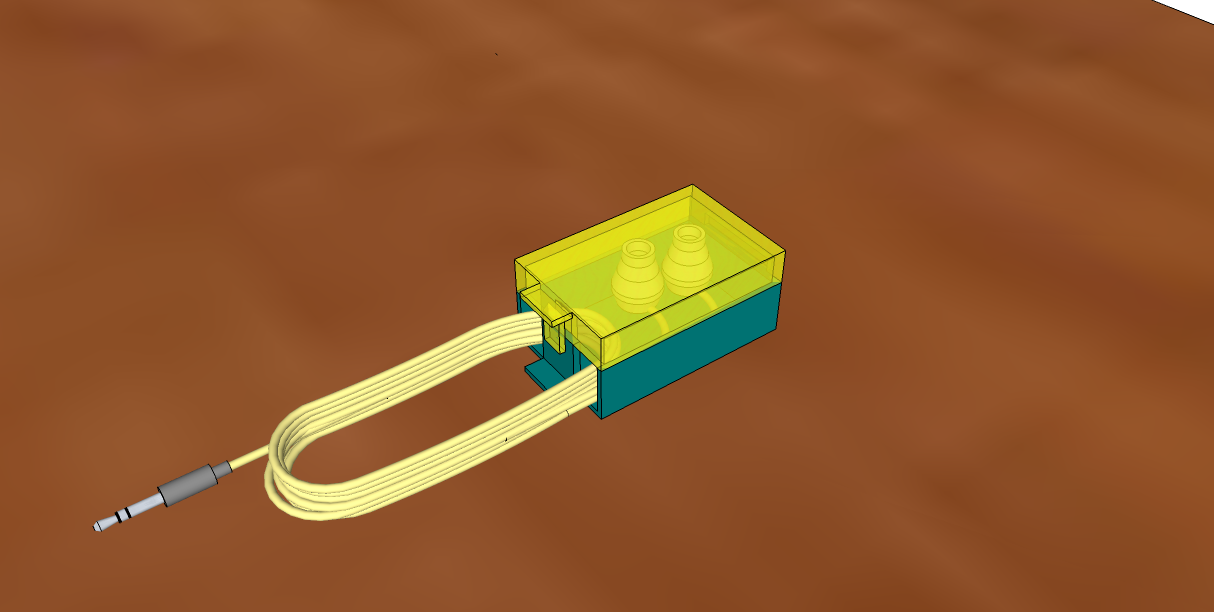
I go out walking with my MP3 all the time, but then there comes a moment in the day when I have to take the dang earbuds off and put them in a pocket or on the car seat, and the cord invariably gets tangled, plus I don’t like lint and dust and dirt on things that I put in my ears anyway.

So I realize that there are already carrying cases that hold earbuds and cords, but my objective is to make one that is as small and thereby as convenient to carry as possible. Hence this design, in which most of the cord is external to the case.

This is just a first attempt at a design for an MP3 earbud cord case. I’d like something more organic, with smoother edges and softer, less breakable plastic, and maybe an artistic design. Stuff for later posts, as I am wont to say.

(Of course, if you’ve ever worked with Sketchup, you know that the real challenge for these drawings was in creating the cord itself!)

Posted in Uncategorized | Leave a comment

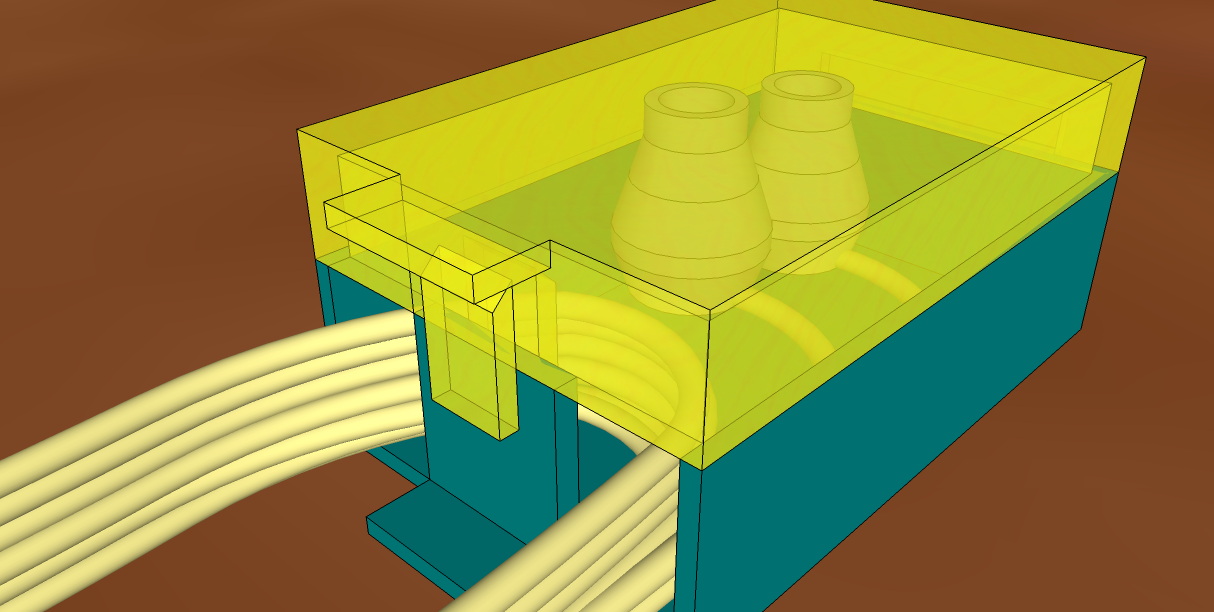
Shipping Container Home Kitchen Unit

As you can see here, I’ve filled out the kitchen unit:

On the right we see a sink, cabinets, and a dishwasher.

On the left is more cabinet space, a stove, oven, microwave, refrigerator and freezer. Note the central control unit under the microwave. The two touch displays are redundant.

Since space is limited, the basic paradigm is that doors slide out rather than swing or tilt. No knobs or handles are shown here, but that’s more for the sake of illustration simplicity than a preference for ‘touch’ operation.

Posted in Uncategorized | Tagged , , , , | Leave a comment