Updated General Purpose Robot

So far, my robot designs have been pretty much just conceptual, but now I’m starting to think about how they might actually be built to serve a real world purpose.

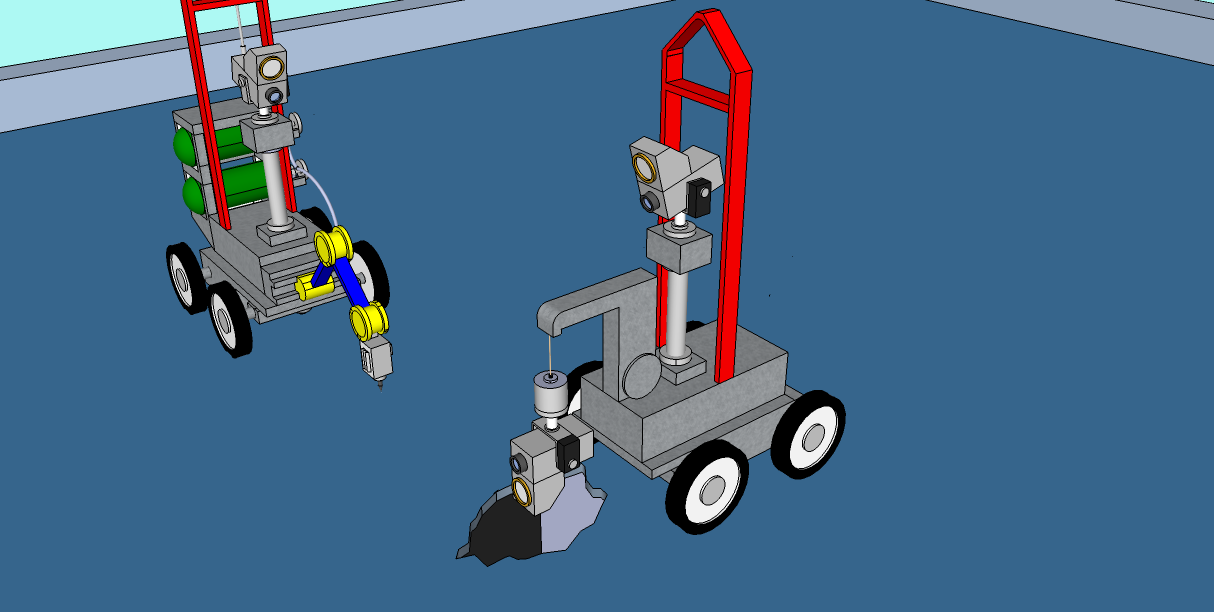
Hence, this shot at a general purpose robot:

The red horseshoe bar is for airlifting via helicopter. I’m using only one camera because two-camera bots are for virtual reality, which this thing is not. I went with the four wheel base instead of the six wheel base, because I honestly don’t see much advantage in six wheels, and with the four wheel base I actually have the capability of turning.

The manipulators are horrid, I agree. If you just glance at them, they’re all right for illustrative purposes. But I need something less cartoony, that actually could be built and serve a purpose. Or did I mention that?

Working . . . .

Posted in Uncategorized | Tagged , , | Leave a comment

Finally, mention of robots to Fukushima

Japan Races to Restart Reactors’ Cooling System

At the request of the Japanese military, a Massachusetts company, iRobot, said it put four robots on a plane for Japan on Friday. Colin Angle, the chief executive, said it had sent two small robots that could measure radiation levels close to the reactors and two larger ones that could pull hoses to spray water on the fuel rods.

He said Japanese soldiers could operate the robots from a protected vehicle.

I hope they get there in time.

In case you haven’t seen this video before:

Posted in Uncategorized | Tagged , , , , , | Leave a comment

US Radiation Monitoring Links

No endorsements, these are just links that I’ve found:

Online Geiger Counter Nuclear Radiation Detector Map

Radiation Network

EPA network

Posted in Uncategorized | Tagged | Leave a comment

Fukushima and Teleoperated Robots (Video)

Posted in Uncategorized | Tagged , , , , | 3 Comments

Nuclear Expert: “Get a camera in there!”

Frank von Hippel, a genuine nuclear expert, talks with Rachel Maddow:

He mentions that the problems are that ‘too much’ of the roof is intact to get hoses in, and they can’t see where to shoot the water until they get a camera in.

So here’s the plan with teleoperated robots. First, we bring them to the containment roof via helicopter.

Make a hole in the roof with hammerbot (mark 2):

Then lower a camera with cambot (Tom Servo says hi!):

Posted in Uncategorized | Tagged , , , , | Leave a comment

Radiation hardening for telebots

I was asked whether teleoperated robots could function in a high-radiation environment. I found a link here, which indicates that microelectronics can survive thousands of rads before degradation. That would be many times a lethal dose for humans.

The electronics should be kept in accessible pull-out/push-in modules that can quickly be replaced, so that the mechanical hardware could stay in service as much as possible.

Posted in Uncategorized | Tagged , , , , , | Leave a comment

Nuclear Teleoperations isn’t a new idea

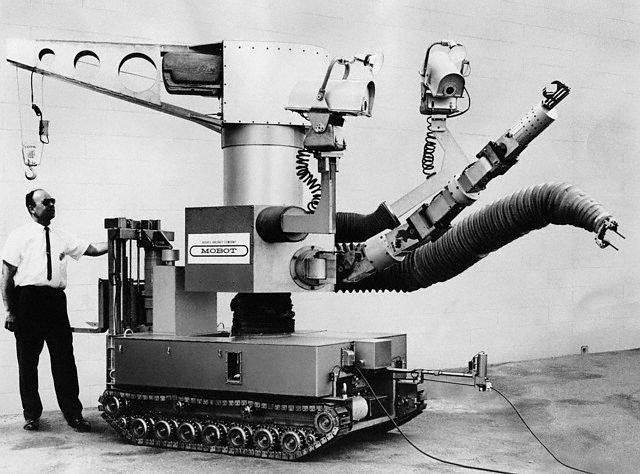
In 1963 came Mobot.

Posted in Uncategorized | Tagged , , | Leave a comment

Fukushima: constructing containment buildings out of shipping containers

Containments for the damaged reactor buildings can be rapidly constructed out of intermodal shipping containers. Shown here are forty-foot units. Approximately 1500 are used to build the walls. At $5000 per unit, the walls can be constructed for $7,500,000 in materials.

As for the roof, cables can be strung across the roof and metal plates can be placed on top of the cables.

A single container ship will carry enough containers for this job. Going by standard shipyard loading operations, this entire structure can be built in less than a day.

A venting and condensation chamber (not shown) can be built alongside the containment building so that steam ventings are not released into the environment.

Containers are stacked eight high on ships, where during storms they experience movements far stronger than earthquakes. The design here is shown twelve high, but these containers are (a) empty and (b) joined with welding.

For safety purposes, it is recommended that teleoperated robots be used in place of human personnel as much as possible.

Posted in Uncategorized | Tagged , , , , | 1 Comment

Fukushima: How to Cool the Fuel Rods

I read this morning that the expended fuel rods at Fukushima are stored in a pool above the reactor core. If the reactor has a meltdown, the pool is damaged and will leak, exposing the fuel rods to air, which will cause them to heat up and release far more radiation into the atmosphere than could a mere meltdown.

Currently the Japanese government is planning to keep the spent fuel rods cool by dumping water from helicopters. This was done to put out the fire at Chernobyl, but I recall that at least one pilot died from radiation exposure.

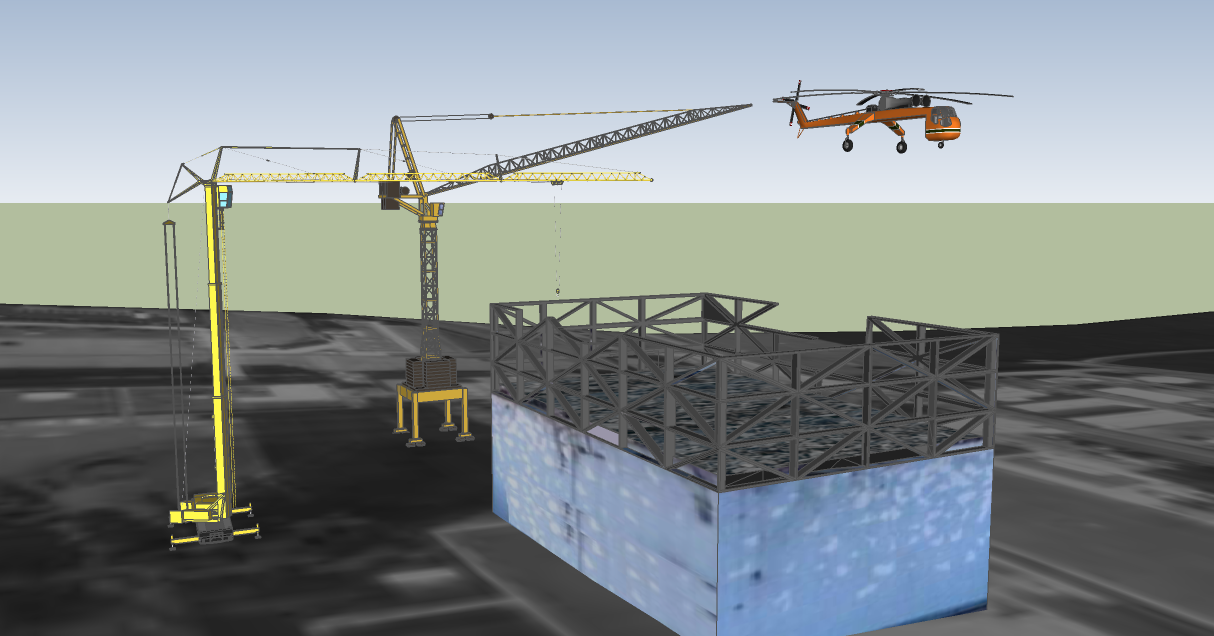
Another way, as shown in the above sketchup image, would be to use tower cranes to position water hoses into the damaged pool. I show both stationary and mobile tower cranes. If Google Sketchup Warehouse has the proper dimensions for the equipment and buildings, this technique appears workable.

I think the flow rate from hoses directed by a fleet of tower cranes would be considerably higher than that provided by helicopters taking turns. Moreover, with the aid of teleoperation, the hose spray could be directed toward the areas with the worst damage and highest levels of heating, whereas dumping water from helicopters might be hit-or-miss in regard to its targeting. Also, hoses from tower cranes could provide an adjustable flow rate, whereas helicopter dumping entails the risk of a transient temperature shock causing an explosion when the rods heat up excessively between dumpings and then are abruptly cooled during the dumpings.

(NOTE: It is beyond the scope of this blog to discuss why it appears that GE deliberately designed Japanese nuclear power plants to be doomsday devices.)

Posted in Uncategorized | Tagged , , , , | Leave a comment

International Pi(e) Day

Yes, there is an International Pi Day, according to wikipedia and even the United States Congress. And Google too — so that makes it official.

In case you didn’t bother to check the link and couldn’t guess, the reason this is Pi Day is because it’s March 14. Third month, fourteenth day — 3.14. And so Geeks everywhere are celebrating.

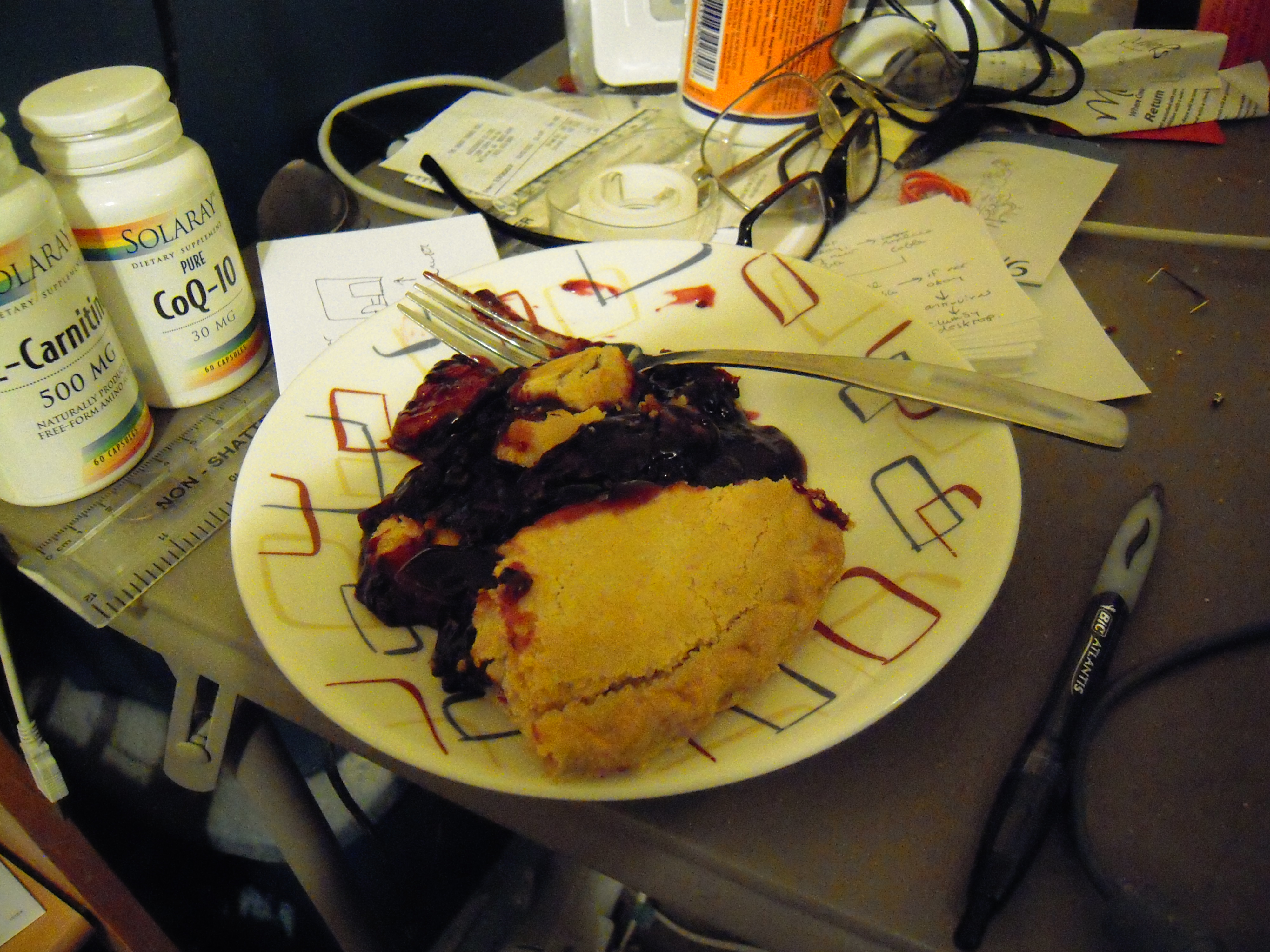
Pi Day is easy to celebrate. One buys a pie and eats it, usually in a collaborative effort. So that’s what I and my guests did. This year’s pi(e) of choice was Marionberry:

A brief ceremony, but fun. And we’re all looking forward to the big blow-out on International Pi To Four Decimal Places Day, in 2015. Parades and Pizza! Parades and Pizza!

And Merry Circumference to all!

Posted in Uncategorized | Tagged , | Leave a comment