
Submarines are yellow, hook-ups are orange, red is the relief hatch chimney, the docking platforms are green with white. The purpose of the coloring is to identify objects in the murky deep.
Submarines are yellow, hook-ups are orange, red is the relief hatch chimney, the docking platforms are green with white. The purpose of the coloring is to identify objects in the murky deep.
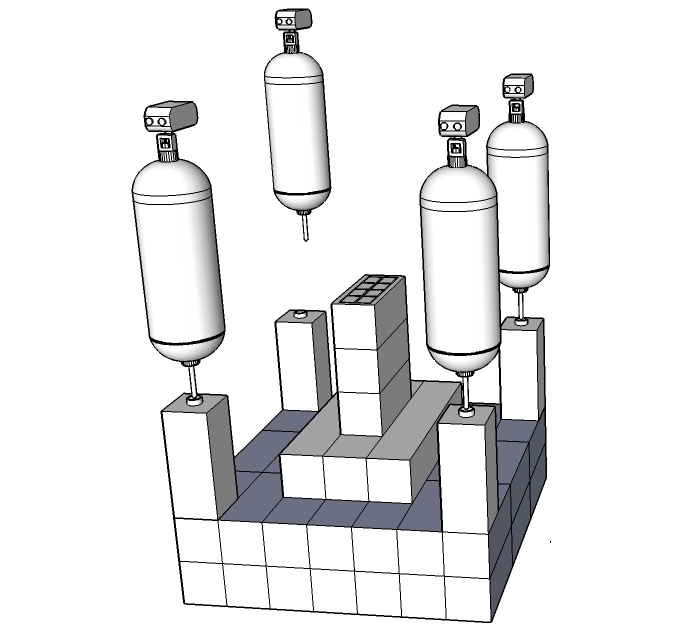
In this version, the hook-ups are moved to the corners and placed on towers. Submarines carry tanks of oil from the spillinator to the surface, where the oil is offloaded onto tanker ships. The submarines then carry the tanks back to the spillinator.
The tanks appear to be about twice the volume of a TEU. That’s 2720 cubic feet, or 77 cubic meters, or 19,244 gallons. It would take approximately four hundred seconds to fill a tank if there were only one tank. So on average, each tank will be there for about twenty-four to twenty-eight minutes.
At $2 a gallon, each tank would be $40,000 of oil.
There is lots of room for modification in this drawing, and I’d also like to do an animation at some point. But the main point is: a low-pressure containment with submarine transport is possible.
Another month, another reading list. I’m reading another book on plastics, and then a book about the scientific effort to identify where human memory is, and then a book on giant molecules, called appropriately enough, Giant Molecules.
And I’m also reading a Lovecraft anthology. His famous story, The Call of Cthulhu is in the middle. That’s my one ficton book. I suppose it’s kind of downbeat. I’ll read something happy next month. Maybe.
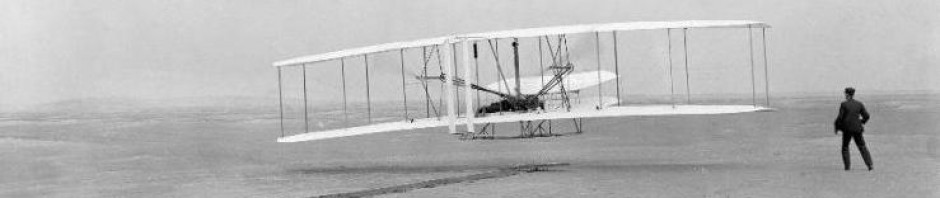
I was surprised a while back to read that the Wright Brothers’ contribution to flight was regarded as ‘meager.’ So after reading two biographies about the Wright Brothers, what did I learn?
The Wright Brothers built a wind tunnel to determine optimal wing design. They learned how to control aircraft by practicing on kites and gliders for months. Finding no engine available for their purposes, they built their own engine. They determined the optimal design for propellors. And then there’s their patent on wing warping.
So they designed the wings, propellors, control systems, and engines. That doesn’t sound meager to me. That sounds like just about everything to do with an airplane.
Attacking the Wrights is not new. I’ve found two stories of ‘secret airplanes’ that supposedly beat the Wrights into the air. I call them ‘secret’ because there are no photographs, no witnesses, no plans, no remnants. Yet here we are, a hundred years later, and the stories are still given credence.
But what’s the big deal with the Wrights anyhow?
Well, if you’re a bright young person, then you need to know the truth path to success. Either the Wrights are an example, or they’re not. If you try to slap together a ‘secret airplane,’ you’ll find it doesn’t work, and then you’ll give up, discouraged. If you realize that any great achievement may require a lot of intermediate steps and attendant effort, and then you go ahead and do it all, then you too can go far.
I don’t know if the journey is the reward, but I do know that without the journey, you don’t get there.
I just finished reading a book, The Production and Properties of Plastics. I won’t link to Amazon.com, because it probably isn’t there. The book was written shortly after World War II.
I learned what a sprue is. I wonder if they still use some of the terms, like ‘flash.’ Mainly it was a lot of chemical names, of which only a handful of trade names, such as lucite and formica, were familiar.
I’m not sure what the personal enrichment was for reading this book, but anyhow, time to move on.
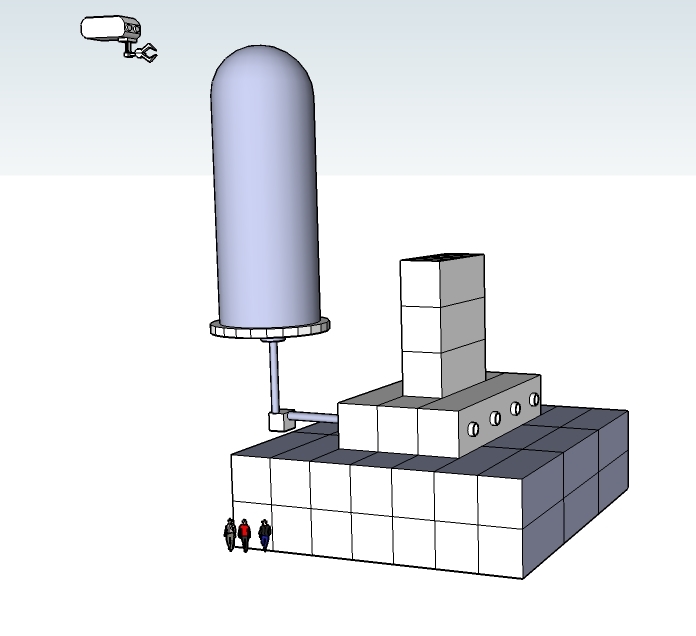
Risers are the pressurized pipes which receive oil from the wellhead. The problem with my design is that I didn’t want there to be any pressure on the wellhead containment (ie, spillinator). So instead, I have an ROV (remote operated vehicle) connect an unpressurized tank to one of the containment valves. The tank fills with oil, and since oil is lighter than water, it floats to the surface.
The general idea is that there can be multiple tanks, so that one is always filling from the containment. Once they reach the surface, the oil is drained. Water takes the place of the oil, which causes the tank to sink to the bottom again, where the ROV retrieves it and connects it to the containment.
This is a very crude picture, of course. And of course those guys at the base need to go sometime too.
Recently, I read The Memory Palace of Matteo Ricci, which is about a sixteenth century Portugese monk who goes to China as a missionary. Why? That is, not why did he go to China but why did I read the book? Because I thought it would discuss his memorization system. You see, Ricci was brilliant at memorizing things.
The book actually gave away the secret in the first few pages, and if you know about the Greeks, you know the system already. Basically, the Greeks would memorize a speech by going into a house, and associating each part of the speech with a different room in the house. Ricci’s contribution was to create a ‘palace’ in his memory with which to associate certain facts.
It’s occured to me that there’s a good reason why the human mind works this way. Basically, our brains are hardwired to remember geographical cues for navigation, not to remember facts and figures. So if we can associate facts and figures with geographical cues, then we can remember the facts and figures better.
Anyhow, I came across this blog entry that was linked to Live Science, and that discussed virtual environments such as Second Life as learning tools. So far as I know, no one has really followed the Greeks and Ricci to the conclusion that a virtual world can create a geography that can be associated with facts and figures for memorization.
It seems to me that this would be really good for learning languages.
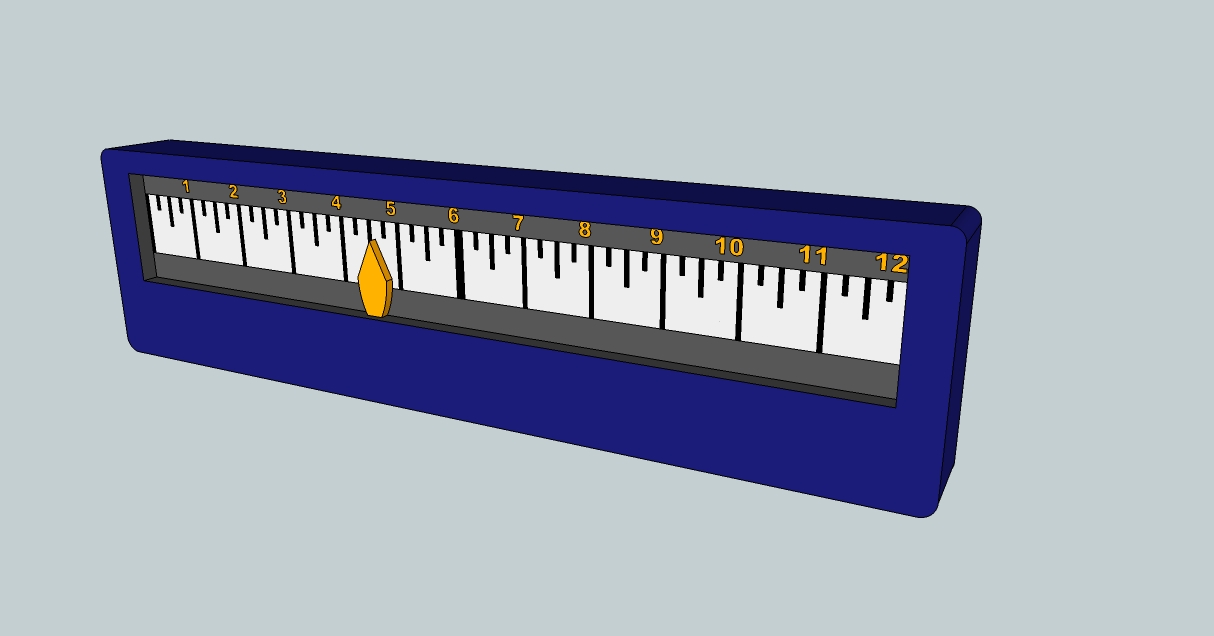
We have round analog clocks and digital clocks, but I haven’t seen a linear analog clock. I think it sends a different psychological message to the viewer: that time is moving forward. Or at least, left to right.

This design is somewhat downscaled from the earlier version but retains the essential features. The riser hook-up valves are on the side, and now they use the roof of the spillinator as a platform. The relief hatches are mounted on a chimney to keep them out of the way of the valves. Note that forty-foot containers are used on top of the hole shown in the center of the previous image.
Electric pumps will have to be used instead of riser pressure in order to bring the oil to the surface. I’m hoping that pumps capable of operating at a depth of one mile beneath the surface of the sea are available. Otherwise, another idea will have to be used.
This model was built in Sketchup without thinking too much about the interior. I’ll fix it tomorrow. But the outside looks like what it should for now.

I’m going through a redesign phase on the oil spill housing. For convenience’s sake, I’ve decided to call it the ‘spillinator.’ Here are shown the first two levels. Note that these are 8’x20’x8.5′ intermodal shipping containers.
In this design, there are 2’x2′ cuts in each face to equalize pressure. The internal area is 20’x24′.
I intend to work an hour or two on this design per day, and will post my progress.
Anyhow: Behold, the Spillinator!
 Engineer Zero