Teleoperated Radioactivity Sample Boat

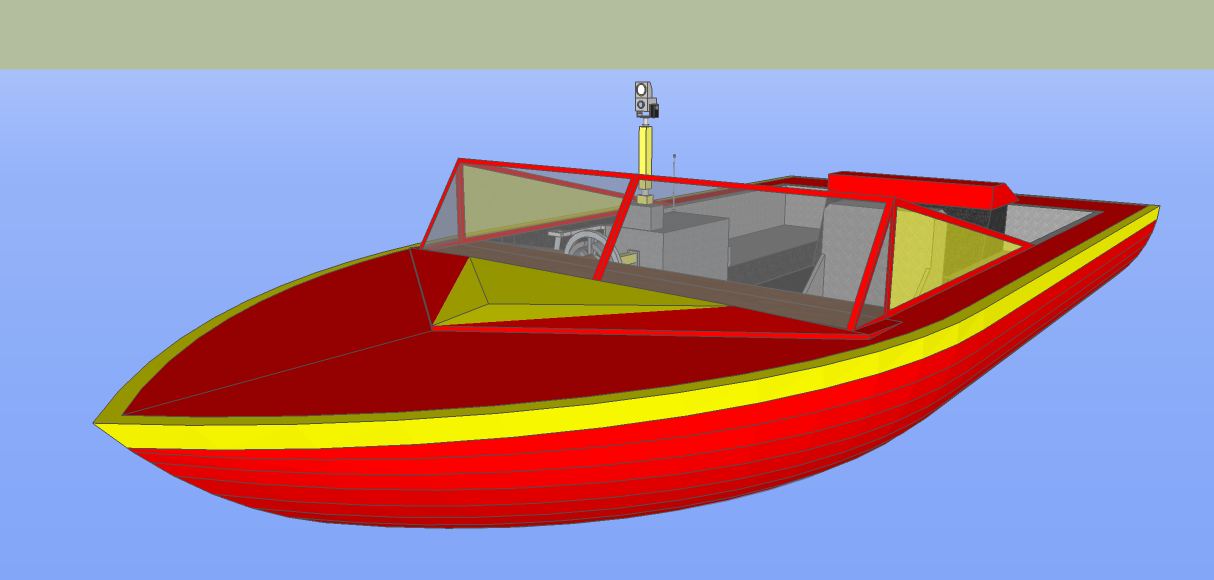
The high levels of radioactivity in the waters off the Fukushima nuclear plant require constant monitoring, which is best conducted without exposing human workers. Hence this design for a teleoperated radioactivity sample boat.

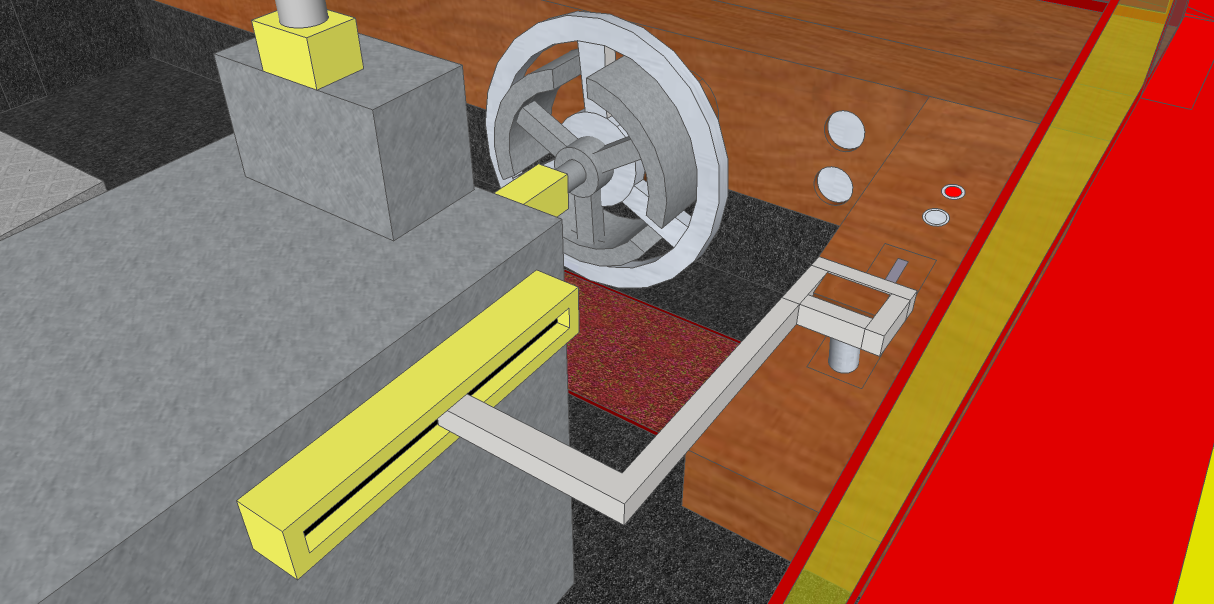
To make the modification effort as simple as possible, I borrowed heavily from my wheeled TOR designs. As for the boat, the design was downloaded from Google Sketchup 3D Warehouse, and the only significant modification was to remove the driver’s seat to make room for the robot housing.

A servo steers the boat, while a linear actuator adjusts the throttle. What about ignition, lighting, etc.? Rather than having mechanical interfaces, it might be best to get under the dashboard and hack into the wiring, but an additional, smaller robot arm could certainly be tasked with punching buttons.

Other than video, all telemetry and control can be interfaced through a single Arduino with communications via XBee shield. Onboard telemetry should include a GPS module.

Sorry, I didn’t have time today to do the sample collecting equipment.

Posted in Uncategorized | Tagged , , , , , | Leave a comment

A Roof for Fukushima

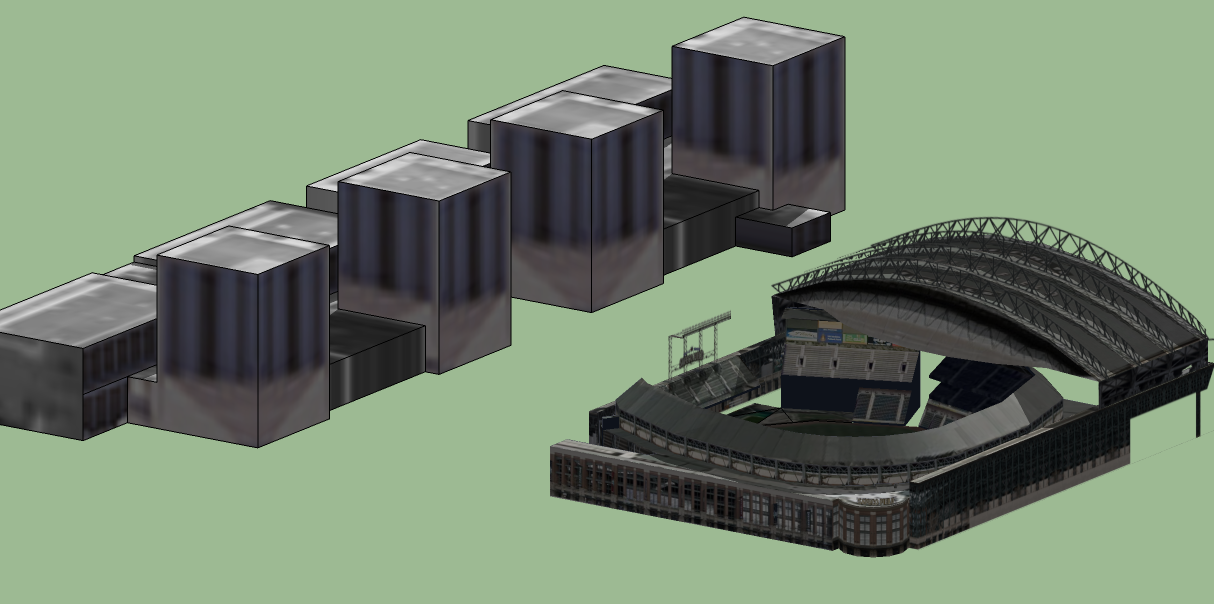
On the right is the baseball stadium known as Safeco Field in Seattle, USA. It is famous for its retractable roof, which rolls back for sunshine on the rare days in Seattle when there is sunshine.

Why bring this up? Sooner or later, Fukushima must be covered with a roof to prevent radiation leakage to the environment. Having a retractable roof may seem a bit of technology overkill, but I mention it because it allows for the possibility that the roof could be assembled at a distance where radiation is lower, and then rolled on rails over the tops of the buildings.

Based on the Safeco Field experience, I believe that structures like this could be constructed for the four damaged reactor buildings at a total cost of less than half a billion dollars and be ready within six months. In the short term, of course, temporary but faster solutions could be employed.

(True, Cowboys Stadium — site of the 2011 Superbowl — has a bigger retractable roof, but it slides in two rather than sideways. )

Posted in Uncategorized | Tagged , , , | Leave a comment

Fukushima Cooling Pump Cascade

A German concrete pump is being used at Fukushima to spray cooling water on the spent fuel rods. Now that the plant’s own cooling pumps are down and the cooling pools are empty of water, this pump may be all that keeps the spent fuel rods from catching fire and spreading radioactivity over a large territory.

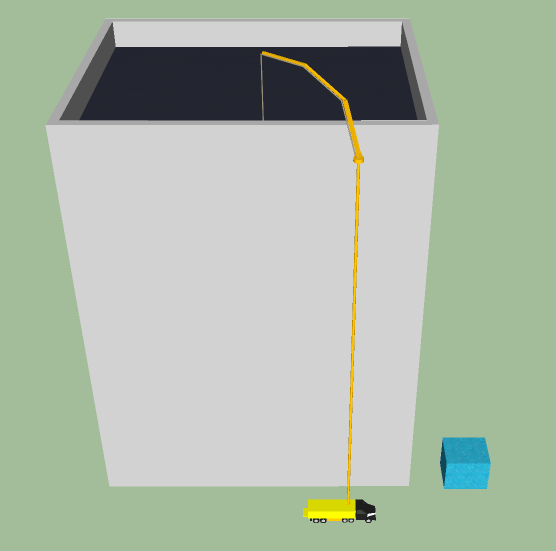
The concrete pump has a flow rate of 160 cubic meters per hour, and that sounds impressive. But does it look impressive? Here’s what the pumping truck looks like compared to a reactor building:

The blue cube is 160 cubic meters. Think of pouring a couple tablespoons of water on a hot frying pan once every hour. Are you cooling the pan down, or just making puffs of steam? Well, at least with a frying pan, the puffs aren’t radioactive.

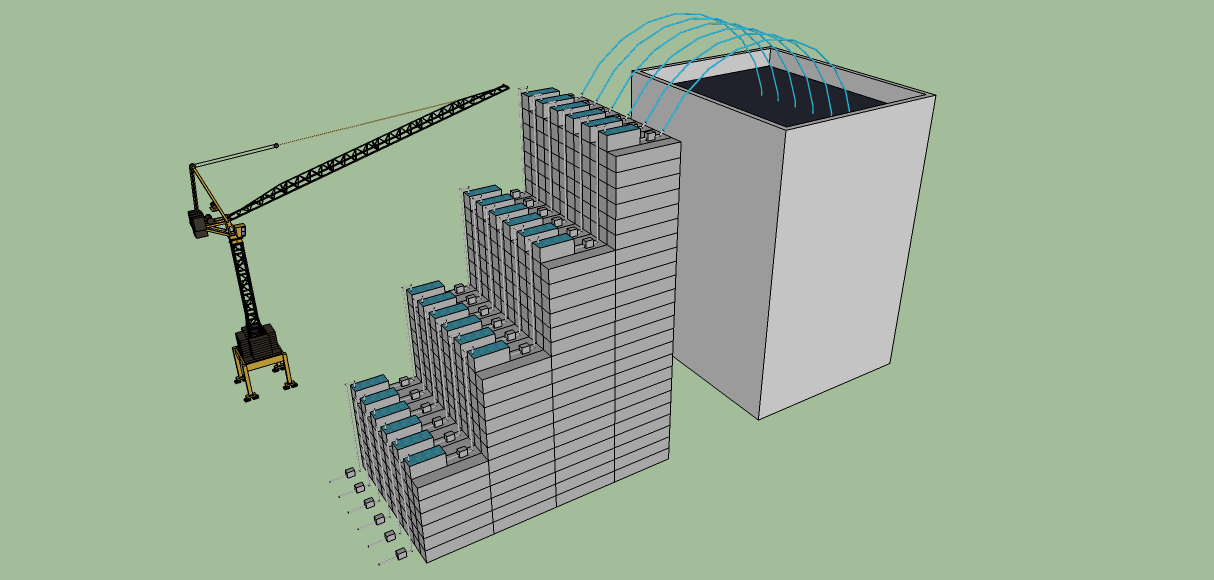
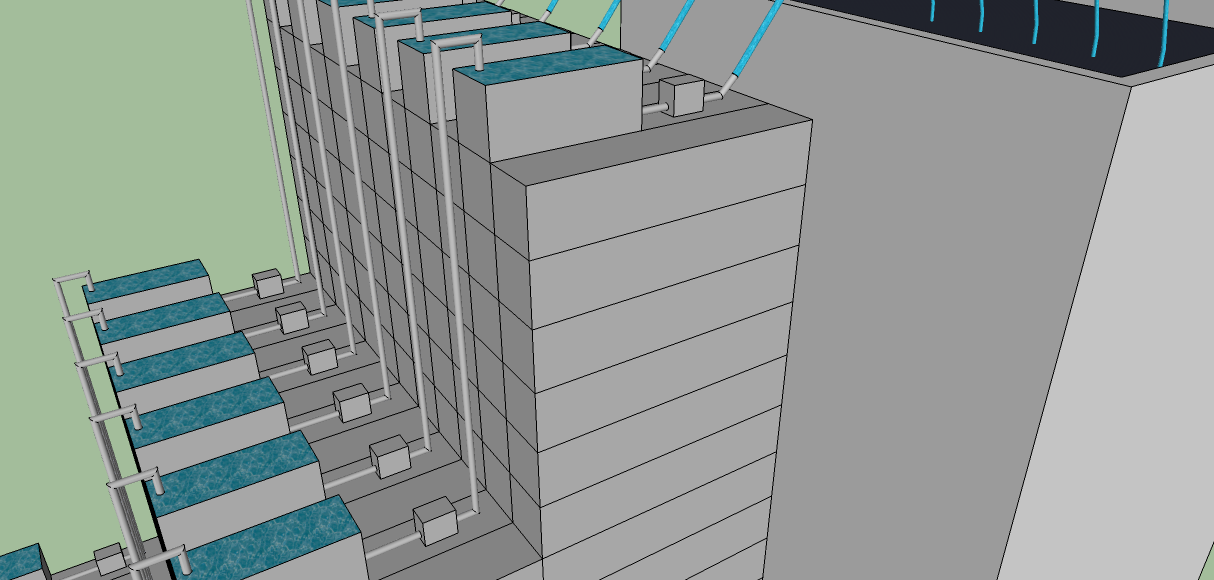
I suggest a more robust solution, like so:

This pump cascade is built out of shipping containers. Each pump housing contains multiple high-flow pumps, like these. With each pump having a flow rate of 360 cubic meters per hour, and ten pumps per cascade and six cascades in all, total flow rate would be 21,000 cubic meters per hour. This would be enough to completely fill the cooling pools in an hour.

(If you checked out the link, you may have noticed that these pumps have a head pressure of 95 meters. Since the reactor building is only 60 meters, why have a cascade at all? Why not just have a single pump for the entire height? Well, I’m not an expert on hydraulics, but I seem to recall that for a given pump head pressure, there’s a trade-off between flow rate and pumping height. By using the pumps in cascade like this, we reduce the pumping height for each pump and thus the flow rate will be higher. Maybe four pump stages as shown is overkill, but I think at least two stages should be used.)

Each 40-ft container costs about three thousand dollars. Total cost for all 720 containers is approximately $2 million. At ten minutes per container, the entire structure can be built within a week.

By the way, mix boron in the water to prevent a fission reaction, or the water will act as a moderator and there will be a steam explosion. This is discussed at Fairewinds Associates.

Posted in Uncategorized | Tagged , , | Leave a comment

Fukushima: Removing Spent Fuel Rods

If you’ve ever looked at Fairewinds Associates videos, you know that the big problem at Fukushima is the drying up of the cooling pools which are suspended over the reactor vessel and contain the spent (but extremely radioactive) fuel rods.

Before a worst case accident occurs, I believe the spent fuel rods must ultimately be removed from the damaged cooling pools and stored off-site (that is, in a place that doesn’t happen to be over a nuclear reactor).

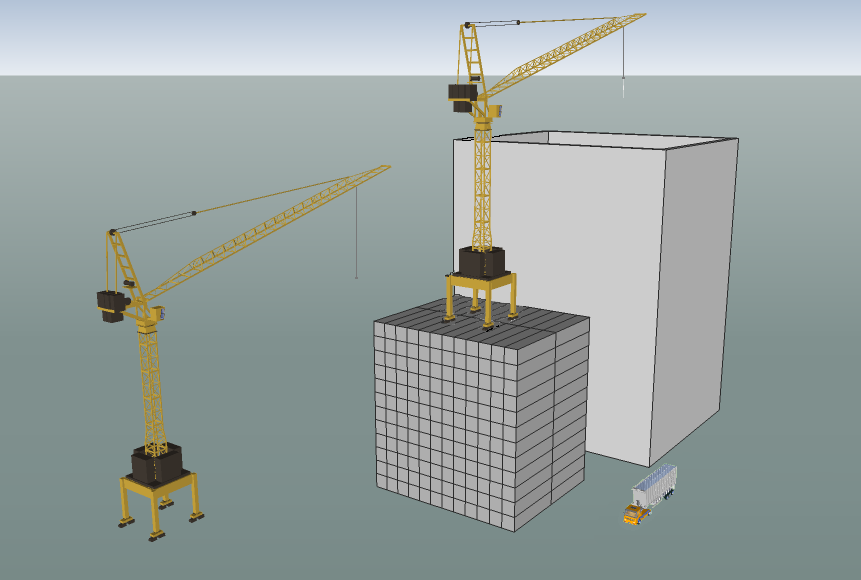
But how do we get the rods out of the cooling pools? The tower crane that I found in Google Sketchup 3D Warehouse is only 60 meters tall, which is unfortunate because that’s about the height of the Fukushima reactor buildings (prior to having their roofs blown off) and therefore doesn’t allow any reach.

So I added a base of shipping containers like so:

The crane on the ground erects the platform, upon which is built the upper crane, which can access the fuel rods in the cooling pool and remove them.

Shipping containers are normally stacked no more than seven or eight high, but since an intermodal shipping container can hold about five times its weight, I thought it was fair to assume that empty containers can be stacked up to five times higher than loaded ones. If so, then a stack of twelve as shown is not a problem.

I’m not saying there aren’t better ideas. But I do think this is safer than concrete burial.

Posted in Uncategorized | Tagged , , | Leave a comment

Japan’s Choice: Go Solar or Go Dark

Japan’s dim capital faces further power crunch” (Associated Press, April 3):

About 9 million kilowatts of capacity may be gone forever as the radiation-leaking Fukushima Dai-ichi nuclear plant is likely to be scrapped and the future of the halted Dai-ni plant is uncertain. That suggests chronic shortages until new power plants are built. A government plan for the power supply that may include new plant construction is to be announced at the end of April.

Electrical power is critical to the automobile and steel industries, and one Tokyo resident comments, “I think it will be nearly impossible for Japanese people to live without air conditioning.”

It will take at least ten years to construct a nuclear power plant. Waiting that long is out of the question. So does Japan go for fossil fuel? That’s not so cheap either.

For fossil fuel plants, according to wikipedia, “Construction costs, as of 2004, run to US$1,300 per kilowatt.” But Synapse Energy comments:

Construction cost estimates for new coal-fired power plants are very uncertain and have increased significantly in recent years. The industry is using terms like “soaring,” “skyrocketing,” and “staggering” to describe the cost increases being experienced by coal plant construction projects. In fact, the estimated costs of building new coal plants have reached $3,500 per kW, without financing costs, and are still expected to increase further.

For the replacement of 10 gigawatts of electrical capacity, Japan would need to spend $35 billion on coal plant construction. Remember, that’s just on plant construction. Then you have to buy the fuel.

Coal-generated electrical power operational costs are 5.5 cents per kilowatt hour. Even at half capacity of 5GW, that would be $24 billion added to the cost over the next ten years.

Total coal power cost for Japan: $59 billion, and it will take several years to build the plants.

Fortunately, there is a power source that Japan can build now — and will provide power cheap. It’s solar power. Current costs for rooftop solar photovoltaic installations even in the anti-solar US have dropped to $4.22 a watt — or $4220 per kilowatt.

For the 10 GW that Japan needs, the total solar power cost would be $42 billion, versus $59 billion for coal power — and, perhaps, Near Infinite for nuclear power.

The aforementioned price for community PV installations is without tax incentives or subsidies. This can be done personally, without a massive government program.

Indeed, the only thing that may prevent Japan from going massively solar this summer is the government, which will dangle false promises of a future glut of subsidized fossil fuel power in front of consumers in order to deter individualized solar power installation in the near term.

But can the solar power industry meet the need in the short term? Solar power industry inventory is currently 3 GW. That’s thirty percent of Japan’s power production gap, already built and ready to install.

Sweat out the long hot summers and shiver through the long cold winters in the dark waiting for fossil fuel plants to be built, or go solar now. That’s the choice for every Japanese citizen, community, and company.

Posted in Uncategorized | Tagged , , , , , | 1 Comment

Robots and Radiation

Robots to the Rescue,” Technology Review (29 March 2011):

. . . . constructing robots designed to withstand high levels of radiation would be difficult. “For radiated environments, one needs robots that are particularly rugged,” he says. “Such robots typically are rather large, slow, have only a few CPUs and sensors.”

Surely the slowness issue doesn’t apply to teleoperated robots. Commands sent through a fiber optics cable travel at the speed of light, no matter what the exterior radiation level is. And so what if the CPU manipulates the claw in milliseconds rather than microseconds? That’s still too fast for a human operator to notice.

Radiation also has relatively little effect on bulk electronics like batteries, power supplies, servo motors, etc. A radiation environment high enough to affect a 24 DC motor is barely this side of a nuclear bomb detonation.

We don’t have to shield an entire robot. Just the vulnerable microelectronic circuitry that forms the “brains” and sensors.

I find it hard to believe that even the microelectronics would be more vulnerable to radiation than humans are. After all, the debate about whether cell phone radiation affects human brain tissue is in the news all the time, but we seldom if ever hear any concern over whether the same radiation affects the cell phone itself.

Even if the radiation in a damaged nuclear plant is sufficient to damage electronics, wouldn’t it be better to simply replace a burn-out module in a robot, on-site, rather than having to hospitalize a human worker due to overexposure?

As I recall from my brief, unhappy days in nuclear power, radiation is attenuated by a factor of ten by a two-inch thickness of lead. It’s got to be a lot easier to encase electronic components in a lead box than to shield an entire human body.

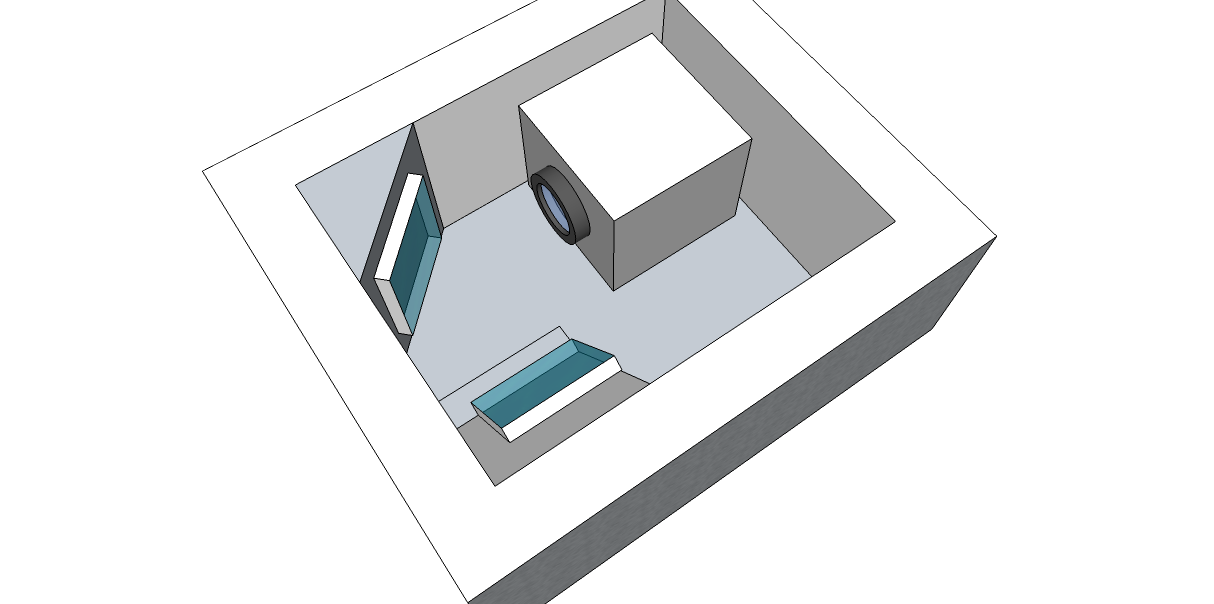
Even cameras could be protected, by using periscope configurations. The camera would be placed in a thick, shielded box with mirrors:

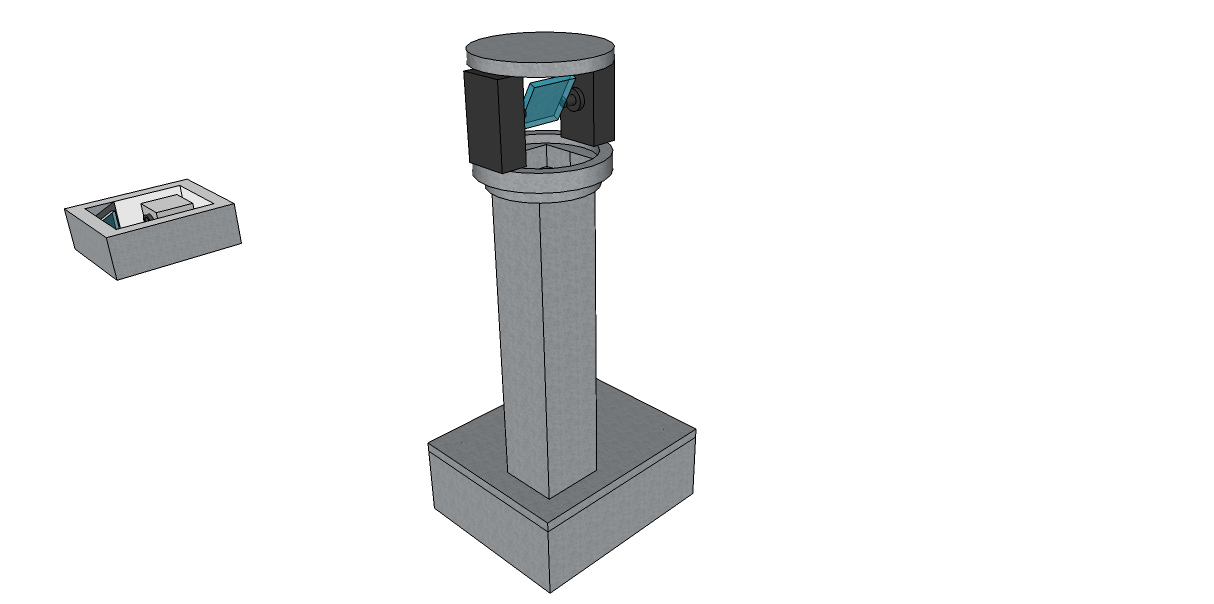
Then a tube is mounted atop the box with mechanisms to tilt and turn the upper mirror:

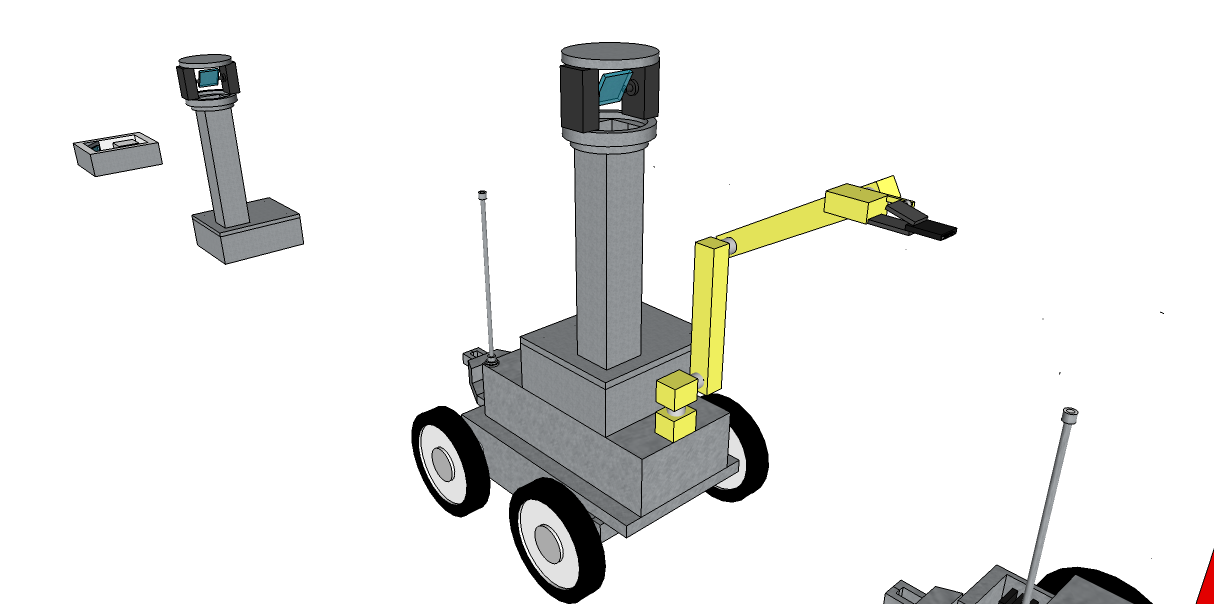
And in turn the periscope assembly is mounted on the robot:

Now, judging from this illustration, I can see that I need to rescale my robot, because video cameras are much smaller than I’ve been showing. That in turn would minimize the size of the protective lead box.

But would the lead box still have to be so heavy that the robot couldn’t move? Many hobbyist robots these days are powered by wheelchair motors, which can carry a hundred kilograms or more. A small lead lined box two inches thick would weigh less than this. Even four inches is possible, and that would attenuate radiation by a factor of a hundred.

Anyhow, how much radiation are we talking about before conventional electronics breaks down? I came across this statement at eHow.com: “Ionization on electronics from nuclear radiation can damage semiconductors within devices for long periods of time after only 5,000 rads of radiation.” ‘Only?’ That dose is five times more than is needed to kill a human worker in a day.

I hope someone reading this will send me a link to numerically-specific (as opposed to general-concept) information on how much radiation it takes to kill electronics.

But until then, I remain convinced that conventional electronics can fare better against radiation than can human beings. Therefore, as much as possible, teleoperated robots should replace human presence in high radiation environments.

Posted in Uncategorized | Tagged , , | Leave a comment

Robot door-opening tool

“Robots to the Rescue” (Technology Review, March 29, 2011):

Some experts also question how helpful robots would be after a nuclear plant disaster. Something as simple as a locked door could prevent a robot from doing its job.

Is it really that hard for a robot to open a door? I came up with this design for a robotic door opening tool:

It’s carried in a wagon behind the robot, then lifted and oriented like so:

It would be under remote control, of course, relayed by the robot to the human operator. I’m debating whether the mode of communication between the robot and the door opener would be radio, infrared, or cable. I’m leaning toward infrared.

But what if the door is locked? Hmm . . . have to design device to insert and turn keys. But is that impossible? It seems to me that these days, journalists can write anything about, say, time travel, and everybody nods. But suggest the ability of a robot to insert a key into a keyhole — why, that’s sheer fantasy!

The above article, incidently, continuously hammers the point that you need extreme radiation hardening for robot sensors to function in a high-radiation environment. I have my suspicions that the problem is exaggerated, but that’s deserving of another blog entry.

Posted in Uncategorized | Tagged , , , , , | Leave a comment

TOR Systems List

This picture identifies the major systems for the TOR. (TOR stands for Tele-Operated Robot.) Here is a preliminary parts list.

1. Arduino Microcontroller for input/output interface between communications and motor/servos. Easy to find, only $35.

2. Wireless Camera available on Amazon.com for under $100.

3. Servos/Actuators can be found at digikey, etc.

4. Sheet metal enclosure. I’m not sure where you get the material, but it must be available locally because it’s used in machine shops all over the place. There are books on Amazon about how to use it.

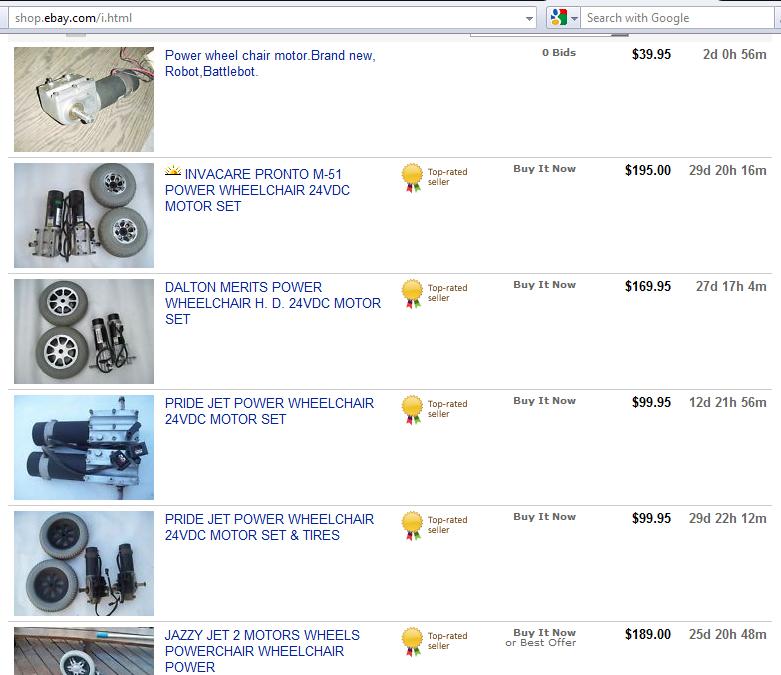
5. Motor (Wheelchair) is available on eBay for around $100-$200. Behold:

6. XBee for point-to-point radio communications. Another $30-$40 item, available at Maker Shed and elsewhere.

Lots of things left off this list: like front tires, 12 V batteries, battery connector, electronics mount and shielding, all kinds of stuff. But this list is a start toward the process of actually building the robot.

And the components connect just like lego bricks, so all you have to do is buy them and snap them together . . . riiiiight. But seriously, I think the hardest part of this project will be to clear enough room in my apartment to build it.

Well, I suppose the arm is going to be a challenge too. On the other hand (excuse the appendage-related pun), if you’ve programmed one servo, you’ve programmed them all. Right? Riiiiight.

Posted in Uncategorized | Tagged , , , , , , , , , | Leave a comment

Robot arm studies

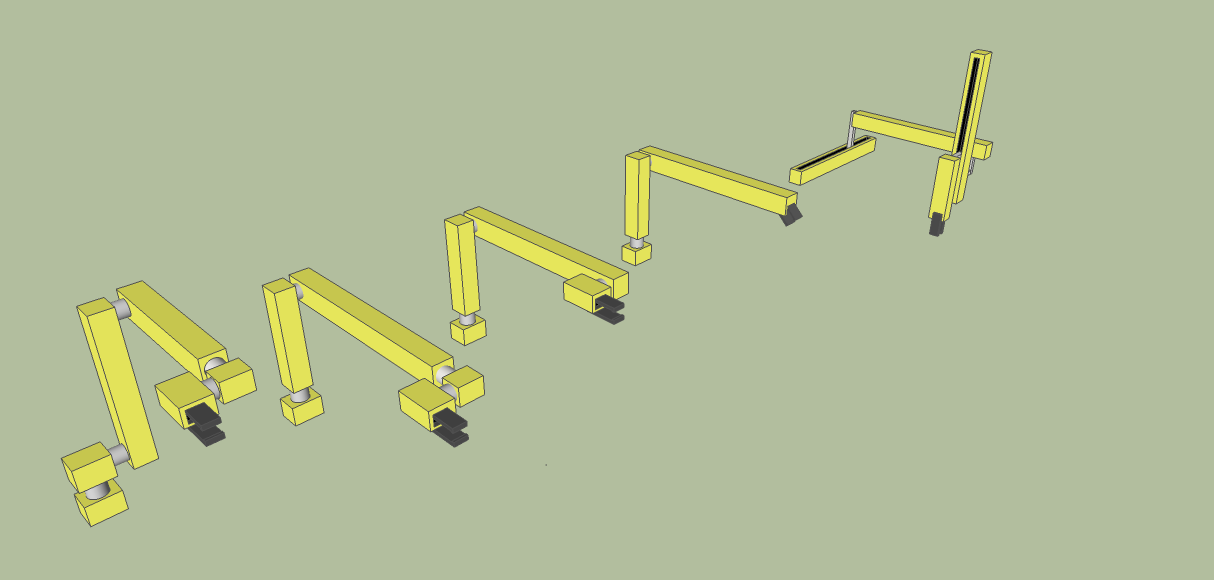
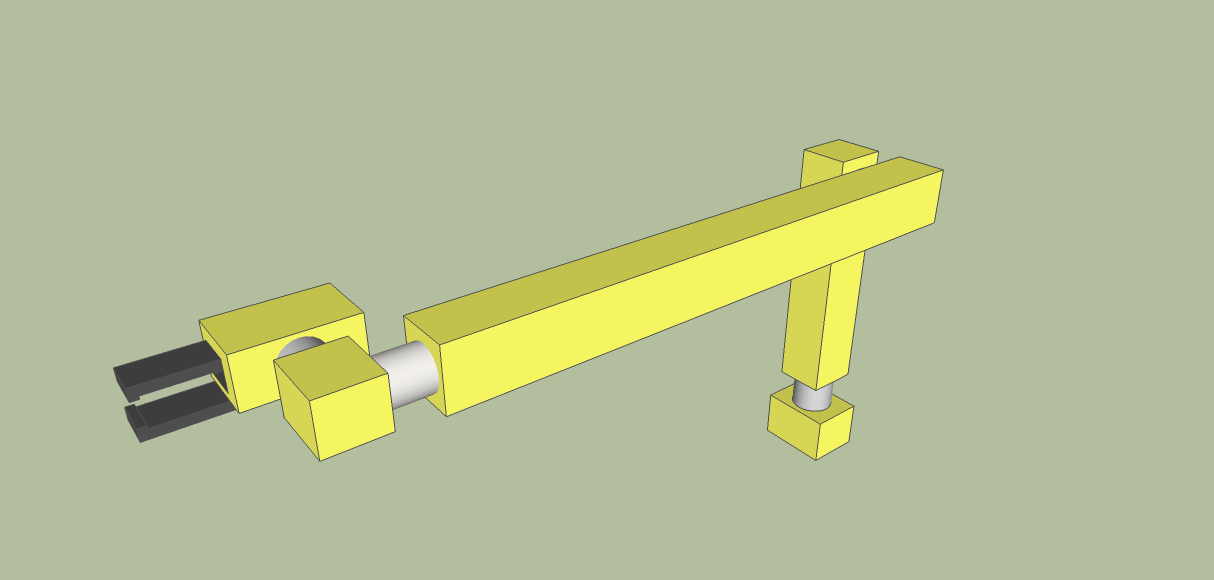
As I get closer to designing a teleoperated robot that I can actually build, I wanted to experiment with different robot arm designs. Hence I took the re-design of a couple days ago and made several re-designs out of it in turn.

In this first version, I deleted the camera at the base because the robot already has a camera. I also changed the claw servo from radial to linear. I’m not sure that was such a good idea, but there we go.

Here I got rid of the back-arm and compensated by extending the fore-arm. I might need a counterbalance now for the fore-arm.

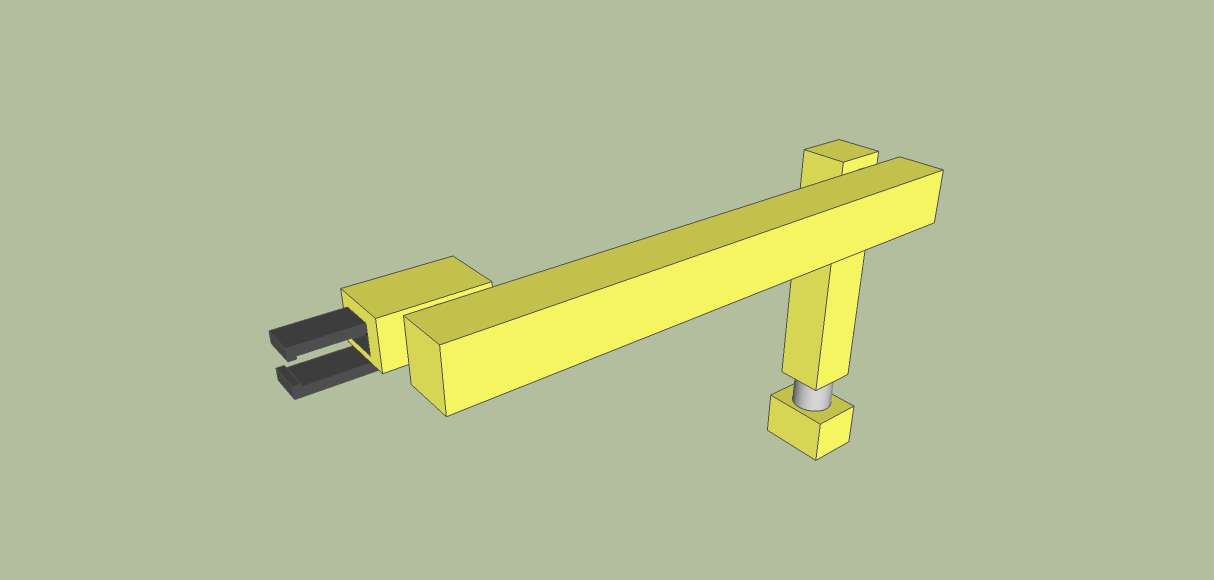
Always vigilant to cut out costly servos, I eliminated the ability of the wrist to turn clockwise/counter-closewise. The claws can still tilt and pick up stuff and punch buttons. Maybe it’s not so good at pulling throttles.

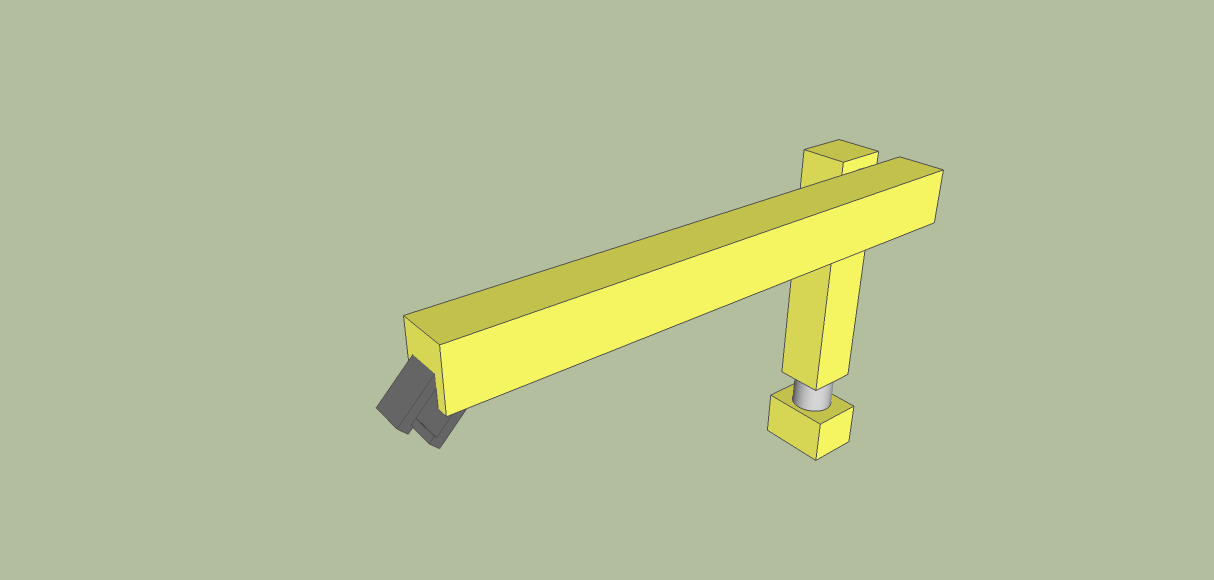
Doing away with one more servo. I tilted the claws as a compromise angle because the wrist angle is now fixed. (My attempt to make the claws stand out more with different coloring seems to have backfired.)

Here’s an unconventional variation. No radial servos, just linears — and only three are required, though the design looks complicated at first sight.

Here is a second view, from underneath. Think of the silver bars as sliding along the black slots, and you can see how this works in three dimensions. I don’t think I’ll ever build this one, however, now that I see how it looks. But that’s the beauty of Sketchup.

Posted in Uncategorized | Tagged , , , , | Leave a comment

Robot re-design

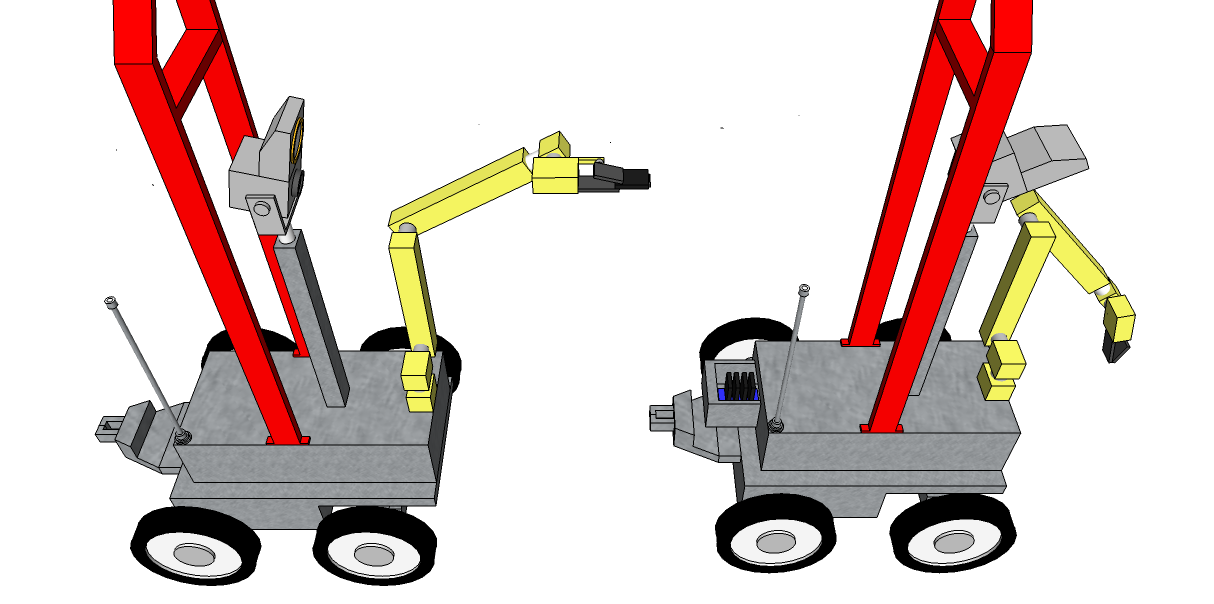
The elbows-back manipulator arms of the previous version always make me think of Fozzie Bear going, “Waka waka!” The design was taken from a space robot and doesn’t really work on a ground vehicle, so I replaced it with the new manipulator.

The redesigned robot looks much more plausible in the control room:

So why are humans still being dangerously irradiated in the control room, when teleoperated robots can monitor gages and push buttons?

Posted in Uncategorized | Tagged , , , , , , | Leave a comment