Soldering is easy and fun . . . .

I’ve been putting off a minor soldering project for over a week now. I don’t know why I’m inflating it into something huge. It’s just one more example of my procastination superpower.

Anyhow, rather than do anything constructive, I wrote this:

ODE TO SOLDERING!

Oh joy of doing things!
Oh joy of hardware hacking!
Oh joy of circuit fabrication!

The pieces are arranged
The iron heats
The rosen melts
The circuit is complete

What is creativity
But the combining of elements?
Soldering is creativity
A poetry of components and currents
(With a funny smell).

Oh come, let us to solder!
Oh plug in the iron!
Oh wait for it to heat!
Oh do it already, for crying out loud!

Posted in Uncategorized | Leave a comment

Crop Circle Maker 1.0

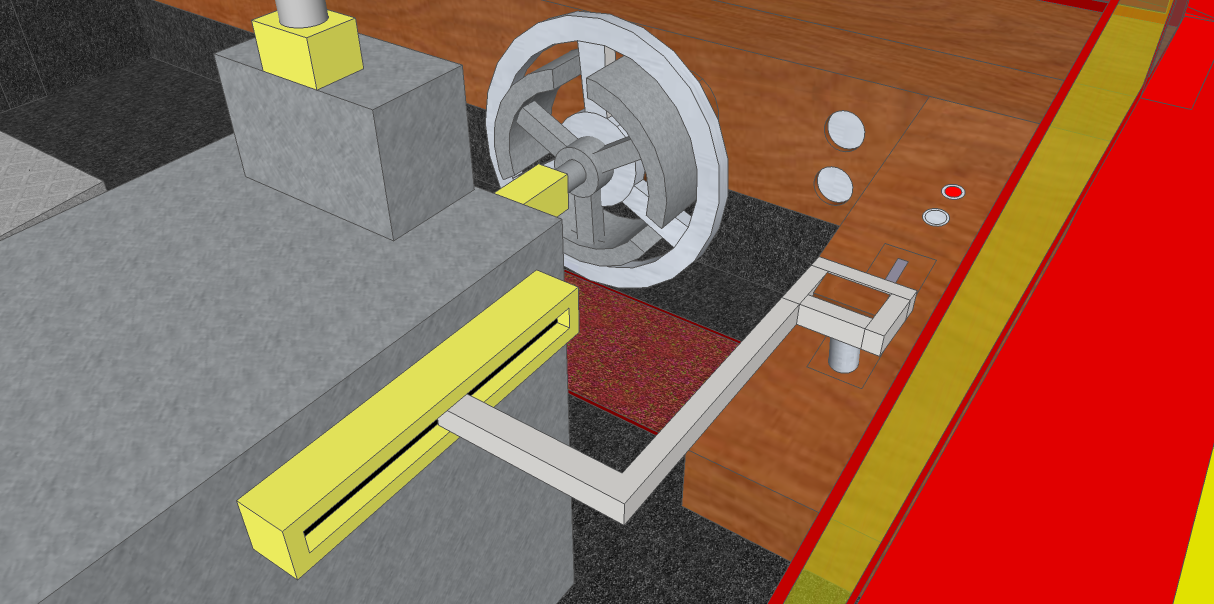
The red mark indicates how many perimeter-lengths the roller has traveled. The hook is for attaching ropes to pivot around poles.

A crop circle pattern 100 feet in diameter would have a surface area of 7800 square feet. Assuming that 2 sq ft are stamped per second, it would take little over an hour to make such a crop circle using this device.

Of course, complicated patterns would requiring calculations and surveying (not shown). Also, a board might be nice for trimming edges.

Posted in Uncategorized | Tagged | Leave a comment

How to go back to the Moon, cheaply

Posted in Uncategorized | Tagged , , , , , , | Leave a comment

American Soyuz/Delta Heavy Lunar Mission

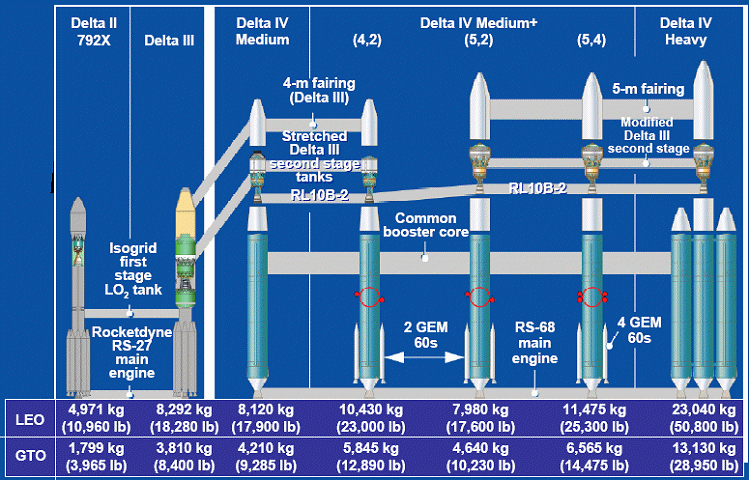
As shown at far right in this diagram from wikipedia, the Delta IV Heavy is a US rocket vehicle capable of placing 23,000 kg into low earth orbit.

This happens to be almost one fifth of the payload capacity of the Saturn V Moon Rocket of the 1960s which placed American astronauts on the Moon. So . . . could six Delta Heavy’s do the work of one Saturn V in orbiting the components of a present-day lunar mission?

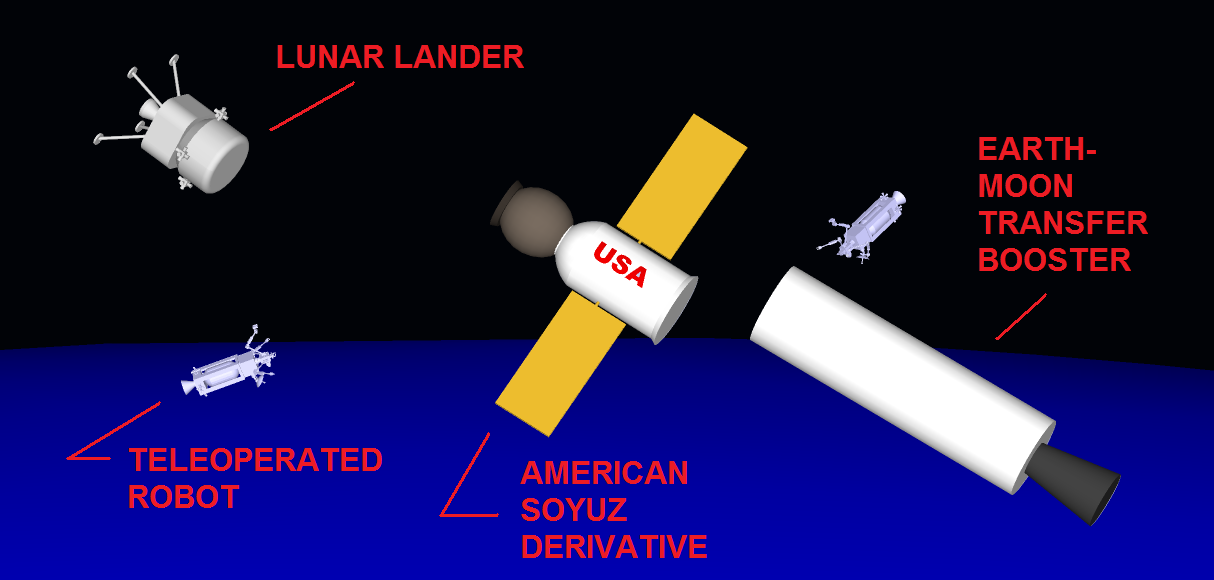
If so, then we don’t have to develop a new heavy-lift launch vehicle — and as a consequence have to spend tens of billions of dollars over the course of a decade or more — before going back to the Moon. We can use the existing Soyuz design for an American space capsule, and existing Delta Heavy hardware to place lunar mission components into low earth orbit, and it can all happen for a few billion dollars in the next few years.

The main thing is building a new lunar lander module, but that shouldn’t take long. Because if it does, the Chinese will beat us!

Posted in Uncategorized | Tagged , , , | 1 Comment

An American Soyuz

The 50th anniversary of the first human flight into space comes with the United States about to retire the Space Shuttle. This means that the US will no longer have the ability to place humans into space on its own. Instead, American astronauts must hitch a ride aboard the Russian space capsules known as Soyuz.

Speaking as an American, I find this situation to be rather embarrassing. So I thought, why doesn’t the US buy some Soyuzes and place them atop American-made rockets, such as the Delta 4? And since the patents — if there were any — have long expired, couldn’t we reverse-engineer a Soyuz and make our own version? This is what the Chinese did with their Shenzou capsule.

Since this is a proven design, it would be inexpensive to develop and American astronauts could again be riding American spaceships into orbit within a couple years.

We Americans could of course decide that it is too humiliating to admit that other countries can come up with good ideas. So instead, we will spend years and billions of dollars building a new spacecraft that will probably be more expensive and less reliable than a Soyuz-derived design.

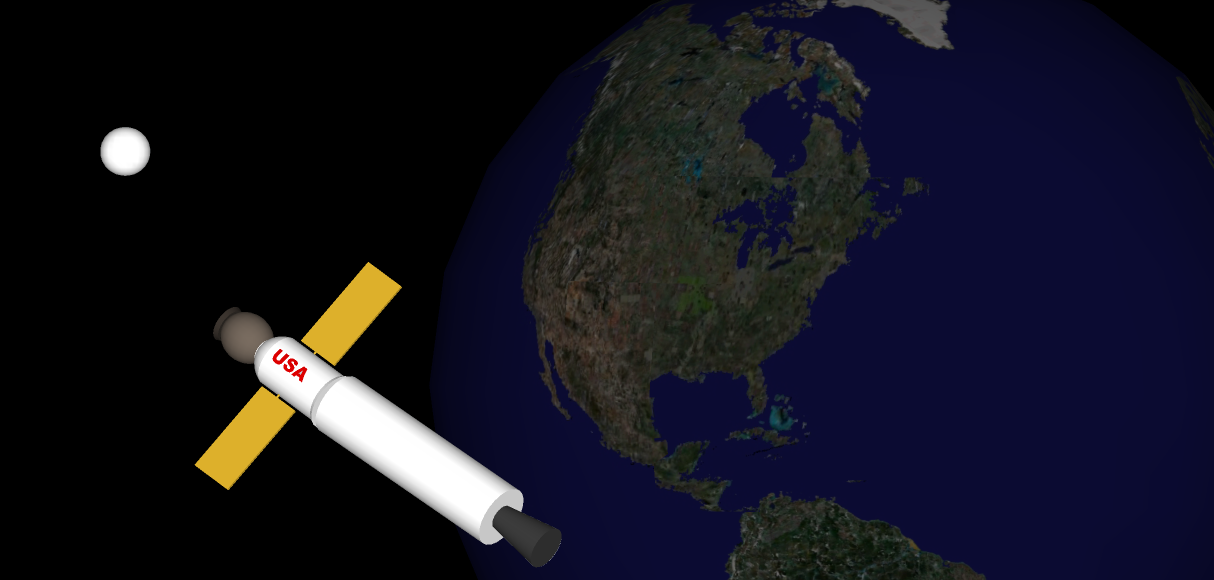
And yet, with the money we would save by going with the experience-proven Soyuz design, we could be circumnavigating the Moon again within five years.

Posted in Uncategorized | Tagged , , , , | Leave a comment

Fukushima coolant recirculation with siphon

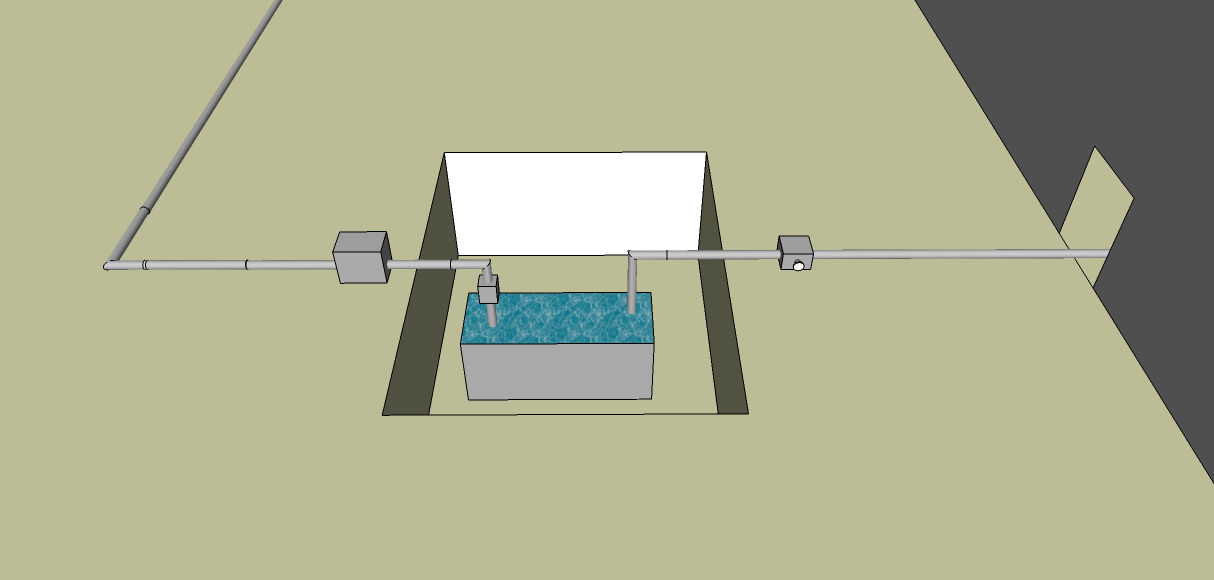
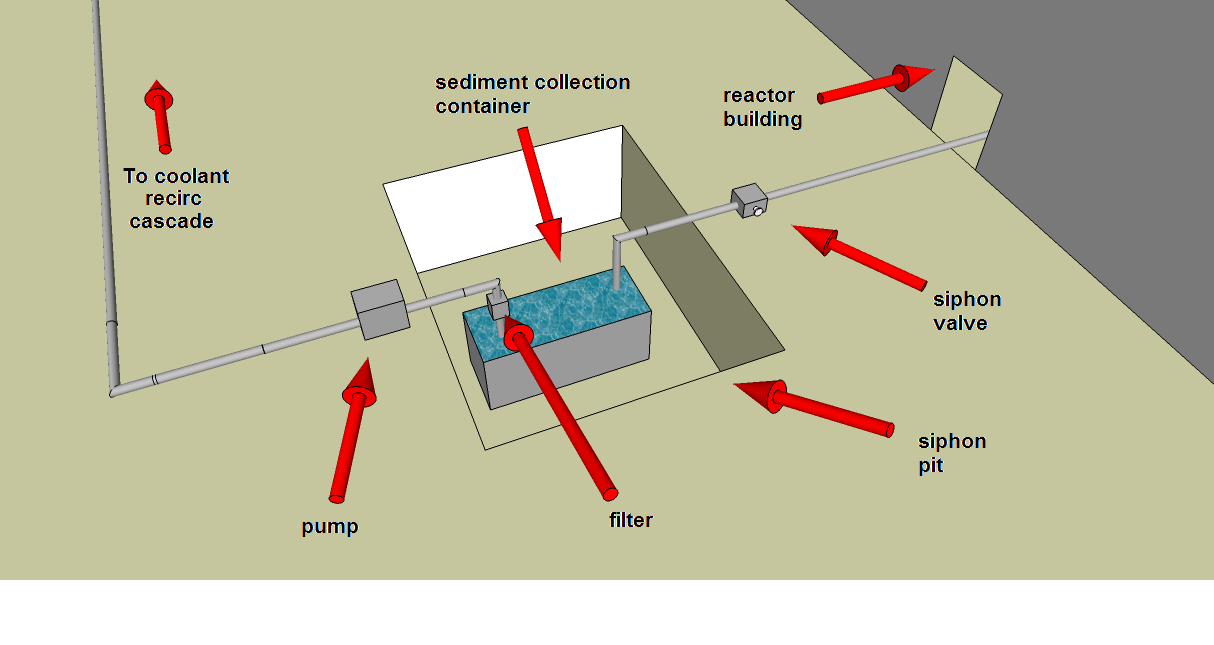
This design avoids damage to recirculation pumps from sea water sediment. A gravity siphon is used to draw water out of the building into a pit where sediment is collected into a shipping container.

Water is then pumped from the shipping container into the coolant pump cascade. A filter blocks the passage of sediment from the container to the pumps.

When the shipping container is filled with sediment, it can be swapped by crane with an empty container. A valve in the feed line stops flow during changeout.

(Description and illustrations are simplified, of course.)

Posted in Uncategorized | Tagged , , , , , | Leave a comment

Coolant Recirculation System at Fukushima

They’ve been using sea water to cool the rods, but when the level threatens to overflow the reactor buildings, they’re flushing the water back into the ocean (ref here and here). This is an obvious radioactivity hazard to the environment, so an auxiliary coolant recirculation system is required.

(For simplicity, only one pump cascade is illustrated.)

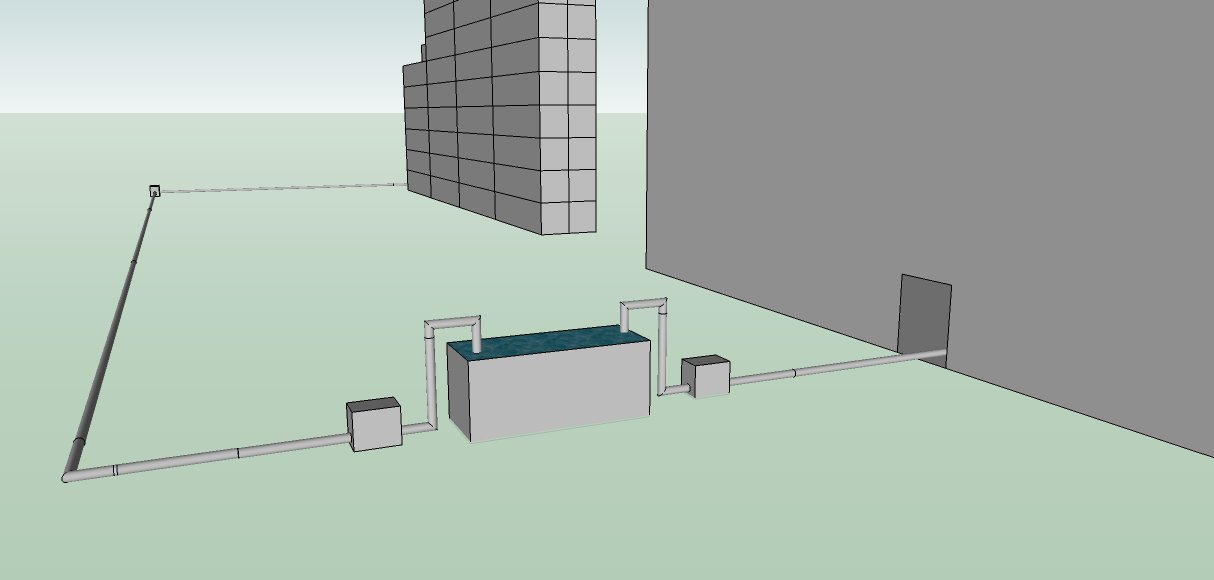
The small housings contain pumps. A shipping container is used for a sediment trap. When it fills to the top, it can be swapped out and buried at a waste site.

The pump on the right will get a lot of sediment passing through it, and will consequently have a short life. Maybe a filter can be placed in front of it too.

The hose on the right will likely get clogged and have to be swapped. But instead of being buried, perhaps it can be flushed and reused.

The equipment will eventually have to be buried too, as it will become highly radioactive from the sediment, which will have become highly radioactive from association with the fuel rods. Teleoperated robots will be handling a lot of these operations, but in the short-term perhaps the low-tech solution is grappling hooks.

If there’s a significant sediment build-up already, it’s essential to start recirculation and filtering coolant water immediately, even before the coolant pump cascade is in place. Sediment in sea water could potentially erode the casings on the fuel rods, allowing fuel to collect at the base of the cooling pools and reactors. That would raise the possibility of accumulating a critical mass and causing refission even with boron in the coolant.

Posted in Uncategorized | Tagged , , , | Leave a comment

Teleoperated Radioactivity Sample Boat

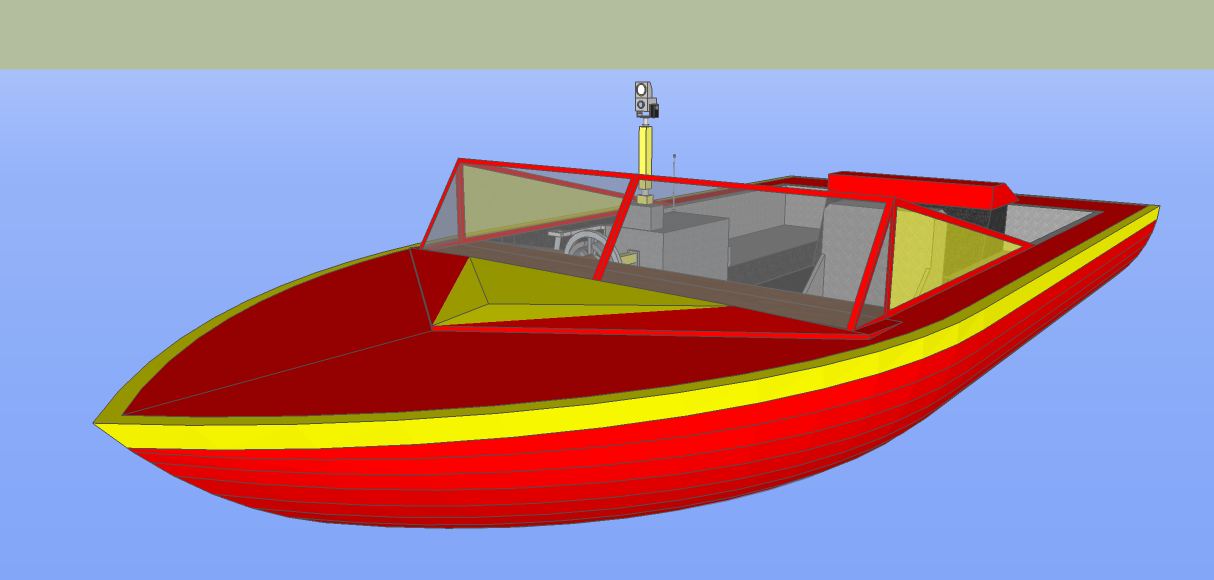
The high levels of radioactivity in the waters off the Fukushima nuclear plant require constant monitoring, which is best conducted without exposing human workers. Hence this design for a teleoperated radioactivity sample boat.

To make the modification effort as simple as possible, I borrowed heavily from my wheeled TOR designs. As for the boat, the design was downloaded from Google Sketchup 3D Warehouse, and the only significant modification was to remove the driver’s seat to make room for the robot housing.

A servo steers the boat, while a linear actuator adjusts the throttle. What about ignition, lighting, etc.? Rather than having mechanical interfaces, it might be best to get under the dashboard and hack into the wiring, but an additional, smaller robot arm could certainly be tasked with punching buttons.

Other than video, all telemetry and control can be interfaced through a single Arduino with communications via XBee shield. Onboard telemetry should include a GPS module.

Sorry, I didn’t have time today to do the sample collecting equipment.

Posted in Uncategorized | Tagged , , , , , | Leave a comment

A Roof for Fukushima

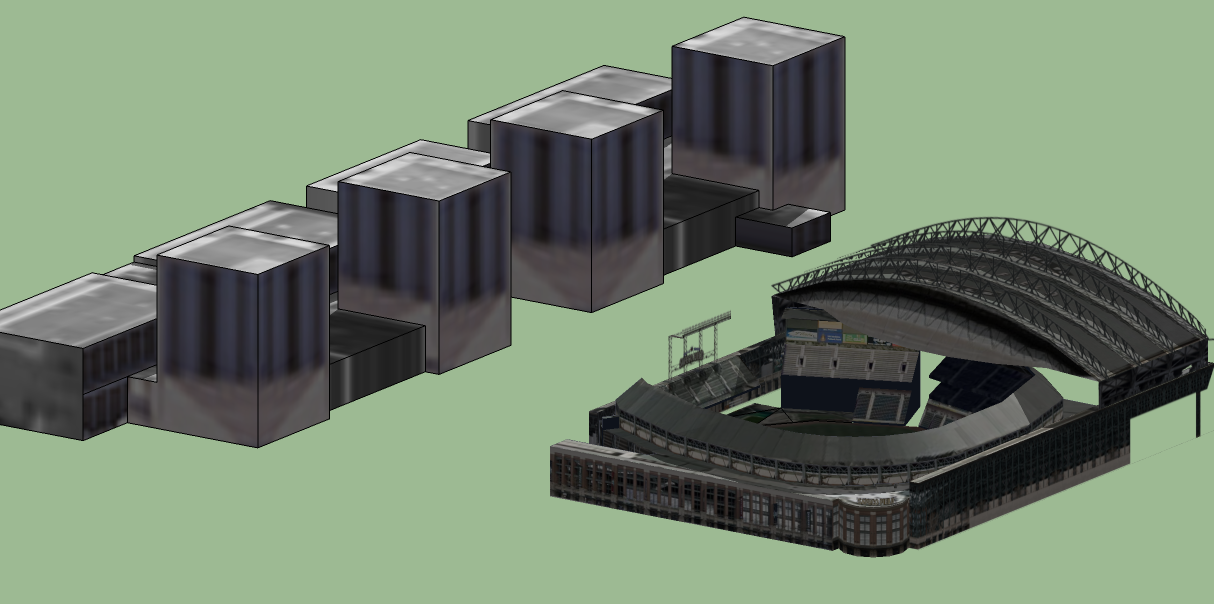
On the right is the baseball stadium known as Safeco Field in Seattle, USA. It is famous for its retractable roof, which rolls back for sunshine on the rare days in Seattle when there is sunshine.

Why bring this up? Sooner or later, Fukushima must be covered with a roof to prevent radiation leakage to the environment. Having a retractable roof may seem a bit of technology overkill, but I mention it because it allows for the possibility that the roof could be assembled at a distance where radiation is lower, and then rolled on rails over the tops of the buildings.

Based on the Safeco Field experience, I believe that structures like this could be constructed for the four damaged reactor buildings at a total cost of less than half a billion dollars and be ready within six months. In the short term, of course, temporary but faster solutions could be employed.

(True, Cowboys Stadium — site of the 2011 Superbowl — has a bigger retractable roof, but it slides in two rather than sideways. )

Posted in Uncategorized | Tagged , , , | Leave a comment

Fukushima Cooling Pump Cascade

A German concrete pump is being used at Fukushima to spray cooling water on the spent fuel rods. Now that the plant’s own cooling pumps are down and the cooling pools are empty of water, this pump may be all that keeps the spent fuel rods from catching fire and spreading radioactivity over a large territory.

The concrete pump has a flow rate of 160 cubic meters per hour, and that sounds impressive. But does it look impressive? Here’s what the pumping truck looks like compared to a reactor building:
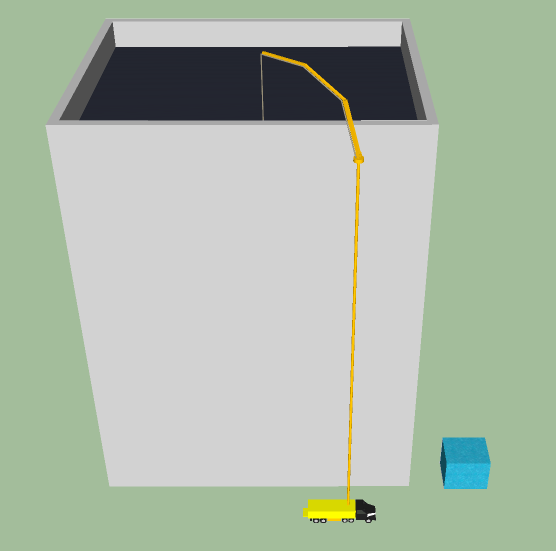
The blue cube is 160 cubic meters. Think of pouring a couple tablespoons of water on a hot frying pan once every hour. Are you cooling the pan down, or just making puffs of steam? Well, at least with a frying pan, the puffs aren’t radioactive.

I suggest a more robust solution, like so:
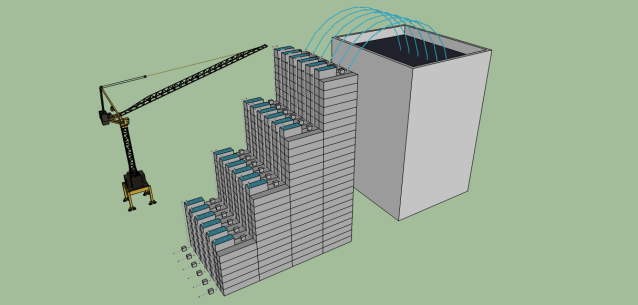
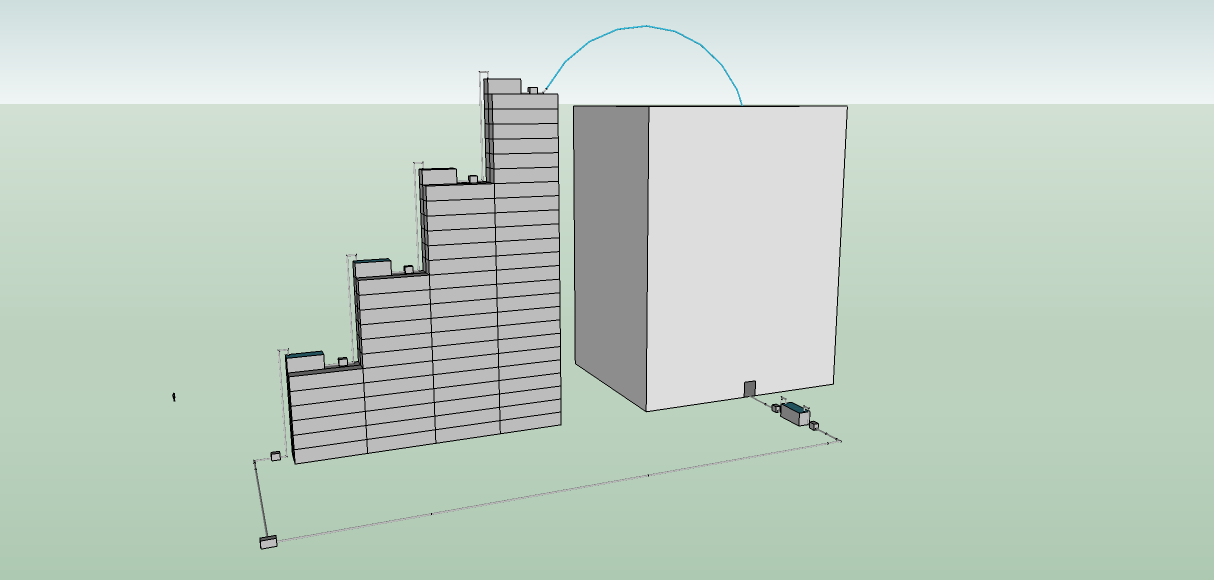
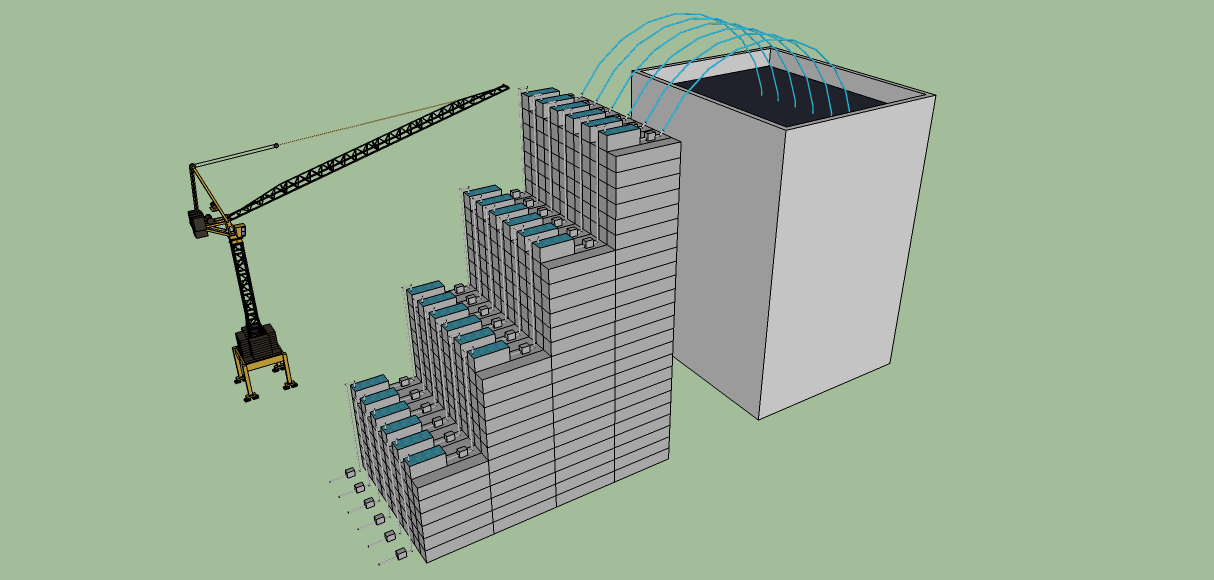
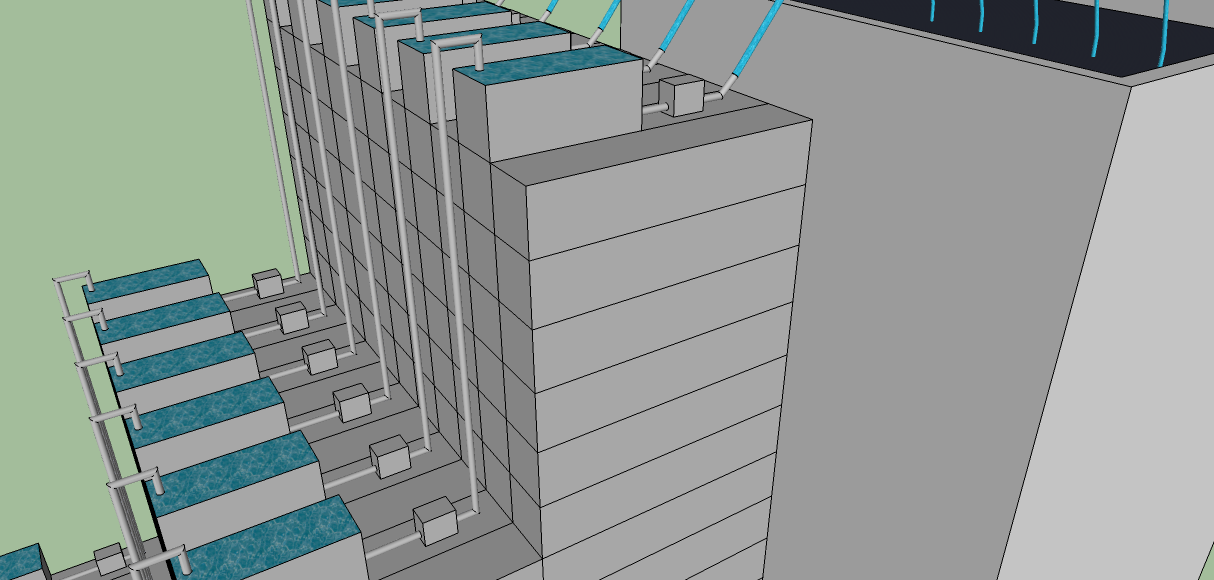
This pump cascade is built out of shipping containers. Each pump housing contains multiple high-flow pumps, like these. With each pump having a flow rate of 360 cubic meters per hour, and ten pumps per cascade and six cascades in all, total flow rate would be 21,000 cubic meters per hour. This would be enough to completely fill the cooling pools in an hour.

(If you checked out the link, you may have noticed that these pumps have a head pressure of 95 meters. Since the reactor building is only 60 meters, why have a cascade at all? Why not just have a single pump for the entire height? Well, I’m not an expert on hydraulics, but I seem to recall that for a given pump head pressure, there’s a trade-off between flow rate and pumping height. By using the pumps in cascade like this, we reduce the pumping height for each pump and thus the flow rate will be higher. Maybe four pump stages as shown is overkill, but I think at least two stages should be used.)
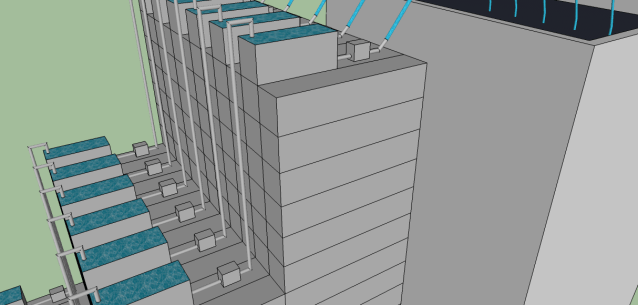
Each 40-ft container costs about three thousand dollars. Total cost for all 720 containers is approximately $2 million. At ten minutes per container, the entire structure can be built within a week.

By the way, mix boron in the water to prevent a fission reaction, or the water will act as a moderator and there will be a steam explosion. This is discussed at Fairewinds Associates.

Posted in Uncategorized | Tagged , , | Leave a comment