Capping the Oil Spill with Shipping Containers

The basic idea is to put a containment box over the oil well. The box is constructed from intermodal shipping containers (aka TEUs — twenty foot equivalent units). It can be assembled on the ocean floor. The TEUs can be welded into modules of two or more on the surface to save time.

The illustration is somewhat misleading, because it gives the impression that the TEUs are intact inside. In fact, most of the TEU interior walls will be cut away to allow liquid (water or oil) to freely circulate within the interior. TEUs can be cut with conventional handheld power saws. This of course will be done above water by humans because that will be much faster and cheaper than doing it underwater by ROV.

The roof is covered with relief hatches. The design is very simple. If the pressure is great, it pushes the hatches up and the pressure is relieved. Approximately 4000-5000 square feet of hatch area is available. Assuming that the well head is approximately 8 square feet, this would be a reduction in pressure by a factor of 500 or more. Thus, if the wellhead is at 5000 psi, the relief hatches would have a pressure of only 10 psi. The pressure will go up if you close the hatches without venting through the valves.

There are 32 riser hook-up valves along the walls. At a gusher rate of 4,800,000 gallons per day, this would be 150,000 gallons per day per valve, and a flow rate of only 1.8 gallons per second per valve. Each valve is one foot wide, which would indicate a linear flow rate of about four inches per second.

The market rate for TEUs is $1300, so that the 160 TEUs used in the device would cost $210,000. Assuming that one TEU is welded per hour per ROV, and that two ROVs are involved in welding, the entire structure can be assembled within 80 hours, or just over three days.

A great advantage of the cap housing is that it exerts no back pressure on the well. Thus it will not cause greater leakage in seabed fissures.

The housing will leak, but this can be resolved over time (ie, days) by caulking the joints. Piling can be driven against the base of the structure to prevent oil leakage from underneath, but as oil floats to the top and only water would be present at the bottom, this should not be a problem.

The housing is not meant to be a pressure containment. Rather, it is meant as a transition from the current gusher situation to a controlled situation where all oil from the well is utilized at the current flow rate. At the beginning of the transition, all the relief hatches on the roof are open and the internal pressure within the housing is equalized with the outside environment. As hookups begin pumping water and then oil from the interior, however, pressure within the housing will decline until the relief hatches close. The relief hatches are simple gravity devices with no moving parts.

Shipping containers are available universally in quantities of thousands.

If at a later date it is desired to seal off the well, the housing can be readily removed by attaching floatation devices, as its total mass is only 400 tons (5000 lbs per container). An air-filled tank of approximately 30 feet diameter would be sufficient to provide neutral buoyancy in the lifting operation.

To summarize: a large oil spill cap/housing constructed from shipping containers.

Advantages: simple, cheap, fast. Safety is maximized because pressure is kept low. Since the initial goal is not to stop up the well but to divert spillage into revenue pumping immediately, it is also the most profitable solution as well.

Posted in Uncategorized | Tagged , , | Leave a comment

Sketchup of lego soap dish model

Posted in Uncategorized | Leave a comment

Lego soap dish model

I went to the Lego store yesterday and assembled a model of my soap dish. It really doesn’t look too much like the Sketchup version, does it? And it doesn’t hold soap very well, either.

But the basic process is to dunk the model in resin and let the resin harden into a mold. Then pour plastic into the mold to get the production unit. Using lego bricks to make the model is one way. I think I’ll try clay next.

Posted in Uncategorized | Leave a comment

Shipping container in sketchup

Shipping containers are cool. Here I drew one in Sketchup. I used a corrugated metal texture and the dimensions are 8 x 20 feet floor and 8.5 feet high, what’s called a TEU (Twenty-foot Equivalent Unit).

I’ve decided to table Blender until next month. It turns out that Sketchup is useful for more than 3D printing, it can express engineering ideas in a very crisp fashion.

Posted in Uncategorized | Leave a comment

Sketchup of Falcon 9 rocket

Here’s a Sketchup drawing of a Falcon 9 rocket that I put together in about half an hour (the drawing, that is, the rocket takes longer to put together). The dimensions are way off because I just eyeballed it. Practice run, but it shows that I know how to make cones and attach objects to one another.

Posted in Uncategorized | Leave a comment

DS game holder

Here’s my Sketchup design for a DS game holder. You stick the games in the slots so that you can keep several out of their cases at one time for easy switching.

Posted in Uncategorized | Leave a comment

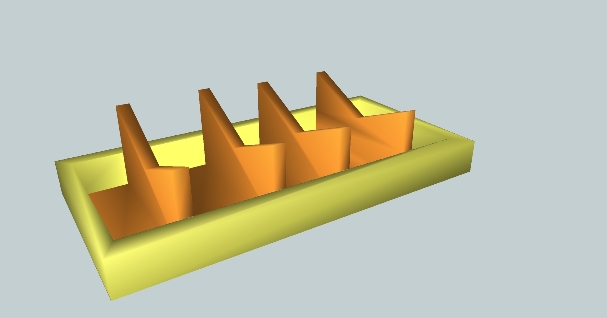
Sketchup Soap Dish

What this country needs is a good soap dish design. First, you need to elevate the soap from the dish so that it does not soak in its own scum. Then you need to keep the soap from slipping off the tray.

It’s a simple design, which I whipped out a couple months ago for Makerbot, before learning that Sketchup doesn’t export to STL. But at least I can paintbucket and smooth it for blog display.

Posted in Uncategorized | Leave a comment

There’s AI and then there’s Internet AI

Internet AI still has a ways to go before it gets a clue. For example, I was reading the chapter on oscillators in Digital Electronics Demystified and wondered how much a 555 timer chip costs. So I went to Yahoo search and got this as the top link:

Posted in Uncategorized | Leave a comment

Hacking Matter: discussion of enzymes

As I mentioned in a previous post on quantum dots, I hadn’t seen anything in Wil McCarthy’s Hacking Matter about using artificial atoms as enzymes to facilitate biochemical processes. Well, the discussion is on page 160.

I wonder about the statement, “More than a thousand different enzymes have been identified . . . . ” Isn’t it more like several thousand?

Posted in Uncategorized | Leave a comment

Quantum dots: Not feeling the magic yet

I’m reading Hacking Matter by Wil McCarthy, and am looking for the killer app for programmable atoms. Sure, it’s great that you can switch from copper to iron, but how often do you need that? And a house that can turn invisible is swell, but that’s entertaining for about five minutes. Granted, that’s longer than I could stay interested in Lost or American Idol, but is it worth reading a book about?

One possible app I haven’t seen so far is the possibility of using programmable atoms as enzymes. Instead of giant refineries and chemical processing plants, you could produce any kind of chemical reaction by simply running the basic chemicals along wafers of programmed artificial atoms. Now, that would be magic, but I see no mention. Is that because the developers of programmable matter aren’t thinking in terms of chemical engineering, or because there’s no prospect there?

Posted in Uncategorized | Tagged , | 1 Comment