The Wright Brothers weren’t meager

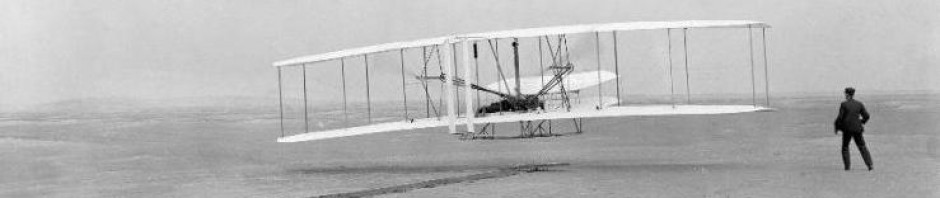
I was surprised a while back to read that the Wright Brothers’ contribution to flight was regarded as ‘meager.’ So after reading two biographies about the Wright Brothers, what did I learn?

The Wright Brothers built a wind tunnel to determine optimal wing design. They learned how to control aircraft by practicing on kites and gliders for months. Finding no engine available for their purposes, they built their own engine. They determined the optimal design for propellors. And then there’s their patent on wing warping.

So they designed the wings, propellors, control systems, and engines. That doesn’t sound meager to me. That sounds like just about everything to do with an airplane.

Attacking the Wrights is not new. I’ve found two stories of ‘secret airplanes’ that supposedly beat the Wrights into the air. I call them ‘secret’ because there are no photographs, no witnesses, no plans, no remnants. Yet here we are, a hundred years later, and the stories are still given credence.

But what’s the big deal with the Wrights anyhow?

Well, if you’re a bright young person, then you need to know the truth path to success. Either the Wrights are an example, or they’re not. If you try to slap together a ‘secret airplane,’ you’ll find it doesn’t work, and then you’ll give up, discouraged. If you realize that any great achievement may require a lot of intermediate steps and attendant effort, and then you go ahead and do it all, then you too can go far.

I don’t know if the journey is the reward, but I do know that without the journey, you don’t get there.

Posted in Uncategorized | Tagged , , | Leave a comment

Sixty plus years of plastics

I just finished reading a book, The Production and Properties of Plastics. I won’t link to Amazon.com, because it probably isn’t there. The book was written shortly after World War II.

I learned what a sprue is. I wonder if they still use some of the terms, like ‘flash.’ Mainly it was a lot of chemical names, of which only a handful of trade names, such as lucite and formica, were familiar.

I’m not sure what the personal enrichment was for reading this book, but anyhow, time to move on.

Posted in Uncategorized | Tagged , | Leave a comment

Life without risers

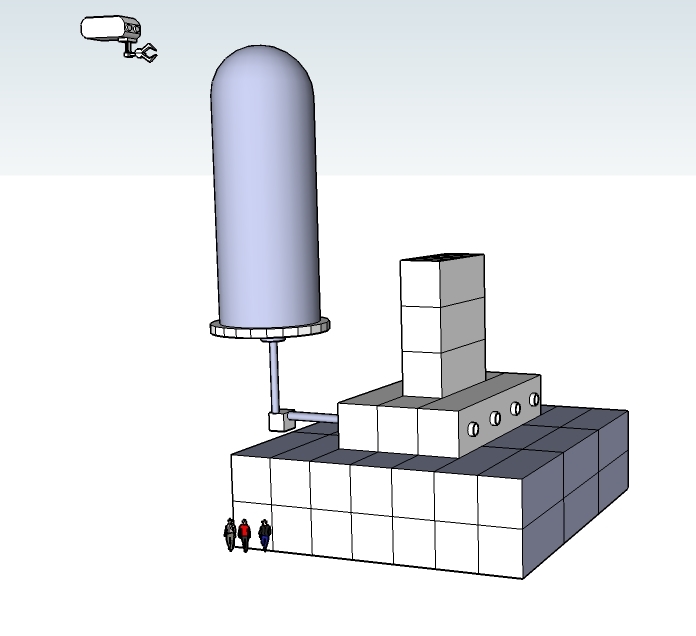
Risers are the pressurized pipes which receive oil from the wellhead. The problem with my design is that I didn’t want there to be any pressure on the wellhead containment (ie, spillinator). So instead, I have an ROV (remote operated vehicle) connect an unpressurized tank to one of the containment valves. The tank fills with oil, and since oil is lighter than water, it floats to the surface.

The general idea is that there can be multiple tanks, so that one is always filling from the containment. Once they reach the surface, the oil is drained. Water takes the place of the oil, which causes the tank to sink to the bottom again, where the ROV retrieves it and connects it to the containment.

This is a very crude picture, of course. And of course those guys at the base need to go sometime too.

Posted in Uncategorized | Tagged , , | Leave a comment

Memory Palaces and Virtual Reality

Recently, I read The Memory Palace of Matteo Ricci, which is about a sixteenth century Portugese monk who goes to China as a missionary. Why? That is, not why did he go to China but why did I read the book? Because I thought it would discuss his memorization system. You see, Ricci was brilliant at memorizing things.

The book actually gave away the secret in the first few pages, and if you know about the Greeks, you know the system already. Basically, the Greeks would memorize a speech by going into a house, and associating each part of the speech with a different room in the house. Ricci’s contribution was to create a ‘palace’ in his memory with which to associate certain facts.

It’s occured to me that there’s a good reason why the human mind works this way. Basically, our brains are hardwired to remember geographical cues for navigation, not to remember facts and figures. So if we can associate facts and figures with geographical cues, then we can remember the facts and figures better.

Anyhow, I came across this blog entry that was linked to Live Science, and that discussed virtual environments such as Second Life as learning tools. So far as I know, no one has really followed the Greeks and Ricci to the conclusion that a virtual world can create a geography that can be associated with facts and figures for memorization.

It seems to me that this would be really good for learning languages.

Posted in Uncategorized | Tagged , , | Leave a comment

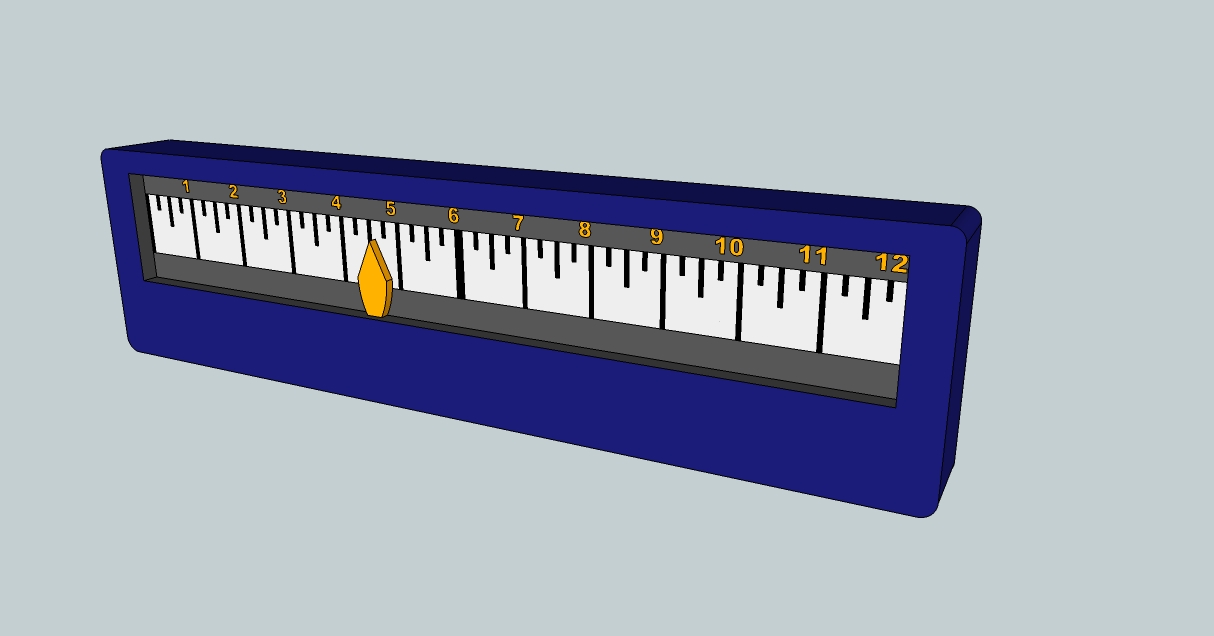
Linear Analog Clock

We have round analog clocks and digital clocks, but I haven’t seen a linear analog clock. I think it sends a different psychological message to the viewer: that time is moving forward. Or at least, left to right.

Posted in Uncategorized | Tagged , , , | 1 Comment

Spillinator Version 3

This design is somewhat downscaled from the earlier version but retains the essential features. The riser hook-up valves are on the side, and now they use the roof of the spillinator as a platform. The relief hatches are mounted on a chimney to keep them out of the way of the valves. Note that forty-foot containers are used on top of the hole shown in the center of the previous image.

Electric pumps will have to be used instead of riser pressure in order to bring the oil to the surface. I’m hoping that pumps capable of operating at a depth of one mile beneath the surface of the sea are available. Otherwise, another idea will have to be used.

This model was built in Sketchup without thinking too much about the interior. I’ll fix it tomorrow. But the outside looks like what it should for now.

Posted in Uncategorized | Tagged , , | Leave a comment

Spillinator Build

I’m going through a redesign phase on the oil spill housing. For convenience’s sake, I’ve decided to call it the ‘spillinator.’ Here are shown the first two levels. Note that these are 8’x20’x8.5′ intermodal shipping containers.

In this design, there are 2’x2′ cuts in each face to equalize pressure. The internal area is 20’x24′.

I intend to work an hour or two on this design per day, and will post my progress.

Anyhow: Behold, the Spillinator!

Posted in Uncategorized | Leave a comment

Capping the Oil Spill with Shipping Containers

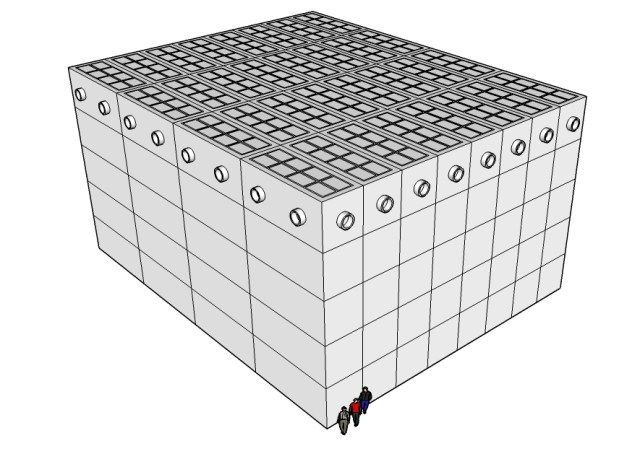
The basic idea is to put a containment box over the oil well. The box is constructed from intermodal shipping containers (aka TEUs — twenty foot equivalent units). It can be assembled on the ocean floor. The TEUs can be welded into modules of two or more on the surface to save time.

The illustration is somewhat misleading, because it gives the impression that the TEUs are intact inside. In fact, most of the TEU interior walls will be cut away to allow liquid (water or oil) to freely circulate within the interior. TEUs can be cut with conventional handheld power saws. This of course will be done above water by humans because that will be much faster and cheaper than doing it underwater by ROV.

The roof is covered with relief hatches. The design is very simple. If the pressure is great, it pushes the hatches up and the pressure is relieved. Approximately 4000-5000 square feet of hatch area is available. Assuming that the well head is approximately 8 square feet, this would be a reduction in pressure by a factor of 500 or more. Thus, if the wellhead is at 5000 psi, the relief hatches would have a pressure of only 10 psi. The pressure will go up if you close the hatches without venting through the valves.

There are 32 riser hook-up valves along the walls. At a gusher rate of 4,800,000 gallons per day, this would be 150,000 gallons per day per valve, and a flow rate of only 1.8 gallons per second per valve. Each valve is one foot wide, which would indicate a linear flow rate of about four inches per second.

The market rate for TEUs is $1300, so that the 160 TEUs used in the device would cost $210,000. Assuming that one TEU is welded per hour per ROV, and that two ROVs are involved in welding, the entire structure can be assembled within 80 hours, or just over three days.

A great advantage of the cap housing is that it exerts no back pressure on the well. Thus it will not cause greater leakage in seabed fissures.

The housing will leak, but this can be resolved over time (ie, days) by caulking the joints. Piling can be driven against the base of the structure to prevent oil leakage from underneath, but as oil floats to the top and only water would be present at the bottom, this should not be a problem.

The housing is not meant to be a pressure containment. Rather, it is meant as a transition from the current gusher situation to a controlled situation where all oil from the well is utilized at the current flow rate. At the beginning of the transition, all the relief hatches on the roof are open and the internal pressure within the housing is equalized with the outside environment. As hookups begin pumping water and then oil from the interior, however, pressure within the housing will decline until the relief hatches close. The relief hatches are simple gravity devices with no moving parts.

Shipping containers are available universally in quantities of thousands.

If at a later date it is desired to seal off the well, the housing can be readily removed by attaching floatation devices, as its total mass is only 400 tons (5000 lbs per container). An air-filled tank of approximately 30 feet diameter would be sufficient to provide neutral buoyancy in the lifting operation.

To summarize: a large oil spill cap/housing constructed from shipping containers.

Advantages: simple, cheap, fast. Safety is maximized because pressure is kept low. Since the initial goal is not to stop up the well but to divert spillage into revenue pumping immediately, it is also the most profitable solution as well.
Posted in Uncategorized | Tagged , , | Leave a comment

Sketchup of lego soap dish model

Posted in Uncategorized | Leave a comment

Lego soap dish model

I went to the Lego store yesterday and assembled a model of my soap dish. It really doesn’t look too much like the Sketchup version, does it? And it doesn’t hold soap very well, either.

But the basic process is to dunk the model in resin and let the resin harden into a mold. Then pour plastic into the mold to get the production unit. Using lego bricks to make the model is one way. I think I’ll try clay next.

Posted in Uncategorized | Leave a comment