Automatic sundials

This sundial link is copied from makezine, it has to do with inputting a location and out comes a printout of a sundial for that location. I’m putting the link here because I have a project in mind for this. We’ll talk later.
Posted in Uncategorized | Leave a comment

Remote Control Mining Robot

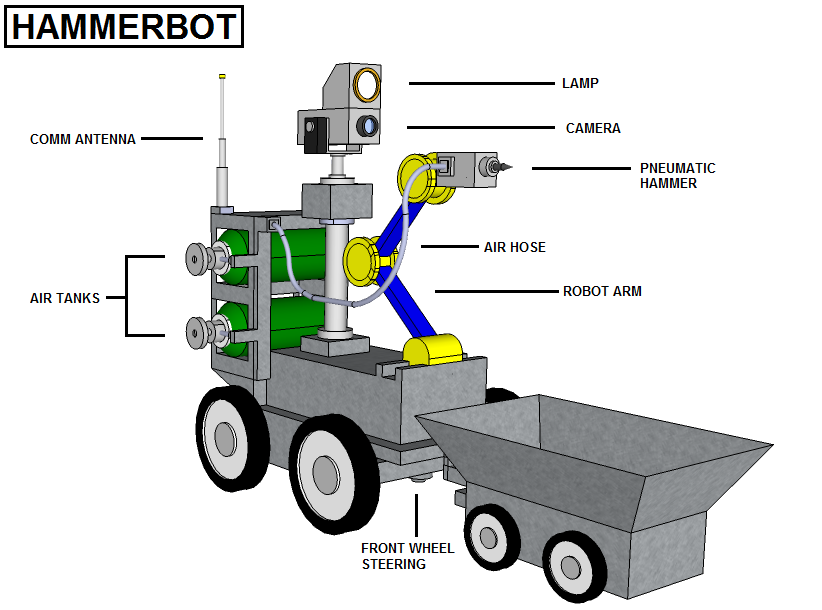
This one I call ‘Hammerbot.’ It uses a pneumatic-powered hammer to chisel into rock. Originally, I had the idea that the broken rock would then fall into the wagon that the robot is pushing in front. Then I realized that there are many reasons why that won’t work, most of all because the poor little robot’s arm isn’t long enough to reach over the wagon.

So now the idea is that it’s pushing this wagon, yes, but it detaches when it goes to hammer on the wall. Another robot or some other kind of attachment is used to collect the chiseled rock that falls at the base of the wall. I’ll work on that concept some more.

Anyhow, in light of the trapped Chilean miners, maybe soon they’ll stay topside and teleoperate robots instead of having to risk their lives.

Posted in Uncategorized | 1 Comment

Shipping Container Playset

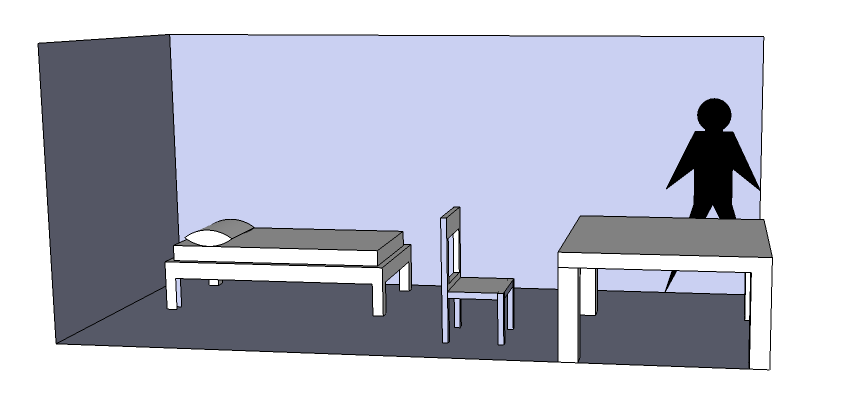
Toying with an idea to make a google sketchup set of furniture for interior decoration of shipping containers.

Posted in Uncategorized | Leave a comment

I don’t know why I did this

Posted in Uncategorized | Leave a comment

D-Cam in sketchup

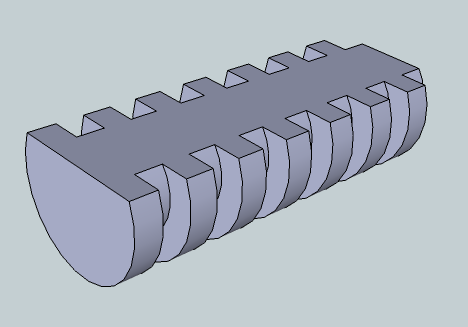
I was visiting the make magazine site and I saw a link to a blog called The Inventive Mind. Notice the D-shaft? I took that as a challenge for Sketchup and drew this:

What I’d like to do is blur the line between virtual reality and material reality with a 3D printing system. Of course, Sketchup really isn’t optimal for that. Blender is probably closer. In that regard, learning Blender is on my list of things to do next month. Seeing that my sketchup skills are now adequate for rough drawings.

Posted in Uncategorized | Leave a comment

Old Time TV

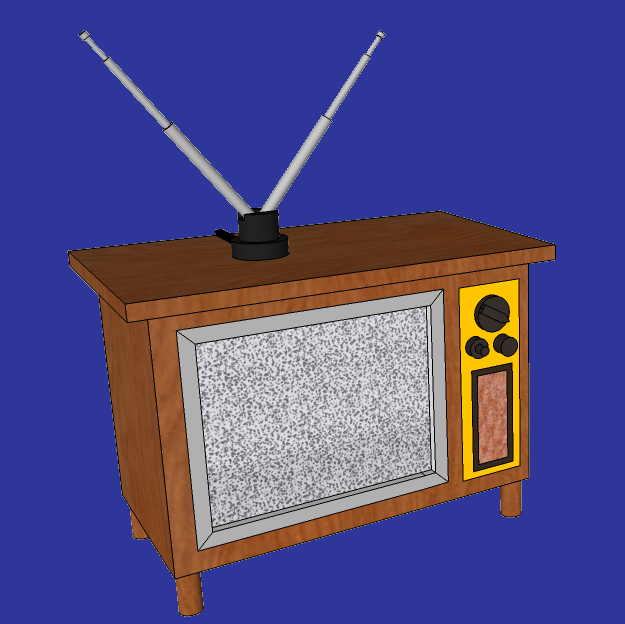
I hesitate to call this an ‘old fashioned’ TV set, because this is what I grew up with. This is, in fact, a rough approximation of what I watched the original Star Trek on when it was first broadcast. The control panel wasn’t yellow, though, but I don’t remember what it was, so yellow it is.

I would have liked to have been able to make some sloped surfaces here, and the antenna assembly would have looked cooler with a dome. Anyhow, something I slapped together. Discuss among yourselves: The Industrial Revolution was neither industrial, nor a revolution.

Posted in Uncategorized | Leave a comment

Crazy Cup

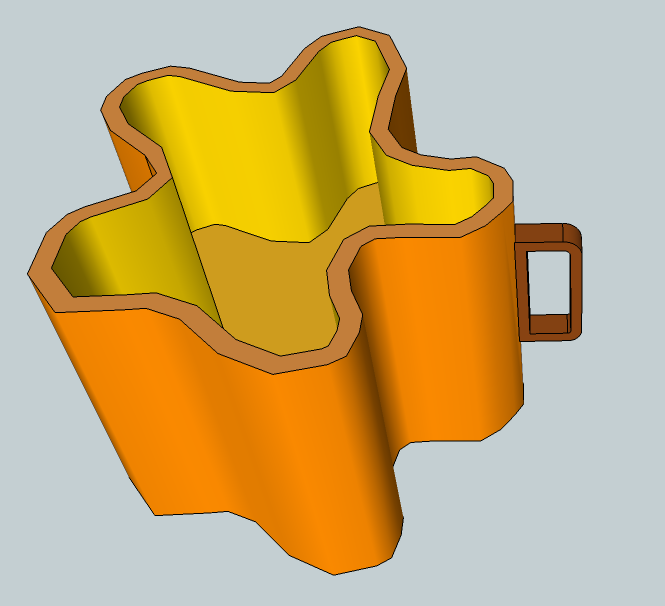
Well, the previous cup was lame, so this one is even lamer. I’m not even sure how you drink out of this. The proportions seem such that in order to get your fingers into the handle, the cup itself would have to be about the size of a jello mold.

Jello mold . . . hmm.

Posted in Uncategorized | Leave a comment

Getting back in the saddle, sketchupwise

It’s been a while since I used sketchup. Actually, it’s been a while since I’ve posted here, hasn’t it?

Anyhow, I thought I’d resolve to post a simple sketch every day. This is not so much to enlighten the world as to engage in practice.

Anyhow, this was about the simplest thing that I could think of that would still stretch my talent, in that I had to make a handle that sticks out of the cup.

Posted in Uncategorized | Leave a comment

Just a little test

I’m still running, right? Good. Just testing.

Posted in Uncategorized | Leave a comment

PAI to cover the spill

I have been reading a book on Industrial Plastics, which describes the properties of several kinds of plastics. I have been considering this information in regard to covering the Gulf of Mexico floor with a layer of plastic to seal off leakage from fissures, as discussed in the previous post.

Well, a good candidate for this job is called Polyamide-imide, or PAI. It was marketed in 1972 by Amoco Chemical Company, under the trade name Torlon.

It has a relative density of 1.41, so that even without rocks mixed in, it will sink and stay sunk. But the really special thing about it is the incredible pressures it can withstand.

Tensile strength: 26,830 pounds per square inch. Compressive strength: 39,900 psi.

Forty thousand pounds per square inch! That should take care of sealing any fissures, redirecting oil flow back into the main hole, from which it can be harvested by the spillinator.

Lest you’re concerned about melting, it has a heat resistance of 260 degrees centigrade. That should keep it in place.

Industrial production of petroleum-based plastics runs to billions of tons annually, which is millions of tons per day. As mentioned, a million tons is sufficient to cover a square kilometer with a layer of plastic one meter thick. So it wouldn’t take long to begin this operation.

Posted in Uncategorized | Leave a comment