Molecule Maker Expansion Set

Here is a screen capture of the latest version of Molecule Maker. Notice the scene tabs, which facilitate zooming in and out. I had to de-select scene transitions to make it work smoother (which, I admit, seems counterintuitive).

The lines sticking out of everything are ‘scaffolding,’ a little trick I learned in Sketchup to align groups and components together. The scaffolding lines are part of a component, and once no longer needed, can be universally deleted with a few clicks of thine mouse.

So how well does the new improved and expanded Molecule Maker work? Not as well as I’d hoped. I had hoped that it would be orders of magnitude faster than the simple version, but it’s only about twice as fast. And you know, I think a physical model set would be twice as fast yet.

I expect to add some methyl group examples, and I need balls for phosphorus, iron, etc. And I think the pentagon-hexagon ‘snowman’ and related templates need to be tilted sideways, to recognize that the work space is wider than high.

My ambition — I’m not sure I want to call it a goal yet — is to do a hundred molecules and upload them to Google 3D Warehouse. That could easily be done within a month, or if I dally, a year. Because my ADD is telling me it’s about time to be distracted.
Posted in Uncategorized | Leave a comment

Molecule Maker: Good Adenine and the Kit

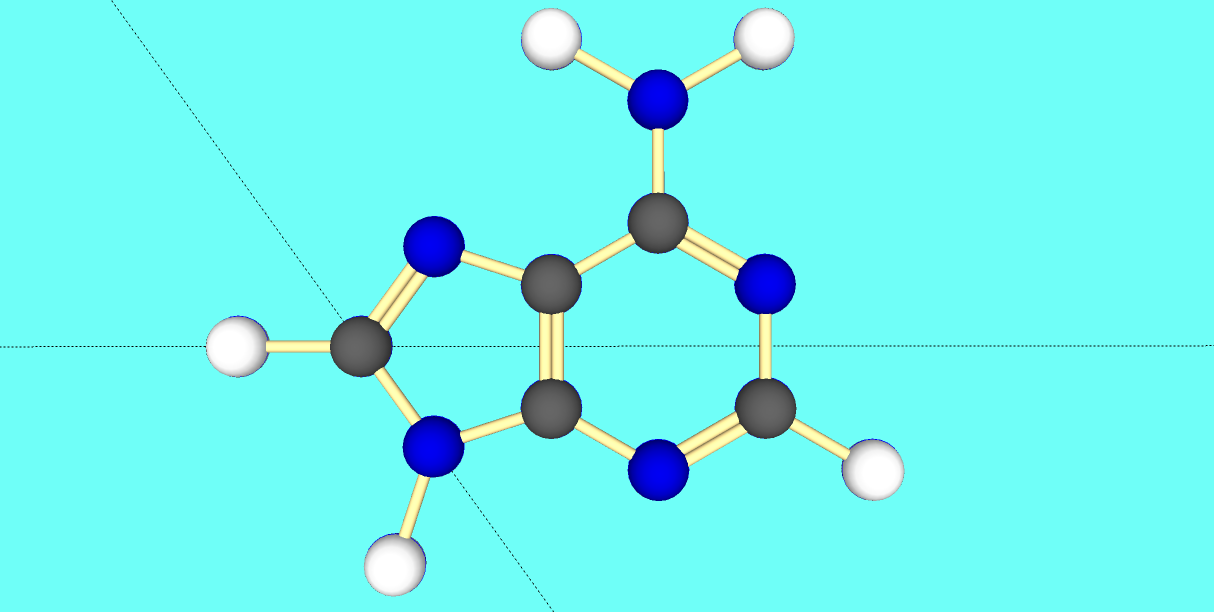
Well, I was right about being wrong. Here is adenine with the correct angles for the hydrogen bonds coming off the pentagonal ring:

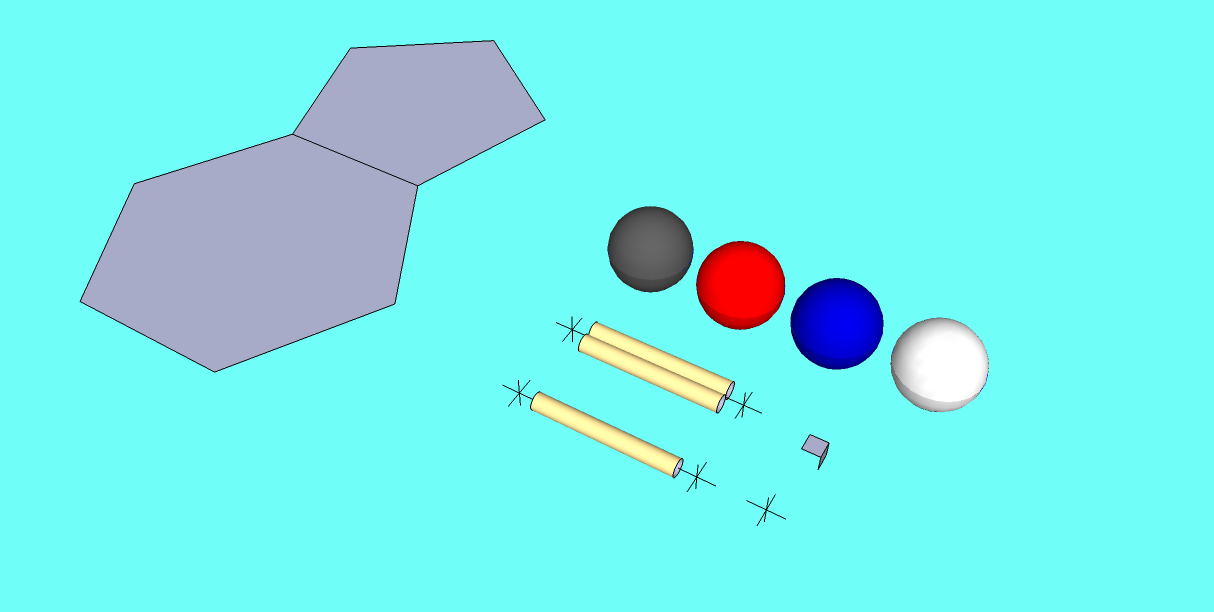
And here is the molecule maker kit, admittedly not looking like much for something that has kept me busy for so many days now but that is the way it works sometimes:

Posted in Uncategorized | Tagged , , | Leave a comment

Molecule Maker: Uracil

Uracil is really easy to make. All you have to do is get rid of the ‘antlers’ of the methyl group on thymine and replace with a ‘unicorn horn’ of hydrogen for uracil. Actually, scientists believe the evolutionary path was in the other direction, from Uracil in RNA to Thymine in DNA, like so:

Why did this evolutionary transition occur? My scientific theory is that originally, briefly, during the course of evolutionary history, there was a version of DNA with uracil, but one day the methyl fairy came along and blessed it, and that’s how thymine got its antlers. The End.

Posted in Uncategorized | 1 Comment

Free Wireless Electricity, Non-Proof of Concept

After burning incense in the Temple of Tesla, a few months ago I did a calculation on just how much electricity is naturally in the atmosphere. It would take an antenna one square kilometer in area suspended ten kilometers over the surface of the Earth to collect one watt of electrical power.

I believe it takes about five watts to charge a cell phone, so the antenna used in this video must have been the size of Manhattan Island:

What was the motivation in producing this video? It doesn’t seem to be promoting a commercial service or product. Maybe the ‘proof of concept’ is to demonstrate someone’s professional video production and editing techniques (the channel name ‘web19designer’ seems to hint that). Anyhow, I saw the video at a news and commentary site where apparently they were taking it seriously, so I thought I should respond seriously.

The idea of drawing electricity from the air isn’t all that flakey — you just have to put it there in the first place. There is a place in England, I believe, where people are powering electric lights with electricity drawn from the air. They just happen to be next to a very powerful radio station.

Well, there are concepts (if I may use that word) to move satellites into lower and higher orbits by extending very long tethers which draw electrodynamic drag and thrust. I don’t recall seeing any calculations for this, but the concept is taken quite seriously.

In contrast, no one with any technical knowhow in the matter seems to be taking seriously the idea of powering stuff on Earth just with an antenna drawing natural electricity from the air. Even a giant government/corporate conspiracy couldn’t stop millions of private citizens from doing it on their own if it were possible.

Yet in a sense, there is a lot of electricity in the atmosphere. It’s called sunlight. It’s over a thousand watts per square meter — so if you buy a solar charger for your cell phone, THAT will get the job done.

Posted in Uncategorized | Leave a comment

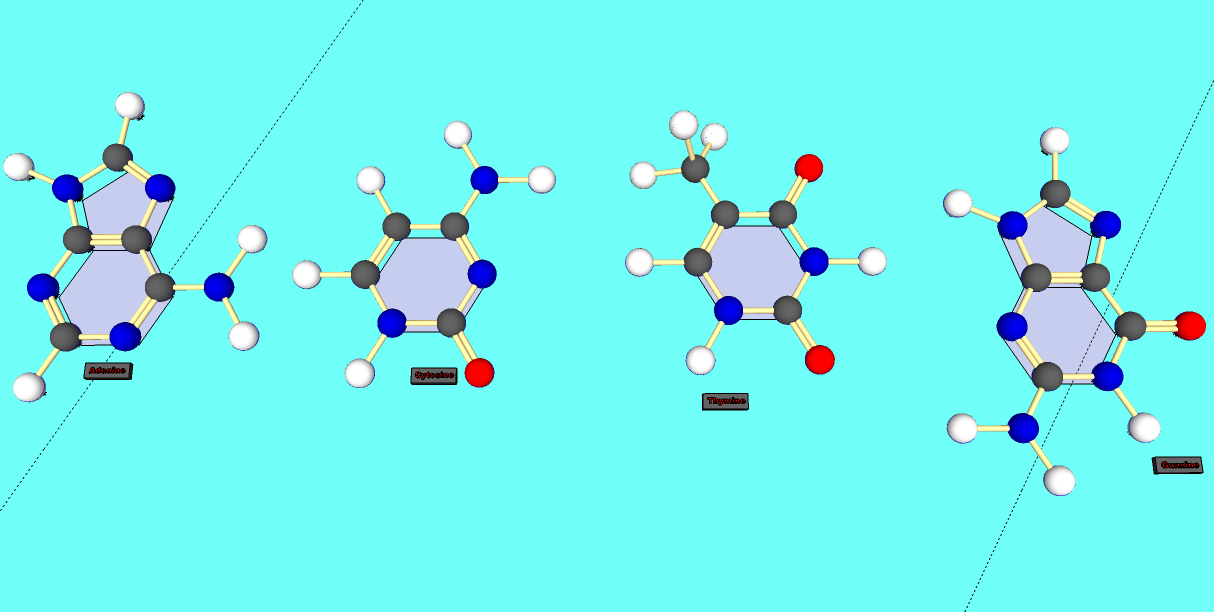
Molecule Maker: DNA Nucleotides

From left to right: adenine, cytosine, thymine, guanine. They took about ten minutes each, thymine a little longer than the others because of the ‘antler.’ I found that I could copy-and-paste a lot of the molecular structure from previous work, for example the pentagonal ring of guanine is the same as adenine.

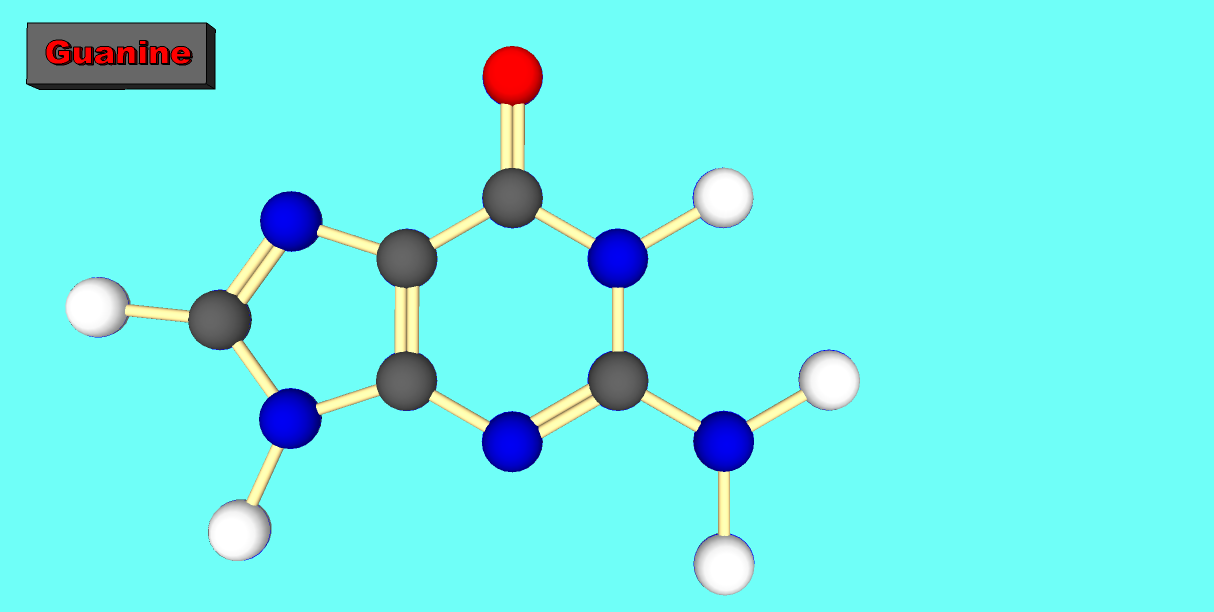
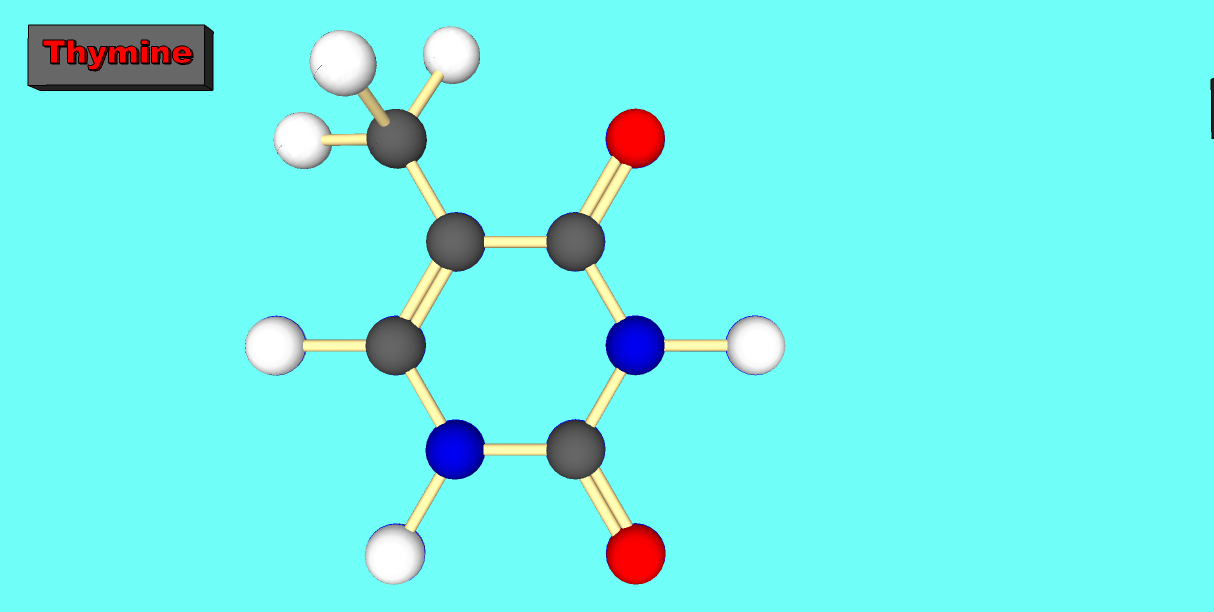
Anyway, here are close-ups:

In case it’s not obvious, white is hydrogen, carbon is black, nitrogen is blue, and oxygen is red. And they’re rather pretty renderings, if I do say so myself.

I should also do uracil, it’s like the fifth Beatle. I notice that at this time the wikipedia entry for uracil has no 3D model. Hee hee, I’ll beat wikipedia to it!

And when will I upload this to Google 3D Warehouse? I think I should give it a day. For some reason, I can stare at a project for hours and can’t see any more errors. Then I glance at it the next day and a glaring error is staring me in the face. I also notice that blog errors often escape notice until I publish, no matter how carefully I preview. That has something to do with quantum physics, according to Einstein or Dogbert.

So it’s probably a good idea to wait.

Posted in Uncategorized | Tagged , , , , , , , | 2 Comments

Molecule Maker: Isooctane

Just for practice, I thought I’d try to make a simple molecule. So I went through my copy of Isaac Asimov’s The Genetic Code, and on page 40 was a diagram for isooctane that looked like this:

Hmm, I thought. That doesn’t look too hard. Then I tried to build it, and I immediately realized that the branching hydrogen atoms would clash unless they were turned in three dimensions. Like so:

So downright proud I was, until I looked at the picture in the wikipedia article for isooctane:

This was getting to be intimidating! So I went back to my model and tinkered some more, and got this:

Which looks a little like a dachshund with antlers on its back. And which probably is still not right as far as the precise branch angles are concerned.

It was not a headache to make this thing. It was actually kind of fun. But it did take a lot of work, which is not my intent here. I want to develop a system of making models which is so easy that anyone can do it after a few minutes watching videos on how to use Sketchup and then reading a brief set of instructions included in the 3D Warehouse file. And so far, such simplicity eludes me.

Anyhow, I’m closer to the real geometry than Asimov could ever possibly get on the printed page. It’s funny how I look back at these old books and realize how graphically limited they were. I didn’t think so at the time but it’s glaring now. I wonder what we’ll seem like a few years from now in a world that swims in photorealistic virtual reality. Probably very primitive!

As a side note, I checked Warehouse just now and couldn’t find isooctane or adenine. Maybe I should just upload my models. Of course, then I would be bombarded with criticisms: “No, you doof! Your branch angles are brain damaged!” My self-esteem is low enough that I don’t need to be told that.

Posted in Uncategorized | Tagged , , , , , | Leave a comment

Molecule Maker: Wooden stick model

I decided to forgo the wikipedia model’s style of showing bonds the same color as the atom. Instead, I’m showing bonds as they would look in a physical kit with wooden sticks for bonds. It’s a lot easier to do this, by the way. I’m not trying to be lazy here (well, I’m not just trying to be lazy), but it follows that if something is simpler and easier for me, then it will be simpler and easier for users as well. And that’s where I’m trying to go with this.

With some tweaks I could upload the kit by tomorrow, but I want to include directions as well. That might take longer.

Posted in Uncategorized | Tagged , | 1 Comment

Molecule Maker: Adventures in Scaffolding

This slideshow requires JavaScript.

I’ve discovered it’s easier to lay out a molecule with scaffolding as shown. The scaffolding is part of a component and can be deleted with a couple mouse clicks when it’s time to display the molecule. If you want to then work on it some more, the scaffolding can be restored with a couple more mouse clicks. I’ll show how to do this in a later blog entry.

Scaffolding is necessary because it is otherwise very difficult in Sketchup to connect objects internally without flipping back and forth between regular and x-ray views. And cylinders just do not like to be rotated, so you have to connect them to a flat surface, which when rotated will rotate the connecting cylinder as well.

I’m sure there’s an easier way to do this, but at least this is getting there.

Posted in Uncategorized | Tagged , | Leave a comment

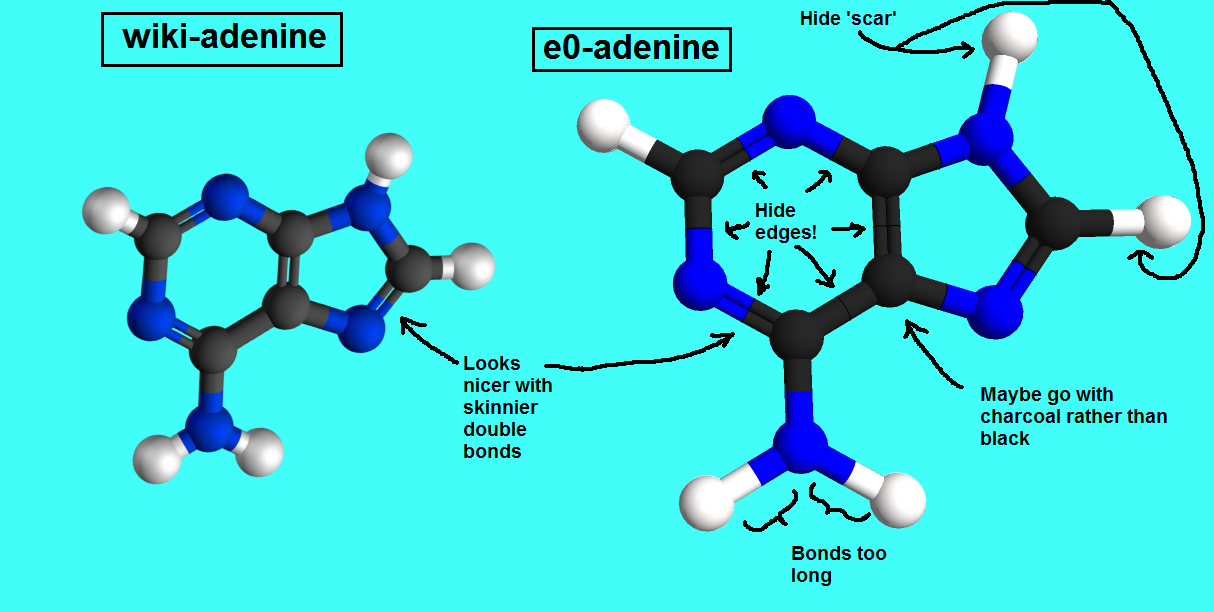
Molecule Maker: Adenine Comparison (First Try)

Lots of flaws become apparent when an image is finally exported. The biggest flaw is unseen here, however, and was my methodology. It took me more than an hour to assemble this thing. When I have a method that can plop these things out as quickly as a model can be assembled from a real-world kit, I’ll share. And then I’ll feel stupid that it took me so long to figure it out.

But at least it’s geometrically correct, and that’s something that gives me a sense of accomplishment. Dear Blog: Today I made a molecule!

Posted in Uncategorized | Leave a comment

The Amazing Decade Ahead

We are on the verge of so many scientific and technological revolutions that the next decade is going to be amazing. Here are some predictions of just how our lives and the entire world will change in the upcoming years.

Solar cells are just silicon wafers, and a lot simpler than microprocessors. Hence, the cost of solar energy will drop far below that of oil and coal. No pollution, no energy crisis, no oil wars. The world will soon be awash with cheap and clean electricity.

Durable, mobile, and cheap, shipping containers will solve the problem of homelessness if nothing else will. For just two thousand dollars — pennies per day over the structure lifetime — a studio apartment-sized home can be provided for every homeless person.

Three-dimensional printing technology is coming of age, making it possible to ‘print’ any small consumer item from coffee cups to baseball caps to eyeglass frames on demand. There will be an explosion in the abundance of consumer goods.

Even food can be ‘printed.’ Simply take the right amounts of chemicals, synthesize amino acids, form into cellular structures — and a perfect hamburger comes out of the machine. World hunger will be abolished from all humanity.

Medical technology is reaching the molecular level, with the ability to not only read the genome but to adjust it in real time. This will mean the end of birth defects, cancer and all disease, and even old age.

Space travel has been hindered by the excessive ratio of rocket mass to fuel energy. Lightweight space shuttles made of graphene will be able to fly into orbit and back with the economies of modern jet liners. Space tourism for the middle class is in reach.

Computer technology will continue to advance, so that every person in the world will own a computer and every village in the Third World will have access to the Internet. Virtual reality will advance so much that if you can dream a world, you can live in it.

The world of this decade will be amazing, exciting, and wonderful — unless we destroy it with war, financial folly, or perhaps the tyranny of good intentions. But if we can refrain from killing each other, there is hope.

Posted in Uncategorized | Tagged | 1 Comment