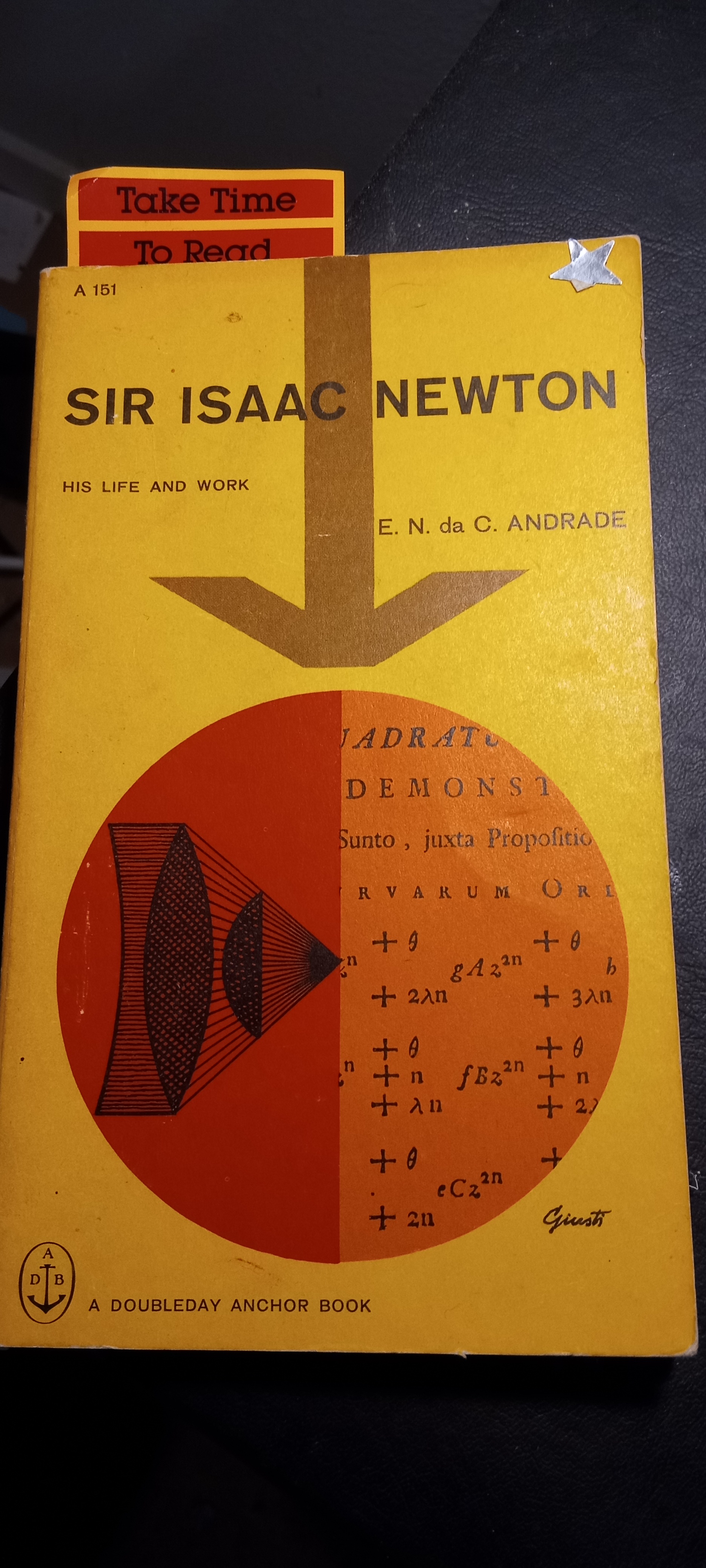
This book was written in 1958. I like older books for biographies because they focus on what the person did rather than his personal life. In the case of Newton, a modern book would probably spend an inordinate amount of time speculating that he was gay. I would rather know about the thought processes that led to his ideas.
While reading this book, however, I got the uncomfortable feeling that maybe Newton wasn’t ‘all that’ he’s been cracked up to be. There was this recurring sequence with other scientists: (1) A scientist would announce an idea, (2) Newton would claim that he thought of it himself years earlier but refrained from publishing it. Okay, so why did you refrain from publishing it at the time? Because I don’t care about publicity. Okay, so if you don’t care about publicity, why are you publishing it now?
If you know anything about calculus, you know that there was a controversy between Newton and a guy named Leibnez over who invented it. Leibnez published first, but Newton claimed to have invented it first but refrained from publishing because . . . yada yada. The British Royal Society set up a committee to investigate the claim. Small catch: Newton was President of the BRS and the committee was stacked with his friends. Even so, the best the committee could do was anoint Newton the ‘co-inventor’ of calculus.
Then there was a guy named Hooke, who suggested in a letter to Newton that gravity might function according to an inverse-square law of distance. Newton claimed that he had come up with the idea independently and refused to acknowledge Hooke.
Then there was a guy named Flamsteed, who was an astronomer who made a catalog on the motion of the Moon. Newton wanted this catalog published immediately to corroborate his theories, but Flamsteed wanted to hold back because he felt there were errors that needed to be proofed. Newton again used his position as President of the Royal Society to get his way.
Was Newton a great scientist? Sure, if only because while others would say, “Hey, maybe this thing causes that thing,” Newton would actually explicitly state the physical laws and do the math. But he seems disingenuous when he claims that he never cared about publicity and yet at the same time played scientific politics by becoming President of the Royal Society and feuding with others over credit for scientific discoveries.
I guess the take away is that people can achieve greatness yet still be jealous for affirmation. Affirmation appears to be addicting.

 Engineer Zero